Bottom line: the Catahoula Leopard Dog is the breed that the modern merle-deafness numbers were built on, and the numbers are better than the internet suggests. When Strain and colleagues (2009, Journal of Veterinary Internal Medicine 23(2):282-286) BAER-tested 153 merle dogs, Catahoulas made up the largest group (54 dogs) — and among double merles (MM), only 10.3% of Catahoulas (3 of 29) were deaf in one or both ears, against 66.7% of Australian Shepherd double merles (2 of 3). Across all breeds, single merles came in at 3.5% and double merles at 25%. The pattern itself comes from a SINE retrotransposon parked at the intron 10 / exon 11 boundary of PMEL (formerly SILV), identified by Clark et al. (2006, PNAS 103(5):1376-1381). Two practical things follow. First, a leopard-patterned Catahoula is not a health problem; a merle-to-merle mating is. Second, a dog can carry merle without looking merle — so if you breed, order an M-locus test that reports allele length, not a yes/no answer, and BAER-test the litter.
- The breed that the merle deafness data was actually measured in
- What merle physically is: a jumping gene inside a pigment gene
- Why “is it merle?” stopped being a yes/no question
- Testing in the United States: pick the method, not just the brand
- Hearing and eye screening is a separate job from DNA
- A working dog with unpigmented skin: the outdoor problem nobody budgets for
- The United Kingdom runs a different rulebook
- What to ask before you take a leopard-patterned puppy home
- Frequently asked questions
- References
- How to get your pet tested
The breed that the merle deafness data was actually measured in


Most breed-health writing about merle recycles the same warnings without ever naming a denominator. The Catahoula is the exception, because the largest published BAER dataset on merle dogs is disproportionately Catahoula. Of the 153 privately owned merle dogs that Strain et al. (2009) tested, 54 were Catahoulas — more than Australian Shepherds (32), Chihuahuas (18) and Collies (15) combined were individually. Ten breeds plus mixed breeds were represented.
That matters for anyone shopping for a Catahoula puppy, because it means the breed is not guessing. Overall deafness prevalence across the study was 9.2% (4.6% unilateral, 4.6% bilateral). Split by genotype:
- Single merle (Mm): 3.5% affected — 2.7% deaf in one ear, 0.9% deaf in both.
- Double merle (MM): 25% affected — 10% in one ear, 15% in both.
The authors’ own conclusion is worth quoting in spirit: deafness risk in merles was comparable to or lower than that seen in piebald breeds such as Dalmatians and white Bull Terriers. Merle is not a uniquely catastrophic gene. It is a gene with a specific, avoidable failure mode.
What merle physically is: a jumping gene inside a pigment gene
SamSo what is the merle gene doing to the coat? Elena MarshIt’s a SINE insertion in PMEL that Clark’s group mapped in 2006 — the same retrotransposon disrupts pigment cells in the inner ear.Clark et al. (2006) showed that merle is caused by a short interspersed element (SINE) that inserted itself at the boundary of intron 10 and exon 11 of the pigment gene PMEL, flanked by a 15-base-pair target site duplication. Inheritance is autosomal and incompletely dominant: one copy gives you the patchwork pattern, two copies give you a predominantly white dog.
The reason this is a health topic and not just a colour topic is that the same pigment cells the mutation disrupts are structurally required in the inner ear and the developing eye. In the Clark cohort, auditory dysfunction was present in 54.6% of MM and 36.8% of Mm dogs, alongside microphthalmia, colobomas and elevated intraocular pressure. Those figures are higher than Strain’s because the cohorts were assembled differently — Clark’s group deliberately included dogs under investigation, while Strain’s were ordinary privately owned pets. Use Strain’s 3.5% / 25% for risk conversations and Clark’s list for the range of what can go wrong.
Clark’s team also noted that the constellation of signs closely mirrors Waardenburg syndrome in humans, the pigmentation-plus-deafness disorder. That parallel is why merle keeps appearing in comparative genetics papers rather than only in breeder forums.
Why “is it merle?” stopped being a yes/no question
SamMy test result says Ma+ rather than just “merle”. What does that mean? Elena MarshIt’s the length of the insertion. Murphy 2018 measured 25 to 105 base pairs across 259 dogs, and the length predicts how the pattern shows.This is the part of merle genetics that changed most recently, and the part that most US buyers have not caught up with. Murphy, Evans, Tsai and Clark (2018, Mobile DNA 9:26) ran fragment analysis on 259 heterozygous merle dogs and found the oligo(dT) tract inside the SINE varies from 25 to 105 base pairs, with length mapping onto phenotype:
- Cryptic merle — 25 to 55 bp. The dog looks non-merle.
- Dilute merle — 66 to 74 bp.
- Standard merle — 78 to 86 bp. This is what people picture.
- Harlequin merle — 81 to 105 bp.
Langevin et al. (2018, PLOS ONE 13(9):e0198536) published a parallel ladder — Mc, Mc+, Ma, Ma+, M, Mh — from a cohort in which Louisiana Catahoulas were the largest group at 73 dogs. Their most consequential finding for breeders is that an m/Mh dog — carrying a single harlequin-length allele — may behave like an M/M dog in terms of hearing and vision. The old “one copy is always safe” heuristic does not survive that result.
There is a second wrinkle. Murphy’s group observed somatic contraction of the tract in 43% of standard merles and 51% of harlequin merles. The insertion is unstable in the body’s own cells, which is why laboratories sometimes report a mosaic result and why a dog’s swab and blood can disagree.
Testing in the United States: pick the method, not just the brand
SamI already ran a consumer DNA kit. Isn’t that enough? Elena MarshNot for breeding. Embark states plainly that its array does not separate cryptic, atypical, standard and harlequin alleles.American owners have more merle testing options than anyone else, which makes it easy to buy the wrong one. The dividing line is microarray versus fragment analysis.
- Consumer array panels. Embark reports M-locus status and explicitly says it “does not currently distinguish between the recently described cryptic, atypical, atypical+, classic, and harlequin merle alleles,” because the array queries only the invariable end of the allele. Embark’s own guidance is not to make breeding decisions on the merle result alone. Wisdom Panel’s consumer panels sit in the same category. These are excellent for ancestry and broad disease screening, and they are the wrong instrument for a stud decision.
- Fragment-analysis labs. UC Davis Veterinary Genetics Laboratory and Paw Print Genetics run allele-sizing methods that return the specific variant. Note that Paw Print Genetics is currently merging with Orivet, so confirm the ordering route and turnaround before you post a sample. Genomia ships internationally and prices its M-locus test at USD 49 excluding VAT, reporting allele lengths from cryptic (200–230 bp on their scale) through harlequin (269–280 bp).
A practical sequencing note for Catahoula breeders: run the M-locus test before you plan a litter, not after a suspicious puppy appears. A cryptic-merle sire is invisible on the ground and only shows up in the paperwork.
Hearing and eye screening is a separate job from DNA
Genotype tells you the risk; it does not tell you whether this individual dog can hear. Those are two different examinations and Catahoula people should book both.
BAER (brainstem auditory-evoked response) is the only way to establish unilateral deafness. A dog deaf in one ear responds normally to its name, oriented sound cues aside, so owners essentially never detect it at home. Strain’s study exists because BAER equipment was applied systematically to pet dogs rather than relying on owner report. In the United States, BAER testing is offered through veterinary teaching hospitals and specialty neurology practices, and the Orthopedic Foundation for Animals maintains a public registry where results can be recorded.
Eye examination matters because the ocular findings in merle — microphthalmia, coloboma, raised intraocular pressure — are structural and present early. An annual ophthalmologist exam recorded with OFA is the standard recommendation for merle-carrying breeding stock, and it is the same appointment that would catch unrelated inherited eye disease.
A working dog with unpigmented skin: the outdoor problem nobody budgets for
Catahoulas were bred to work stock and hogs in Louisiana, which means sun, water and long days outside. Merle changes the calculus there, because the same allele that scatters pigment through the coat also leaves patches of skin without pigment underneath.
LABOKLIN lists sun sensitivity and skin tumours alongside deafness and blindness in its description of homozygous merle. This is a slow risk rather than a dramatic one, and it is the one most likely to be ignored, because a young dog shows nothing. The practical version for a heavily white or double-merle Catahoula working in the Gulf South:
- Watch the nose, eyelid margins, ear tips and belly — the thin-coated, pale sites where solar damage shows up first.
- Shift hard work toward the ends of the day in summer rather than relying on the dog to self-regulate. A dog focused on stock will not stop.
- Raise any persistent crusted or ulcerated patch with your veterinarian early. Solar-induced lesions are far easier to manage before they become masses.
None of this applies to a normally pigmented single merle in any special way. It is specific to dogs carrying large unpigmented areas — which, in practice, means the double merles that the mating rules above are designed to prevent in the first place.
The United Kingdom runs a different rulebook
SamI’m in the UK. Does any of this change? Elena MarshYes. The Kennel Club refuses to register puppies from a merle-to-merle mating, and Catahoulas are not a recognised breed there at all.British buyers face a structurally different environment. The Kennel Club does not register dogs produced from a merle-to-merle mating, and it only accepts merle registrations in breeds where the colour is long established — its named list includes the Australian Shepherd, Beauceron, Bergamasco, Border Collie, Cardigan Welsh Corgi, Dachshund (as dapple), Great Dane, Long Haired Pyrenean Sheepdog, Rough Collie, Shetland Sheepdog and Smooth Collie. Where a breed is not on that list, the Kennel Club will not register a merle dog and specifically warns owners not to register it under another colour instead.
The Catahoula Leopard Dog is not a Kennel Club breed, so a UK buyer is dealing with an unregistered import or an unrecognised breeder network. That removes the registry-level safety net that a Cardigan Welsh Corgi buyer gets by default, and it puts the entire burden of verification on the paperwork you personally demand. For UK testing, Laboklin UK runs the same M-locus panel used in continental Europe as test 8188. It accepts buccal swabs, quotes a turnaround of one to three weeks, and prices coat-colour work at £66.00 including VAT for the first colour test on a dog and £33.00 for each additional colour test — so pairing the M-locus with another colour locus on the same swab is cheaper than two separate submissions. Its published breed list for the test names the Catahoula Leopard Dog (Louisiana), Beauceron, Welsh Corgi (Cardigan) and Pyrenean Shepherd among others, and the lab now reports the allele size in base pairs for each allele found.
In the United States there is no equivalent national rule. AKC does not fully register the Catahoula — the breed entered the Foundation Stock Service in 1996, while the United Kennel Club recognised it as the Louisiana Catahoula Leopard Dog in 1995 — so merle policy in practice is set by the parent clubs and by individual breeders, not by a registry that can refuse the litter.
What to ask before you take a leopard-patterned puppy home
SamHow do I raise this with a breeder without sounding accusatory? Elena MarshAsk for documents, not opinions: both parents’ M-locus reports and the litter’s BAER results. Good breeders already have them.A workable script, in order:
- “Can I see the M-locus report for both parents?” You want a report that names an allele — M, Ma, Mc, Mh — not one that says “merle: present.” If both parents carry a merle-length allele, the litter includes MM risk regardless of how the parents look.
- “Was the litter BAER-tested?” For a merle litter this is the single most informative screening test, and its absence tells you something about the programme.
- “Has an ophthalmologist examined the parents?” Ask for the OFA record rather than a verbal assurance.
- “What happens if the puppy turns out to be deaf?” A written answer is worth more than a reassuring one.
On cost: US pet insurance treats hereditary and congenital conditions inconsistently. Some carriers cover them as standard, others exclude them outright, and effectively all of them exclude anything considered pre-existing at enrolment — which a deafness diagnosis made before you buy the policy will be. Waiting periods (commonly a few days for accidents and around 14 to 30 days for illness, depending on carrier and state) apply on top. If you are taking on a merle puppy, read the hereditary-condition clause of that specific policy before the puppy comes home, not after the first specialist visit. UK buyers face the same structure with different vocabulary: lifetime policies and time-limited policies handle a chronic congenital finding very differently, and a BAER result on record before the policy starts will be treated as pre-existing.
And to be explicit, because this article is about a pigment gene and not a diagnosis: nothing here replaces a veterinary examination. If your dog is not responding to sound, or if you see an eye abnormality, book the appointment rather than ordering a swab kit.
Frequently asked questions
Q. Is a merle Catahoula less healthy than a solid one?
A single-merle dog carried a 3.5% deafness rate in Strain et al. (2009), and the authors judged merle risk comparable to or lower than piebald breeds such as Dalmatians. The pattern itself is not the problem — the merle-to-merle mating is.
Q. Why were Catahoula double merles so much less affected than Australian Shepherds?
In the published data, 3 of 29 Catahoula MM dogs (10.3%) were affected versus 2 of 3 Australian Shepherd MM dogs (66.7%). The Australian Shepherd denominator is tiny, so read that 66.7% with caution; the authors flagged breed differences in merle-associated deafness as real but incompletely characterised.
Q. Both parents look solid. Can the puppies still be double merle?
Yes. Cryptic merle alleles of 25 to 55 bp produce little or no visible pattern (Murphy et al. 2018). Appearance is not evidence of genotype in either direction.
Q. Is one copy of merle always safe to breed from?
Not necessarily. Langevin et al. (2018) reported that an m/Mh dog may show the same effect as M/M. That is the single strongest argument for buying a test that reports allele length.
Q. My lab reported a mosaic. Did they make a mistake?
Probably not. The tract contracts in somatic cells — in 43% of standard and 51% of harlequin merles in Murphy’s cohort — so more than two alleles can legitimately appear, and different sample types can disagree. Ask the laboratory for its interpretation in writing.
Q. Does a consumer kit’s merle result count for a registry or a stud contract?
Treat it as a screening result. Embark states it does not distinguish the allele classes and advises against breeding decisions based on the merle result alone. Registries and serious stud contracts want an allele-level report.
Q. My Catahoula is deaf in one ear. What changes day to day?
Mostly sound localisation: the dog cannot tell where a noise came from, which matters near traffic and off-leash. Hand signals and a long line handle most of it. Have your veterinarian confirm the finding with BAER rather than assuming from behaviour.
References
- Strain GM, Clark LA, Wahl JM, Turner AE, Murphy KE (2009) Prevalence of deafness in dogs heterozygous or homozygous for the merle allele. Journal of Veterinary Internal Medicine 23(2):282-286.
- Clark LA, Wahl JM, Rees CA, Murphy KE (2006) Retrotransposon insertion in SILV is responsible for merle patterning of the domestic dog. PNAS 103(5):1376-1381.
- Murphy SC, Evans JM, Tsai KL, Clark LA (2018) Length variations within the Merle retrotransposon of canine PMEL: correlating genotype with phenotype. Mobile DNA 9:26.
- Langevin M, Synkova H, Jancuskova T, Pekova S (2018) Merle phenotypes in dogs — SILV SINE insertions from Mc to Mh. PLOS ONE 13(9):e0198536.
- UC Davis Veterinary Genetics Laboratory — Merle test
- Paw Print Genetics — canine genetic testing
- Embark — Merle coat pattern testing and its array limitations
- Genomia — Locus M (Merle), USD 49 excl. VAT, allele lengths reported
- LABOKLIN — M-locus (Mh, M, Ma+, Ma, Mc+, Mc, m and mosaics), test 8188
- The Kennel Club (UK) — What is merle? Registration policy and accepted breeds
- Orthopedic Foundation for Animals — health testing registries (BAER, eyes)
- OMIA 000205-9615 — Coat colour, merle, PMEL-related in Canis lupus familiaris
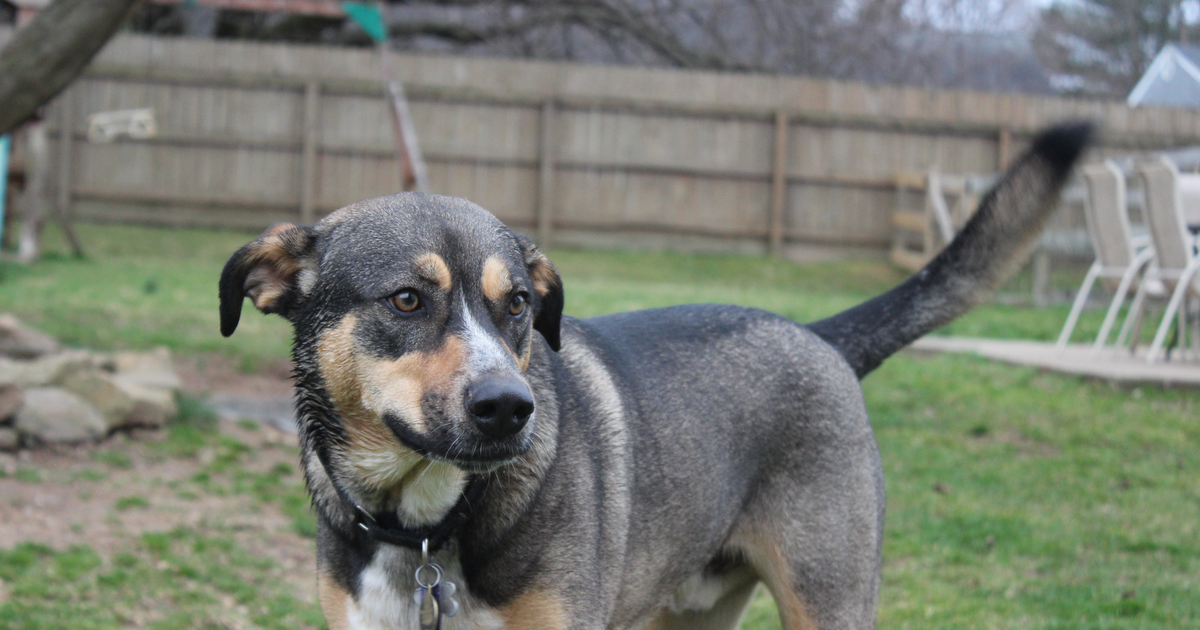
Image: “Catahoula Leopard Dog” — CC0 (scaled proportionally and centre-cropped to 1200×630)
How to get your pet tested
Some pet DNA tests screen for hereditary-disease carrier status or genetic risk markers, but the results are information, not a diagnosis. If your pet has symptoms or you need a confirmed diagnosis, please consult your veterinarian.
Below is where Merle (M locus / PMEL) can be tested, grouped by where you live and marked by whether each service explicitly lists this variant (✅ = listed / ❓ = unverified / ❌ = not offered).
In the United States
In the United Kingdom
In India
Elsewhere
Note: even if the kit can be purchased/shipped internationally, the service itself (sample return, analysis, results) is not guaranteed in your country. Check each service’s stated service area and sample-return method before ordering.
Services offered in other regions (may not be available where you live)
Worried about your pet’s health? — Talk to a veterinarian
A confirmed diagnosis and any treatment plan are decisions for a veterinarian, not a test kit. The links below are professional resources.
AVMA — Find a veterinarian (American Veterinary Medical Association)
This section contains advertising (affiliate links); we may earn a commission if you buy through them. As an Amazon Associate, we earn from qualifying purchases. Genetic tests do not guarantee the prevention, diagnosis, or treatment of any disease — results indicate tendencies and provide information only.
This page is educational information, not veterinary diagnosis or advice. Always consult a veterinarian about your pet’s health.
About the author
Elena Marsh
Editor & writer (not a veterinarian)
A writer with a molecular-biology background and a lifelong dog and cat owner. Not a veterinarian — she translates peer-reviewed genetics research and primary data into plain language, always as information rather than diagnosis.