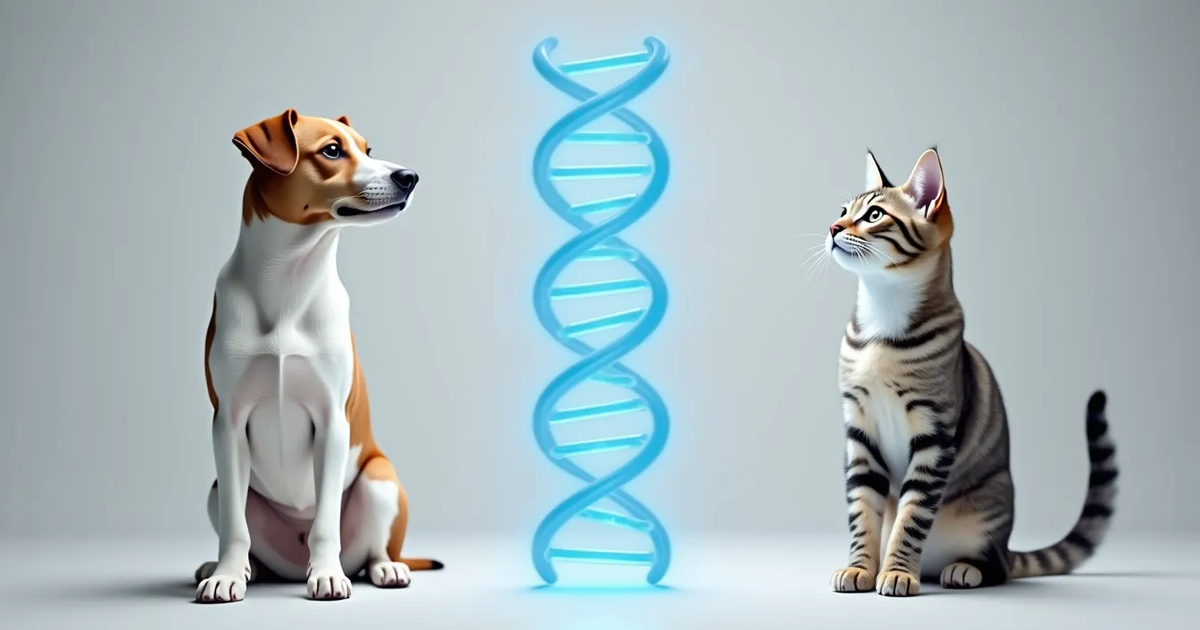
In short: a pet DNA test tells you your dog’s or cat’s breed and ancestry, physical traits, and carrier status or risk markers for certain hereditary conditions — as information, not a diagnosis. PetGene explains what these tests can — and cannot — reveal, based only on peer-reviewed research, treating results as probability rather than destiny. For any diagnosis or treatment, always consult a veterinarian.
About PetGene
PetGene is a research-first, aggregator-style resource. A non-veterinarian editorial team reads the primary literature — PubMed-indexed studies, veterinary journals, and databases such as OMIA — and rebuilds it into plain-language articles about specific breeds and genes. We do not sell tests, publish testimonials, or run supplement ads. Every article rests on five or more tier‑1/2 sources and ends with a full reference list. For any diagnosis, medication, or treatment decision, always consult a veterinarian.
What we cover
Each topic is written for the breeds in which the variant matters most — researched for that market, not translated between languages. The English edition currently covers:
| Species | Gene | Condition | Featured breed | Read |
|---|---|---|---|---|
| Dog | ABCB1 (MDR1) | Drug (multidrug) hypersensitivity | Australian Shepherd | Read the article |
| Dog | SOD1 | Degenerative myelopathy (DM) | Boxer | Read the article |
| Cat | MYBPC3 | Hypertrophic cardiomyopathy (HCM) | Maine Coon | Read the article |
| Cat | PKD1 | Polycystic kidney disease (PKD) | Persian | Read the article |
Recommended: which test works where you live
New here? Start with our service comparison table. It is organised by where you live — the US, the UK, India, or other regions — so you can see at a glance which dog & cat DNA tests actually ship to and provide service in your country, and which variants each one tests.
Latest articles


Primary sources we build on
Every PetGene article is grounded in primary literature — peer-reviewed studies and curated genetic databases — not opinion or advertising.
- PubMed (NIH / U.S. National Library of Medicine)
- OMIA — Online Mendelian Inheritance in Animals (University of Sydney)
- Washington State University — Veterinary Clinical Pharmacology Laboratory (MDR1)
- American Kennel Club (AKC)
- The Cat Fanciers’ Association (CFA)
Frequently Asked Questions (FAQ)
Q. Can a pet DNA test tell me if my pet is sick?
Most consumer DNA tests report breed/ancestry, traits, and carrier status or risk markers for some hereditary conditions. Results are information, not a confirmed diagnosis. See a veterinarian if your pet has symptoms or needs a diagnosis.
Q. Can I use the results as a diagnosis?
No. Consumer DNA tests are not intended for diagnosis. Health and treatment decisions are made by a veterinarian, who may use the results as one piece of information.
Q. What should I do once I have the results?
Take the report to a general-practice vet and bring the exact variant nomenclature — for example ABCB1 nt230(del4) rather than just “MDR1 positive” — because the specific variant determines what is clinically relevant. In the US your vet can refer you to a board-certified diplomate: ACVIM covers cardiology, internal medicine, neurology and oncology, ACVO covers inherited eye disease. In the UK specialist access is gated by referral and only vets on the RCVS Specialist list may be described as Specialists, so do not try to book a referral centre directly.
Q. Will a DNA test affect my pet insurance?
Check the policy wording before you test. In the US, Trupanion covers hereditary and congenital conditions on its standard policy provided no signs appeared before the effective date, and Healthy Paws makes the crucial point explicit: a condition does not need to have been diagnosed to count as pre-existing. In the UK the question is whether you hold a lifetime policy such as Petplan’s Covered For Life, which refreshes the annual vet-fee limit at each renewal. None of the insurers we reviewed states that a genetic carrier or risk result on its own creates a pre-existing condition.
Q. Which conditions and breeds do you currently cover?
For dogs: MDR1/ABCB1 drug sensitivity, degenerative myelopathy (DM/SOD1) and Collie eye anomaly (CEA/NHEJ1). For cats: hypertrophic cardiomyopathy (HCM/MYBPC3) and polycystic kidney disease (PKD/PKD1). Each topic is written for the breeds in which the variant is most relevant.
Q. How many sources does each article use?
Each article is built on primary literature — typically five or more tier-1/2 references such as PubMed-indexed studies, veterinary journals, and databases like OMIA (Online Mendelian Inheritance in Animals). Every article ends with a reference list you can check.
Q. Who writes this site?
A non-veterinarian editorial team that synthesizes peer-reviewed research, veterinary journals, and primary sources. We aggregate published evidence and do not diagnose or treat.
Q. Is Fur Baby Gene available in other languages?
Yes. Fur Baby Gene publishes in English, Japanese (日本語), Simplified Chinese (简体中文) and German (Deutsch). Use the language links in the header. Each language has its own articles written for that market — not machine translations.
About the author
About the author

Elena Marsh
Editor & writer (not a veterinarian)
A writer with a molecular-biology background and a lifelong dog and cat owner. Not a veterinarian — she translates peer-reviewed genetics research and primary data into plain language, always as information rather than diagnosis.
This site contains affiliate advertising and is provided for information only. It is not veterinary diagnosis, advice, or treatment, and genetic tests do not guarantee the prevention, diagnosis, or treatment of any disease. Always consult a veterinarian about your pet’s health.