The short answer: The Cavalier King Charles Spaniel is the founder breed for inherited macrothrombocytopenia caused by the TUBB1 D249N (c.745G>A) variant. Affected dogs make fewer but abnormally large platelets that still work normally — there is no bleeding disorder. Automated analyzers under-count those big platelets, so the machine reads a falsely low platelet number. The value of testing is to avoid misdiagnosis and unneeded steroids or antibiotics. It is not a disease and not a diagnosis; a veterinarian interprets platelet counts.
- What macrothrombocytopenia and TUBB1 are (a platelet-specific tubulin)
- Why the automated count reads falsely low (and a manual smear fixes it)
- How common it is in Cavaliers, and the misdiagnosis trap
- Clear, carrier, affected — and how it’s inherited
- What the test can and cannot tell you
- The two TUBB1 macrothrombocytopenia variants at a glance
- FAQ — Frequently Asked Questions
- References
- How to get your pet tested
What macrothrombocytopenia and TUBB1 are (a platelet-specific tubulin)


“Macrothrombocytopenia” is a two-part word: macro-thrombocyte (large platelet) plus -penia (a low count). In the Cavalier King Charles Spaniel, both halves trace back to a single gene, TUBB1 (beta-1 tubulin). TUBB1 is a platelet-specific tubulin — the protein is used almost exclusively by the cells that build platelets, which is why a change in it affects platelets and essentially nothing else in the body.
Platelets are made in the bone marrow by giant cells called megakaryocytes. A megakaryocyte extends long arms called “proplatelets,” and inside each arm a coil or ring of TUBB1 microtubules acts like a template that sets platelet size and then pinches off normal, uniformly small platelets. The variant c.745G>A, p.(D249N) (catalogued as OMIA:002434-9615) destabilizes that tubulin. The result is that megakaryocytes release fewer platelets, and the ones they do release are abnormally large — but structurally and functionally normal. It is worth stating plainly: the classic, common Cavalier macrothrombocytopenia is this TUBB1 D249N variant, not a separate condition at another locus.
Why the automated count reads falsely low (and a manual smear fixes it)
SamSo the machine says “low,” but the dog is fine? How does a lab get it wrong? Elena MarshAutomated analyzers size-gate cells, so platelets that are too big fall outside the “platelet window” and get skipped — a documented artifact, not real thrombocytopenia (Auburn/Boudreaux lab; LABOKLIN).Modern hematology analyzers (impedance or optical) count platelets by measuring particle size and only tallying objects that fall inside a preset “platelet-sized” window. Cavalier platelets carrying D249N are often large enough to spill out of that window — some are as big as red blood cells. The machine either ignores them or mis-classifies them, so it reports fewer platelets than are actually present. The count is a measurement artifact; the dog’s true platelet mass can be normal or near-normal.
Two things correct the illusion. First, a manual blood-smear estimate: a technician looks at the smear under a microscope, sees the unusually large platelets, and estimates the count by eye — a method that isn’t fooled by size gating. Second, a DNA test for the TUBB1 variant explains why the automated number is low in the first place. Both point to the same conclusion, and the details are documented by the Auburn / Boudreaux laboratory (congenital macrothrombocytopenia, beta-1 tubulin) and by testing labs such as LABOKLIN.
How common it is in Cavaliers, and the misdiagnosis trap
SamIs this rare, or do lots of Cavaliers have it? Elena MarshIt’s common — asymptomatic macrothrombocytopenia in Cavaliers is frequently cited across a wide range, roughly 31–56% and higher, though a single precise cohort figure isn’t firmly established.This trait is not a fringe curiosity in the breed. Published and clinical reports describe asymptomatic macrothrombocytopenia as very common in Cavaliers, with prevalence figures commonly cited across a broad range — roughly 31% to 56%, and in some reports higher. We give it as a range on purpose: a single, precisely verified cohort allele frequency isn’t something we’ll assert here. The Cavalier King Charles Spaniel — an AKC-recognized breed since 1995 and consistently a top-20 US breed — is the index or founder breed for this exact variant.
Because it is so common, the real risk is the misdiagnosis trap. A falsely low automated platelet count in a Cavalier is easy to mistake for immune-mediated or acquired thrombocytopenia — genuine conditions that do require treatment. That can trigger unnecessary work-ups, or worse, inappropriate corticosteroids or antibiotics aimed at a problem the dog does not have. Knowing that the low number is a benign inherited artifact lets the veterinary team stop, look at a smear, and avoid treating a healthy dog.
Clear, carrier, affected — and how it’s inherited
SamIf both her Cavalier’s parents were fine, how did she end up with this? Elena MarshThe inheritance is described two ways: testing labs like LABOKLIN/LABOGEN call D249N autosomal-dominant with intermediate expression, while OMIA’s summary label lists it as recessive — so it’s fairest to report both.Here’s where honesty matters more than a tidy single answer. Testing laboratories (LABOKLIN / LABOGEN) report the D249N variant as autosomal-dominant with intermediate, incomplete expression: heterozygous dogs tend to show platelet counts that sit between genetically clear dogs and homozygous-affected dogs. OMIA’s summary label, by contrast, historically describes it as recessive. Rather than pick one dogmatically, the accurate framing is: reported as incomplete / intermediate dominance by testing labs, historically summarized as recessive.
In practical terms, a genotype result will usually read as clear (two normal copies), carrier / heterozygous (one copy — under the intermediate model, may show a mildly lowered automated count with large platelets), or affected / homozygous (two copies — the largest platelets and the lowest automated readings). Under the intermediate-dominance description, “carrier” is not necessarily silent, which is exactly why the automated count can look off even in dogs with just one copy.
What the test can and cannot tell you
SamSo should she be worried about surgery or an injury with a “low” count like that? Elena MarshNo — the platelets function normally and there’s no increased bleeding risk (Davis 2008), but she should still tell her vet before any surgery so a low pre-op number isn’t misread.The TUBB1 DNA test can tell you whether your Cavalier carries the D249N variant, and it can explain why an automated platelet count reads low. That explanation is genuinely useful: it heads off the misdiagnosis trap, and it means a surgeon or emergency vet won’t be alarmed by a low pre-operative count and delay or over-treat.
What the test cannot do is diagnose a disease — because there isn’t one. This is a benign trait, not a bleeding disorder. Affected dogs have large but fully functional platelets and no increased bleeding risk (Davis 2008; Auburn / Boudreaux lab; LABOKLIN). It is not a coagulation disorder and requires no treatment. The DNA result and a manual smear confirm the explanation, but they are not a clinical diagnosis — a veterinarian interprets platelet counts in the context of the whole dog. The single most useful action is a practical one: tell your vet, before any procedure, that your Cavalier may have inherited macrothrombocytopenia.
The two TUBB1 macrothrombocytopenia variants at a glance
| Variant | Breeds | Reported inheritance |
|---|---|---|
| D249N (c.745G>A) | Cavalier King Charles Spaniel and other small companion breeds (founder breed: CKCS) | Dominant with intermediate / incomplete expression (historically summarized as recessive) |
| R2H (c.5G>A) | Norfolk Terrier, Cairn Terrier | Recessive |
FAQ — Frequently Asked Questions
Q. My vet said my Cavalier has low platelets — is my dog sick, and does it need steroids?
Usually no. In Cavaliers, a low automated platelet count is very often the benign TUBB1 macrothrombocytopenia artifact, where large platelets are simply under-counted by the machine. The platelets work normally and there’s no bleeding disorder, so steroids or antibiotics are typically inappropriate. Ask your vet to confirm with a manual blood-smear estimate and/or a DNA test before any treatment — but always let the veterinarian make the call.
Q. Should I tell my vet before surgery?
Yes. Tell your veterinary team ahead of any procedure that your Cavalier may have inherited macrothrombocytopenia, so a low pre-operative automated count isn’t mistaken for a real bleeding risk. Because the platelets are functional, affected dogs are not reported to have increased surgical bleeding, but the surgeon should have the full picture.
Q. Is this the same as the “common” Cavalier platelet trait, or something separate?
It’s the same thing. The classic, common macrothrombocytopenia seen in Cavaliers is the TUBB1 D249N variant — not a separate condition at a different gene.
Q. My dog’s parents seemed normal — how did it happen?
Reports of the inheritance differ: testing labs describe D249N as dominant with intermediate expression (so even one copy can nudge the count), while OMIA historically summarizes it as recessive (where two clear-looking parents can each pass a hidden copy). A DNA test on the parents and pup clarifies the genotypes — clear, carrier, or affected.
References
- OMIA — Macrothrombocytopenia, TUBB1-related (OMIA:002434-9615): https://www.omia.org/OMIA002434/9615/
- Davis B, Boudreaux MK, et al. 2008, J Vet Intern Med 22(3):540 (PMID 18466252): https://pubmed.ncbi.nlm.nih.gov/18466252/
- Auburn University / Boudreaux laboratory — Congenital Macrothrombocytopenia (Beta-1 Tubulin): https://www.vetmed.auburn.edu/wp-content/uploads/2024/07/CONGENITAL-MACROTHROMBOCYTOPENIA-BETA1-TUBULIN.pdf
- LABOKLIN — Macrothrombocytopenia (MTC): https://laboklin.com/en/products/genetics/hereditary-diseases/dog/macrothrombocytopenia-mtc/
- American Kennel Club — Cavalier King Charles Spaniel: https://www.akc.org/dog-breeds/cavalier-king-charles-spaniel/
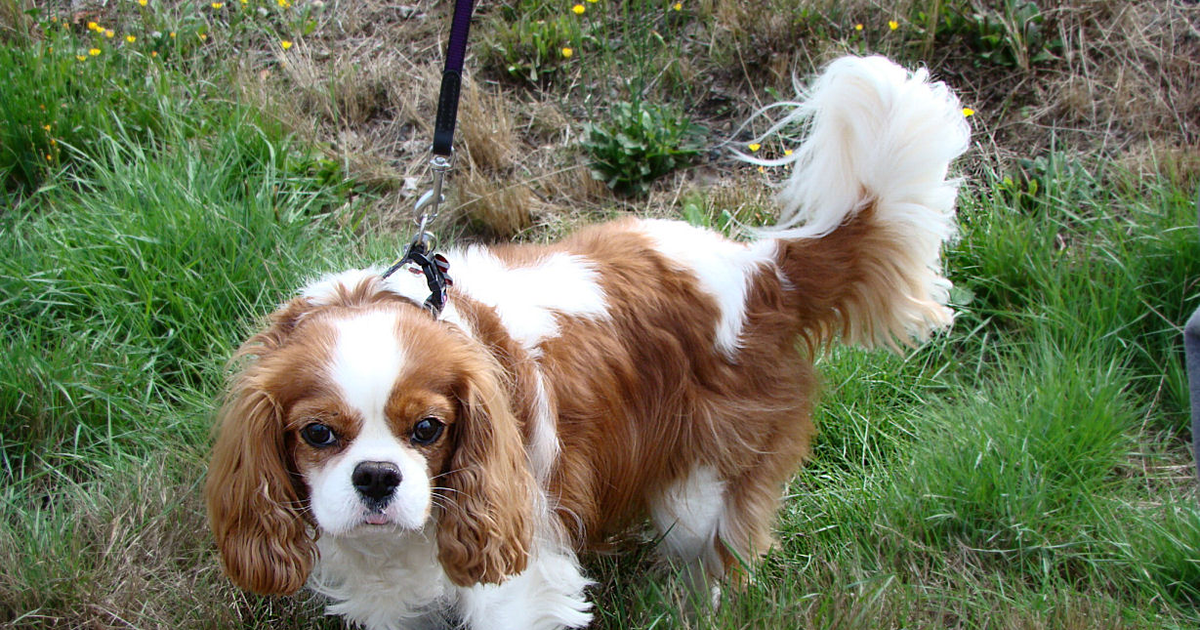
Eyecatch photo: Cavalier King Charles Spaniel by Krysta, CC BY 2.0, via Wikimedia Commons.
How to get your pet tested
Some pet DNA tests screen for hereditary-disease carrier status or genetic risk markers, but the results are information, not a diagnosis. If your pet has symptoms or you need a confirmed diagnosis, please consult your veterinarian.
Below is where Macrothrombocytopenia (TUBB1) can be tested, grouped by where you live and marked by whether each service explicitly lists this variant (✅ = listed / ❓ = unverified / ❌ = not offered).
In the United States
In the United Kingdom
In India
Elsewhere
Note: even if the kit can be purchased/shipped internationally, the service itself (sample return, analysis, results) is not guaranteed in your country. Check each service’s stated service area and sample-return method before ordering.
Services offered in other regions (may not be available where you live)
Worried about your pet’s health? — Talk to a veterinarian
A confirmed diagnosis and any treatment plan are decisions for a veterinarian, not a test kit. The links below are professional resources.
AVMA — Find a veterinarian (American Veterinary Medical Association)
This section contains advertising (affiliate links); we may earn a commission if you buy through them. As an Amazon Associate, we earn from qualifying purchases. Genetic tests do not guarantee the prevention, diagnosis, or treatment of any disease — results indicate tendencies and provide information only.
This page is educational information, not veterinary diagnosis or advice. Always consult a veterinarian about your pet’s health.
About the author
Elena Marsh
Editor & writer (not a veterinarian)
A writer with a molecular-biology background and a lifelong dog and cat owner. Not a veterinarian — she translates peer-reviewed genetics research and primary data into plain language, always as information rather than diagnosis.