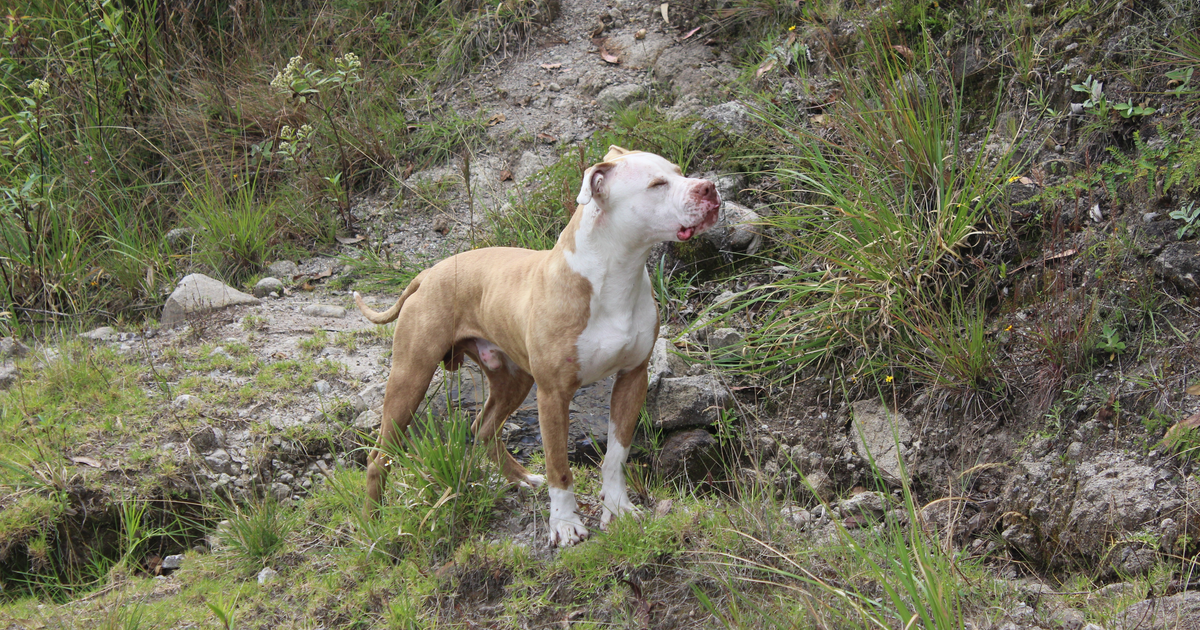
SamOur pit bull puppy’s skin tore when he was just playing. Elena MarshThat is genuinely frightening, and I understand why you rushed here. There is a documented, very rare genetic skin disorder in this breed that can look exactly like that. SamIs it something we did wrong as owners? Elena MarshNo — this is inherited, not caused by handling. Jaffey et al. (2022, Genes) traced it to a single gene, ADAMTS2, that dogs are simply born with or without. SamCan a DNA test just tell us for sure? Elena MarshNot yet in the way you might hope — no mainstream consumer panel screens for it, so diagnosis still leans on a vet exam and biopsy. Let’s walk through what that actually looks like.Conclusion: A frameshift variant in the ADAMTS2 gene (c.2280117delC) causes severe, sometimes fatal skin fragility — dermatosparaxis Ehlers-Danlos syndrome — in American Pit Bull Terrier puppies, and only dogs inheriting two copies of the variant are affected (Jaffey et al., 2022, Genes; OMIA:000328-9615).

- How and When Symptoms Appear
- The Molecular Story: One Gene, Several Breeds, a Range of Severity
- Finding Testing and Diagnosis Pathways in the US and UK Today
- Carrier Testing as a Breeding Decision Tool
- Insurance and the Cost Reality
- What to Bring to the Vet Visit
- Frequently Asked Questions
- References
- How to get your pet tested
How and When Symptoms Appear
Dermatosparaxis-type Ehlers-Danlos syndrome (dEDS), historically called dermatosparaxis or cutaneous asthenia in the veterinary literature, is a connective tissue disorder in which the skin itself is the primary battlefield. Affected puppies typically present with skin that tears or sloughs away from minor trauma — a littermate’s nip, a scratch against a fence, or even routine handling during a bath or nail trim can open a wound. The skin may also be visibly hyperextensible (it can be stretched further than normal before it resists), joints can be loosely mobile, and healed wounds tend to leave thin, crinkled “cigarette-paper” scars rather than normal scar tissue (Jaffey et al., 2022, Genes).
Because these signs appear so early and can escalate quickly — some of the reported American Pit Bull Terrier cases required euthanasia in puppyhood due to the severity and recurrence of the injuries — this is not a “wait and see” condition. Any puppy with skin that tears unusually easily, especially from a breed known to carry the variant, warrants an urgent veterinary evaluation rather than home wound care alone. A veterinarian, ideally one with dermatology experience, is the right first call.
The Molecular Story: One Gene, Several Breeds, a Range of Severity
SamIs the Pit Bull version the same as other breeds’? Elena MarshRelated but not identical — different mutations in the same gene, and that difference seems to track with how severe the disease is.ADAMTS2 encodes procollagen I N-proteinase, an enzyme that trims newly made procollagen into mature collagen fibrils — essentially the final assembly step for the collagen fibers that give skin its tensile strength. When this enzyme is disabled, the body still makes procollagen but cannot process it correctly, and the resulting collagen network is structurally weak. This is why the skin — the tissue most dependent on a dense, well-organized collagen matrix — is where the disease shows up most dramatically.
In the American Pit Bull Terrier, Jaffey et al. (2022, Genes 13(11):2158; PMID 36421833) identified a frameshift variant, c.2280117delC, predicted to produce a severely truncated, non-functional protein, p.(Pro4ArgfsTer175). The same paper found an identical frameshift variant in the Alapaha Blue Blood Bulldog, a breed with presumed shared ancestry with the Pit Bull type, consistent with the variant being inherited from a common founder rather than arising independently twice. Both breeds’ documented cases were severe.
Compare that with the Doberman Pinscher, where Jaffey et al. (2019, Animal Genetics 50(5):543-545; PMID 31294848) reported a different, nonsense variant, c.769C>T, p.(Arg257Ter) — again a variant expected to truncate the protein early and abolish its function, and again associated with a clinically severe presentation. By contrast, a 2025 study in the Catahoula Leopard Dog (Jaffey, Bullock & Katz, Topics in Companion Animal Medicine 66:100976) found a missense variant, c.2491238G>A, p.(Arg966His), that changes rather than destroys the protein. That dog’s disease course was markedly milder, and it lived past nine years of age — a striking illustration that not every genotype produces the same phenotype, even within one gene and one disease name.
Interestingly, ADAMTS2-related skin fragility is not confined to dogs. Simon et al. (2023, G3 13(9):jkad152) reported a frameshift ADAMTS2 variant in a domestic shorthair cat with the same underlying biology (OMIA:000328-9685), reinforcing that this is a conserved collagen-processing pathway across species, not a dog-specific curiosity. None of this changes the bottom line for any individual dog: a genetic diagnosis, if one is ever obtained, should come from a veterinary geneticist interpreting the specific variant found — not from breed alone.
Finding Testing and Diagnosis Pathways in the US and UK Today
SamSo where do we actually go to get this checked? Elena MarshToday that means a veterinary dermatologist and a skin biopsy, not a mail-in DNA kit — the consumer panels don’t cover this gene yet.It is important to be direct about this: as of now, no major consumer canine DNA panel (Embark, Wisdom Panel, and similar services) is documented as offering a standard ADAMTS2/dermatosparaxis test. This is a genuinely rare disease — Jaffey et al. (2022) noted that only around eight affected dogs had been reported in the literature worldwide at the time of publication — and rarity is exactly why it has not yet been built into mass-market panels, which prioritize variants with larger affected populations.
In practice, a presumptive diagnosis today is clinical: a veterinarian assesses skin fragility and extensibility, and confirmation typically comes from a skin biopsy sent for histopathology, which can show characteristic disorganization of the dermal collagen and, when tested, reduced tensile strength of the tissue. Molecular confirmation of the specific ADAMTS2 variant is possible but is generally arranged through veterinary genetics research groups actively studying connective tissue disorders in dogs, rather than through a standard commercial order form. In the US, this usually means a referral to a board-certified veterinary dermatologist through the American College of Veterinary Dermatology (ACVD) network, or a connective-tissue-disease research contact at a veterinary school such as UC Davis or Cornell’s veterinary college. In the UK, the equivalent route is a referral to an RCVS-recognized specialist in veterinary dermatology, with major teaching hospitals such as the Royal Veterinary College (RVC) representing the kind of academic center where such cases are documented and, occasionally, sequenced for research purposes.
Expect the initial dermatology referral and skin biopsy with histopathology to run roughly $300-$800 in the US (higher at academic referral hospitals, and additional if sedation or multiple biopsy sites are needed), or very roughly £200-£500 at a UK referral practice. There is no standardized price for ADAMTS2 sequencing itself precisely because there is no commercial test to price — if a research lab agrees to run confirmatory sequencing, cost and turnaround will be case-by-case. None of this replaces a veterinarian’s direct examination; it is a framework for the conversation you should have with one.
Carrier Testing as a Breeding Decision Tool
SamCould two healthy-looking parents still have an affected puppy? Elena MarshYes — that’s the defining feature of autosomal recessive inheritance, and it’s exactly what happened in the documented cases.Dermatosparaxis-type EDS is inherited in an autosomal recessive pattern. Every dog carries two copies of the ADAMTS2 gene, one from each parent. A dog with one normal copy and one variant copy — a carrier — makes enough functional enzyme to build normal collagen and shows no signs of disease at all. Only a dog that inherits the variant from both parents (two copies) is affected. This means two outwardly healthy, unaffected carrier parents can, on average, produce a litter where roughly one in four puppies is affected, two in four are unaffected carriers, and one in four inherits no copies of the variant — with no way to tell carriers from clear dogs just by looking at them.
This is precisely why, in a genuinely rare disease like this one, molecular confirmation matters beyond the individual sick puppy: if a research or veterinary genetics lab identifies the causal variant in an affected dog’s litter, testing the parents and other close relatives for carrier status becomes a meaningful, targeted breeding decision tool — allowing carrier-to-carrier pairings to be avoided going forward. Because no commercial panel currently screens for this variant, a breeder or owner who wants that information today should discuss it directly with a veterinary geneticist or the research group that documented the mutation in their line, rather than assuming a general-purpose ancestry-and-health panel already covers it.
Insurance and the Cost Reality
SamWould pet insurance help pay for any of this? Elena MarshPossibly for the diagnostic workup, but hereditary/congenital conditions are commonly excluded once a condition is identified as inherited.US pet insurance policies vary by provider, but as a widely known industry practice, most exclude or limit coverage for conditions classified as hereditary or congenital, particularly if they were present or foreseeable before the policy was purchased, or once a condition has been formally diagnosed as inherited. This means a diagnostic dermatology visit and initial biopsy may be covered under an accident-and-illness plan taken out before any symptoms appeared, but ongoing management of a confirmed hereditary skin fragility disorder is the type of claim insurers commonly decline under a hereditary-conditions exclusion. In the UK, the same general principle applies with most standard policies. The practical takeaway is to read the policy’s hereditary/congenital exclusion clause carefully before assuming coverage, and to keep in mind that early diagnosis — even without a definitive genetic test — can still matter for whatever coverage does apply.
What to Bring to the Vet Visit
SamWhat should we actually prepare before we go? Elena MarshDocumentation is your best tool here — video of how the skin behaves, plus a family history, gives the vet far more to work with than a description alone.Because dEDS-type skin fragility can be intermittent and dramatic only in the moment it happens, a short video clip of an actual tearing or skin-sloughing incident — taken safely, without causing further injury — is often more useful to a veterinarian than a verbal description after the fact. Also worth bringing: any information about littermates or parents (were any other puppies in the litter affected, or did any relatives have unusual scarring or skin fragility), the age at which symptoms first appeared, and a simple log of incidents (date, what triggered it, how the wound healed). If your regular veterinarian suspects a connective tissue disorder, ask specifically about referral to a board-certified veterinary dermatologist (US, via ACVD) or an RCVS-recognized dermatology specialist (UK), and whether skin biopsy with histopathology is warranted. If the case looks consistent with a hereditary connective tissue disorder, your vet may also be able to connect you with a veterinary genetics research contact for potential molecular confirmation — useful for future breeding decisions even if it does not change the affected puppy’s immediate care.
One more practical note relevant to American Pit Bull Terrier owners specifically: where you can legally keep this breed varies. In the UK, “pit bull type” dogs have been restricted under the Dangerous Dogs Act 1991, and enforcement has periodically been extended to related types (including the American XL Bully, restricted more recently). In the US, breed-specific legislation is a patchwork set by state and municipality, and several US states have passed breed-neutral laws that preempt local breed bans — but local rules still vary widely. This matters for genetics conversations because it can affect where you can access breed-experienced veterinary and specialist care, and it is worth checking current local regulations directly rather than assuming your city’s rules match a neighboring one.
Frequently Asked Questions
Q. Is dermatosparaxis-type EDS common in American Pit Bull Terriers?
No — it is extremely rare. Jaffey et al. (2022, Genes) documented only about eight affected dogs across the literature worldwide, including the Pit Bull Terrier and Alapaha Blue Blood Bulldog cases they reported. It should not be assumed present without veterinary and, ideally, genetic confirmation.
Q. Can a commercial DNA testing kit diagnose this in my dog?
Not currently. No major consumer panel is documented as screening for the ADAMTS2 variants involved. Diagnosis today relies on veterinary clinical examination and skin biopsy histopathology, with molecular confirmation available mainly through veterinary genetics research groups.
Q. If my dog is a carrier, will they show any symptoms?
No. This is an autosomal recessive condition — a dog with only one copy of the variant is a clinically normal carrier. Only dogs with two copies (one from each parent) are affected, which is also why two unaffected carrier parents can still produce an affected puppy.
Q. Are all ADAMTS2-related skin conditions equally severe?
No. Severity appears to depend on the specific variant. The frameshift variants documented in the Pit Bull Terrier, Alapaha Blue Blood Bulldog, and the nonsense variant in the Doberman are associated with severe, sometimes fatal presentations, while a missense variant found in a Catahoula Leopard Dog (Jaffey, Bullock & Katz, 2025) produced a milder course, with the affected dog living past nine years.
Q. What should I do right now if my puppy’s skin has torn unexpectedly?
Seek veterinary care promptly — this is not a wait-and-monitor situation regardless of the underlying cause. Bring any video of the incident and information about littermates or parents, and ask about referral to a board-certified veterinary dermatologist if a connective tissue disorder is suspected.
References
- Jaffey JA, Bullock G, Guo J, et al. Novel Homozygous ADAMTS2 Variants and Associated Disease Phenotypes in Dogs with Dermatosparactic Ehlers-Danlos Syndrome. Genes. 2022;13(11):2158. PMID 36421833. https://pmc.ncbi.nlm.nih.gov/articles/PMC9690363/
- Jaffey JA, Bullock G, Teplin E, et al. A homozygous ADAMTS2 nonsense mutation in a Doberman Pinscher dog with Ehlers Danlos syndrome and extreme skin fragility. Animal Genetics. 2019;50(5):543-545. PMID 31294848. https://pubmed.ncbi.nlm.nih.gov/31294848/
- Jaffey JA, Bullock G, Katz ML. Dermal pathology in a Catahoula Leopard dog with Dermasparaxis Ehlers Danlos syndrome caused by a homozygous ADAMTS2 missense variant. Topics in Companion Animal Medicine. 2025;66:100976. https://www.sciencedirect.com/science/article/abs/pii/S1938973625000297
- Simon R, Kiener S, Thom N, et al. Identification of an ADAMTS2 frameshift variant in a cat family with Ehlers-Danlos syndrome. G3 (Bethesda). 2023;13(9):jkad152. https://pmc.ncbi.nlm.nih.gov/articles/PMC10468306/
- Online Mendelian Inheritance in Animals (OMIA). Dermatosparaxis, ADAMTS2 (dog). OMIA:000328-9615. https://omia.org/OMIA000328/9615/
- Online Mendelian Inheritance in Animals (OMIA). Dermatosparaxis, ADAMTS2 (cat). OMIA:000328-9685. https://omia.org/OMIA000328/9685/
- American College of Veterinary Dermatology (ACVD). Find a board-certified veterinary dermatologist. https://www.acvd.org/
- Royal College of Veterinary Surgeons (RCVS). RCVS Find a Vet / Recognised Specialists register. https://findavet.rcvs.org.uk/
- UK Government. Dangerous Dogs Act 1991. https://www.legislation.gov.uk/ukpga/1991/65/contents
- UK Government. Rules for owning an XL Bully dog. https://www.gov.uk/guidance/rules-for-owning-an-xl-bully-dog
- Royal Veterinary College (RVC), University of London. Small Animal Referral Hospital. https://www.rvc.ac.uk/small-animal-vet
- UC Davis School of Veterinary Medicine, Veterinary Genetics Laboratory. https://vgl.ucdavis.edu/
- Cornell University College of Veterinary Medicine, Riney Canine Health Center. https://www.vet.cornell.edu/departments-centers-and-institutes/riney-canine-health-center
How to get your pet tested
Some pet DNA tests screen for hereditary-disease carrier status or genetic risk markers, but the results are information, not a diagnosis. If your pet has symptoms or you need a confirmed diagnosis, please consult your veterinarian.
Below is where Dermatosparaxis Ehlers-Danlos syndrome (ADAMTS2) can be tested, grouped by where you live and marked by whether each service explicitly lists this variant (✅ = listed / ❓ = unverified / ❌ = not offered).
In the United States
In the United Kingdom
In India
Elsewhere
Note: even if the kit can be purchased/shipped internationally, the service itself (sample return, analysis, results) is not guaranteed in your country. Check each service’s stated service area and sample-return method before ordering.
Services offered in other regions (may not be available where you live)
Worried about your pet’s health? — Talk to a veterinarian
A confirmed diagnosis and any treatment plan are decisions for a veterinarian, not a test kit. The links below are professional resources.
AVMA — Find a veterinarian (American Veterinary Medical Association)
This section contains advertising (affiliate links); we may earn a commission if you buy through them. As an Amazon Associate, we earn from qualifying purchases. Genetic tests do not guarantee the prevention, diagnosis, or treatment of any disease — results indicate tendencies and provide information only.
This page is educational information, not veterinary diagnosis or advice. Always consult a veterinarian about your pet’s health.
About the author
Elena Marsh
Editor & writer (not a veterinarian)
A writer with a molecular-biology background and a lifelong dog and cat owner. Not a veterinarian — she translates peer-reviewed genetics research and primary data into plain language, always as information rather than diagnosis.