The short answer: Cats have blood types A, B, and AB, set by the CMAH gene. The Devon Rex is one of the highest type-B breeds (~41% type B). Type B is a perfectly healthy trait — not a disease — but it matters for two things: breeding (a type-B queen bred to a type-A tom can produce kittens with neonatal isoerythrolysis, NI) and transfusion safety. A DNA test predicts type but is breed-dependent and does not replace serological blood typing at a vet lab. It is not a diagnosis — any sick kitten or breeding/transfusion decision needs a veterinarian.
Blood types A, B, and AB — and the CMAH gene


Domestic cats have three AB-system blood types: A, B, and the rare AB. Which one a cat has comes down to the CMAH gene. As Bighignoli et al. (2007, BMC Genetics) showed, CMAH is an enzyme that adds a sugar to a molecule on the red-blood-cell surface — chemically, it converts NeuAc into NeuGc. That NeuGc sugar is the type-A antigen.
When a cat carries two working copies of CMAH, it makes NeuGc and is type A. When both copies are loss-of-function, the enzyme can’t do its job, the cat only makes NeuAc, and it is type B. In genetic terms, type B is recessive and type A is dominant over B. Type AB is a separate story — it comes from a distinct CMAH variant (c.364C>T), seen especially in Ragdolls (Gandolfi et al. 2016), and it is rare (well under 1% of cats).
Why type-B queens risk NI in their kittens
SamSo if her cat is type B, why did she keep saying she’s worried about the newborn kittens? Elena MarshBecause type-B cats carry strong, naturally-occurring anti-A antibodies even without a prior transfusion — and a type-B queen can pass those to type-A kittens through her colostrum (Silvestre-Ferreira & Pastor 2010).Here’s the mechanism. A type-B queen bred to a type-A (or AB) tom can produce type-A kittens. Type-B cats have unusually strong naturally-occurring anti-A antibodies — they don’t need a prior exposure to build them. Those antibodies concentrate in the queen’s colostrum (first milk). When type-A kittens nurse in the first day of life, they absorb the anti-A antibodies, which then attack and destroy the kittens’ own red blood cells. This is neonatal isoerythrolysis (NI).
NI shows up as fading and dying kittens, dark discolored urine (pigmenturia), and sometimes tail-tip necrosis. Per Silvestre-Ferreira & Pastor (2010), if such a mating happens, the management is to withhold the queen’s colostrum for roughly the first 16–24 hours of life and foster or hand-rear the kittens during that window, after which the gut stops absorbing intact antibodies. A fading kitten is an emergency — see a veterinarian immediately.
The Devon Rex and the numbers — plus an honesty hook
SamCan she just run a cheek-swab DNA test on her queen and be done with it? Elena MarshThat’s the catch — Kehl, Mueller & Giger (2019) genotyped zero type-B Devon Rex despite the breed’s high serological type-B rate, so the common DNA panel under-detects type B here.The Devon Rex ranks among the breeds with the highest type-B frequency. Silvestre-Ferreira & Pastor (2010) report about 41% type B in Devon Rex, with US surveys landing in the 25–43% range. It is a recognized CFA/TICA breed, so breeders keep detailed pedigrees where blood-type planning fits naturally.
| Breed | Type-B frequency (%) |
|---|---|
| Devon Rex | 41 |
| Cornish Rex | 33 |
| Turkish Van | 60 |
| Turkish Angora | 46 |
| Sphynx | 17 |
| Birman | 18 |
Type-B frequencies from Silvestre-Ferreira & Pastor (2010).
Now the honesty hook. DNA typing is breed-dependent. Kehl, Mueller & Giger (2019, Animal Genetics) genotyped zero type-B Devon Rex in their sample — even though serology says the breed is heavily type B. In other words, the common CMAH b-allele DNA panel under-detects type B in this breed, and the authors state that genotyping “is not yet a replacement for immunohematological testing.” A DNA test is a useful planning aid, but any real breeding or transfusion decision must be confirmed by serological blood typing at a vet lab. A DNA test does not rule out NI risk.
Transfusion safety
SamDoes the blood type only matter for breeding, or for other situations too? Elena MarshIt’s critical for transfusions — because of those pre-formed anti-A antibodies, a mismatched transfusion can cause acute, fatal hemolysis even on a cat’s very first transfusion (Silvestre-Ferreira & Pastor 2010).Unlike some species, a type-B cat’s strong naturally-occurring anti-A antibodies mean that giving type-A blood to a type-B cat can trigger a severe, acute, potentially fatal hemolytic reaction on the first transfusion — there’s no “safe first mismatch.” That’s why the rule for any feline transfusion is: always serologically blood-type and cross-match the donor and recipient beforehand. This is a clinical decision that belongs entirely with a veterinarian.
What a DNA test can and cannot tell you
SamSo is a DNA test worth it at all for her breeding program? Elena MarshYes, as a planning screen — but not as proof; Kehl et al. (2019) is the reason breeders confirm every mating-relevant result with serology at a vet lab.What a DNA test can do: give a breeder an early, low-stress planning signal about likely blood type across a cattery, help prioritize which cats to serologically confirm, and inform pairing strategy before a mating is scheduled.
What a DNA test cannot do: serve as a diagnosis, replace serological blood typing, or “rule out” NI risk — especially in the Devon Rex, where the standard panel is known to under-detect type B. It also does not make a clinical call about transfusions. For any decision where a kitten’s life is on the line — a planned mating with a type-B queen, a transfusion, or a fading newborn — confirm with serology at a vet lab and consult a veterinarian.
FAQ — Frequently Asked Questions
Q. My Devon Rex queen is type B and I’m planning a litter. What should I do?
Have her and the tom serologically blood-typed at a vet lab first. If a type-B queen is bred to a type-A or AB tom, the kittens can develop neonatal isoerythrolysis. If that mating goes ahead, the standard management (Silvestre-Ferreira & Pastor 2010) is to withhold the queen’s colostrum for roughly the first 16–24 hours and foster or hand-rear during that window — plan this with your veterinarian in advance.
Q. Can a DNA cheek swab replace a blood-typing test?
No. DNA typing is breed-dependent, and in the Devon Rex the common CMAH panel under-detects type B — Kehl, Mueller & Giger (2019) genotyped zero type-B Devon Rex despite the breed’s high serological type-B rate. The authors say genotyping is “not yet a replacement for immunohematological testing.” Use DNA as a planning aid, but confirm with serology at a vet lab.
Q. Is blood type B a disease or something to worry about health-wise?
No. Type B is a normal, healthy trait determined by the CMAH gene. A type-B cat lives a completely normal life. It only matters in two contexts: breeding (NI risk) and transfusion safety.
Q. What is type AB, and is it common?
Type AB is a separate blood type caused by a distinct CMAH variant (c.364C>T), reported especially in Ragdolls (Gandolfi et al. 2016). It is rare — well under 1% of cats.
References
- Silvestre-Ferreira AC, Pastor J. Feline neonatal isoerythrolysis and the importance of feline blood types. Veterinary Medicine International 2010:753726. PMID 20631821. https://pmc.ncbi.nlm.nih.gov/articles/PMC2899707/
- Kehl A, Mueller E, Giger U. DNA genotyping of the feline AB blood group. Animal Genetics 2019;50(4). PMID 30854707. https://pmc.ncbi.nlm.nih.gov/articles/PMC6520129/
- Bighignoli B, et al. Cytidine monophospho-N-acetylneuraminic acid hydroxylase (CMAH) mutations associated with the domestic cat AB blood group. BMC Genetics 2007;8:27. PMID 17916260. https://pubmed.ncbi.nlm.nih.gov/17916260/
- OMIA — Blood group AB system, CMAH, in Felis catus. OMIA:000119-9685. https://www.omia.org/OMIA000119/9685/
- Cat Fanciers’ Association — Devon Rex breed. https://cfa.org/devon-rex/
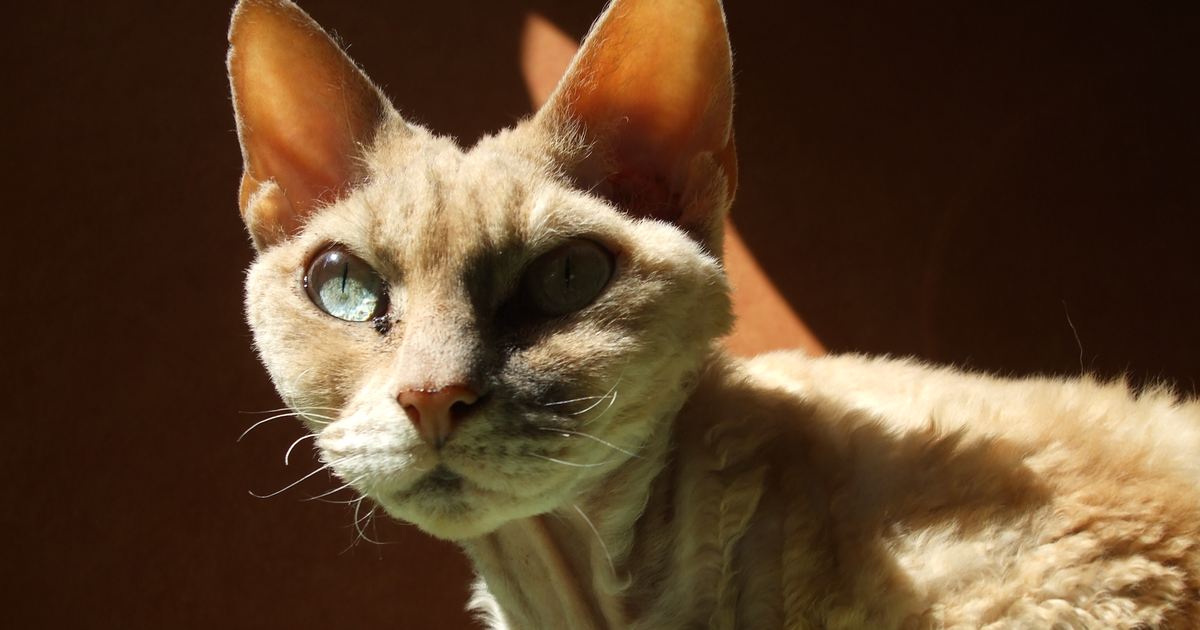
Eyecatch photo: Devon Rex by Freestyle nl, CC BY-SA 3.0, via Wikimedia Commons.
How to get your pet tested
Some pet DNA tests screen for hereditary-disease carrier status or genetic risk markers, but the results are information, not a diagnosis. If your pet has symptoms or you need a confirmed diagnosis, please consult your veterinarian.
Below is where Blood type B (CMAH) can be tested, grouped by where you live and marked by whether each service explicitly lists this variant (✅ = listed / ❓ = unverified / ❌ = not offered).
In the United States
In the United Kingdom
In India
We could not verify a service in this region that explicitly lists this variant. Please ask your veterinarian.
Elsewhere
Note: even if the kit can be purchased/shipped internationally, the service itself (sample return, analysis, results) is not guaranteed in your country. Check each service’s stated service area and sample-return method before ordering.
Services offered in other regions (may not be available where you live)
Worried about your pet’s health? — Talk to a veterinarian
A confirmed diagnosis and any treatment plan are decisions for a veterinarian, not a test kit. The links below are professional resources.
AVMA — Find a veterinarian (American Veterinary Medical Association)
This section contains advertising (affiliate links); we may earn a commission if you buy through them. As an Amazon Associate, we earn from qualifying purchases. Genetic tests do not guarantee the prevention, diagnosis, or treatment of any disease — results indicate tendencies and provide information only.
This page is educational information, not veterinary diagnosis or advice. Always consult a veterinarian about your pet’s health.
About the author
Elena Marsh
Editor & writer (not a veterinarian)
A writer with a molecular-biology background and a lifelong dog and cat owner. Not a veterinarian — she translates peer-reviewed genetics research and primary data into plain language, always as information rather than diagnosis.