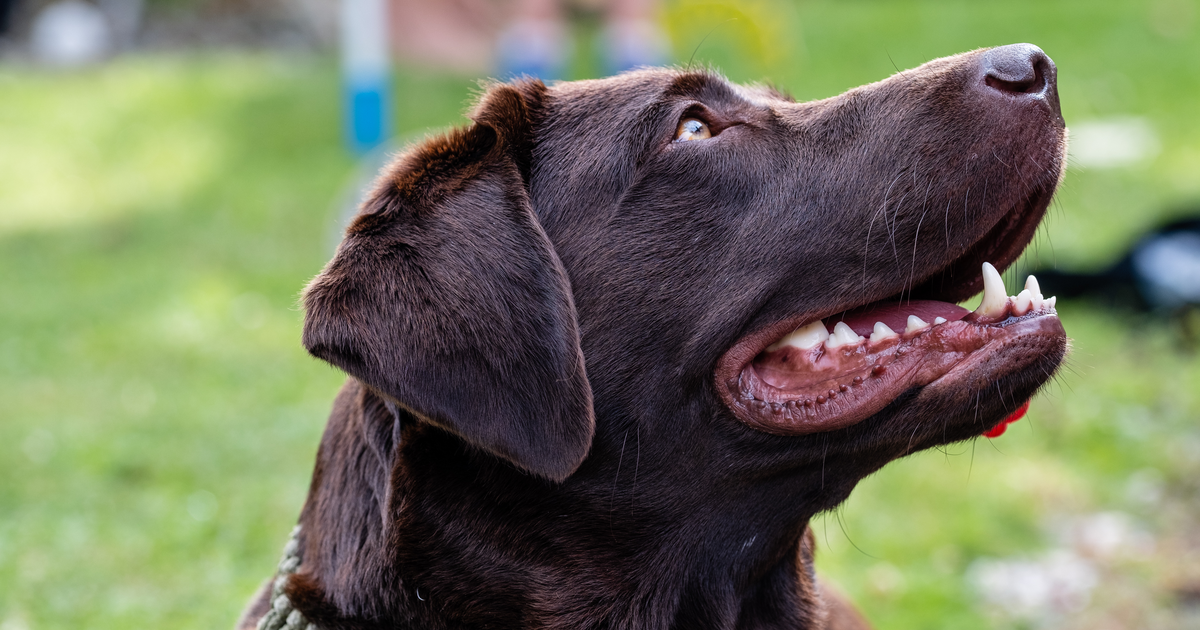
The short answer: The Labrador Retriever is the No. 2 most popular US breed (AKC, 2024), and it is one of roughly 29 breeds that carry prcd, a single autosomal-recessive variant (PRCD c.5G>A) causing progressive retinal atrophy. Because it is recessive, a dog needs two copies to go blind from it; carriers stay clinically normal. A DNA test reports clear / carrier / affected — that is genetic information and risk for this one variant, not a clinical diagnosis.
What PRCD and prcd-PRA actually are


Progressive retinal atrophy (PRA) is a family of inherited retinal diseases in dogs. The most widespread single form is prcd-PRA, caused by the variant PRCD c.5G>A (OMIA:001298-9615). It is an autosomal-recessive rod-cone degeneration, meaning the light-sensing cells of the retina slowly break down. The PRCD gene was identified by Zangerl and colleagues in 2006, and the same gene underlies a form of human retinitis pigmentosa — one reason the canine variant is so well characterized. Importantly, prcd is not a Labrador-only problem: the same c.5G>A variant is documented across roughly 29 breeds, including the Poodle, Cocker Spaniel, Chihuahua, Portuguese Water Dog and American Eskimo Dog.
How common it is in Labradors and other breeds
SamSo how many Labradors actually carry it? Elena MarshThere isn’t an honest single Labrador percentage to quote — the large commercial dataset of Clark, Anderson, Donner and colleagues (2023, Genes; 86,667 dogs across 61 breeds; PMID 38003037) shows the prcd allele frequency declining under testing rather than sitting at a fixed number.It is tempting to want one tidy figure, but the data don’t support inventing one. Across 2004–2019, the large screening dataset shows the prcd allele frequency declining under testing — as breeders test and avoid carrier × carrier matings, the frequency trends downward. That is a trend, not a point estimate, so any responsible summary marks the Labrador figure as reported but not precisely established. Where a breed has been quantified, we can cite it directly: in English Cocker Spaniels, Andrade et al. (2019, Animals) reported measured prcd genotype frequencies. The table below keeps this honest.
| Breed | prcd (PRCD c.5G>A) status | Source |
|---|---|---|
| Labrador Retriever | Reported; precise % not established — declining under testing | Clark/Anderson/Donner et al. 2023 |
| English Cocker Spaniel | Reported and quantified (measured genotype frequencies) | Andrade et al. 2019 |
| Poodle | Reported (among ~29 prcd breeds) | OMIA:001298-9615 |
| Portuguese Water Dog | Reported (among ~29 prcd breeds) | OMIA:001298-9615 |
| Chihuahua | Reported (among ~29 prcd breeds) | OMIA:001298-9615 |
| American Eskimo Dog | Reported (among ~29 prcd breeds) | OMIA:001298-9615 |
Symptoms and progression: night blindness first
SamIf a dog is affected, when would you even notice something? Elena MarshNot at birth — prcd-PRA is progressive, with signs often appearing around 3–5 years, and rods degenerate first, which is why night blindness typically comes before day-vision loss.The PRCD gene encodes a small protein in the light-sensing outer segments of rod and cone photoreceptors, structures that renew themselves continuously. The c.5G>A variant changes the second amino acid of that protein and disrupts the normal disc-renewal process. Because rods (responsible for dim-light vision) tend to degenerate first, the earliest sign is usually night blindness — a dog hesitant on stairs at dusk or bumping objects in low light. Cones then follow, so day vision fades and the condition ends in blindness. Crucially, affected dogs are normal at birth; this is a progressive, not a congenital, disease, which is why owners may not notice anything until middle age.
Clear, carrier, affected — and the breeding math
SamMy sister wants a litter one day. Does “carrier” rule that out? Elena MarshNo — because the disease needs two mutant copies, a carrier × clear mating produces zero affected puppies, which is exactly the logic the recessive inheritance model (Zangerl et al. 2006) predicts.A DNA test reports one of three results for this variant: clear (two normal copies), carrier (one copy, clinically normal, never goes blind from this gene), or affected (two copies, at risk of developing prcd-PRA). Because the disease is autosomal recessive, the breeding math is simple and reassuring:
- carrier × carrier → on average 25% affected, 50% carrier, 25% clear.
- carrier × clear → no affected puppies (50% carrier, 50% clear).
This is why testing does not mean removing carriers from a gene pool — it means pairing them wisely. A carrier bred to a clear mate produces zero affected dogs while preserving genetic diversity, which is precisely how the population-level allele frequency has been declining under testing.
What the test can and cannot tell you
SamSo if the test says “clear,” is the dog’s vision guaranteed safe? Elena MarshNo — the test only reads the PRCD c.5G>A variant (OMIA:001298-9615); it doesn’t detect other PRA genes, and a real diagnosis comes from a veterinary ophthalmologist using an eye exam or ERG.A prcd DNA test is information and genetic risk for one specific variant — not a clinical diagnosis. It tells you whether the dog carries zero, one, or two copies of PRCD c.5G>A. It does not detect the many other genes that can cause PRA or other retinal disease, and a “clear” result for prcd does not certify overall eye health. A clinical diagnosis is made by a veterinary ophthalmologist through an eye examination (for example ECVO or OFA-Eye screening) and, where needed, an electroretinogram (ERG). The right way to think about it: the DNA test complements an eye exam — it never replaces one.
FAQ — Frequently Asked Questions
Q. My Labrador tested “carrier.” Will he go blind?
Not from this gene. prcd-PRA is autosomal recessive, so a carrier has only one copy of the variant, stays clinically normal, and does not develop prcd-related blindness. Two copies (affected) are needed to be at risk.
Q. Does a “clear” prcd result mean my dog’s eyes are fine?
No. The test reads only the PRCD c.5G>A variant. It does not detect other PRA genes or other eye conditions, so a clear result is not a clean bill of eye health. An ophthalmology exam is still the way to assess overall vision.
Q. Can I still breed a carrier?
Yes. Breeding a carrier to a clear mate produces no affected puppies (only carriers and clears). Testing lets you avoid carrier × carrier pairings rather than removing carriers from the gene pool.
Q. How common is prcd in Labradors?
There is no reliable single percentage to quote. The largest screening dataset shows the prcd allele frequency declining under testing over 2004–2019 as a trend, so responsible sources mark the Labrador figure as reported but not precisely established.
References
- AKC — Most Popular Dog Breeds 2024: https://www.akc.org/expert-advice/news/most-popular-dog-breeds-2024/
- OMIA:001298-9615 (PRCD, Canis lupus familiaris): https://omia.org/OMIA001298/9615/
- Zangerl B, et al. 2006, Genomics (PMID 16938425): https://pubmed.ncbi.nlm.nih.gov/16938425/
- Clark/Anderson/Donner et al. 2023, Genes 14(11):2093 (PMID 38003037): https://pmc.ncbi.nlm.nih.gov/articles/PMC10671078/
- Andrade LR, et al. 2019, Animals 9(10):844 (PMID 31640229): https://pmc.ncbi.nlm.nih.gov/articles/PMC6826964/
How to get your pet tested
Some pet DNA tests screen for hereditary-disease carrier status or genetic risk markers, but the results are information, not a diagnosis. If your pet has symptoms or you need a confirmed diagnosis, please consult your veterinarian.
Below is where PRA (progressive retinal atrophy) can be tested, grouped by where you live and marked by whether each service explicitly lists this variant (✅ = listed / ❓ = unverified / ❌ = not offered).
In the United States
In the United Kingdom
In India
Elsewhere
Note: even if the kit can be purchased/shipped internationally, the service itself (sample return, analysis, results) is not guaranteed in your country. Check each service’s stated service area and sample-return method before ordering.
Services offered in other regions (may not be available where you live)
Worried about your pet’s health? — Talk to a veterinarian
A confirmed diagnosis and any treatment plan are decisions for a veterinarian, not a test kit. The links below are professional resources.
AVMA — Find a veterinarian (American Veterinary Medical Association)
This section contains advertising (affiliate links); we may earn a commission if you buy through them. As an Amazon Associate, we earn from qualifying purchases. Genetic tests do not guarantee the prevention, diagnosis, or treatment of any disease — results indicate tendencies and provide information only.
This page is educational information, not veterinary diagnosis or advice. Always consult a veterinarian about your pet’s health.
About the author
Elena Marsh
Editor & writer (not a veterinarian)
A writer with a molecular-biology background and a lifelong dog and cat owner. Not a veterinarian — she translates peer-reviewed genetics research and primary data into plain language, always as information rather than diagnosis.