Bottom line: The Miniature American Shepherd’s own parent club lists the Cone Degeneration (CD) DNA test under Optional Testing — a tier that MASCUSA defines as “tests specific to the MAS that identify diseases currently seen in the MAS.” Read that sentence twice: the club is telling you the disease is present in the breed and that testing for it is optional. The six tests it does require for OFA/CHIC are hip radiographs, an annual ACVO eye exam, PRA-prcd, MDR1, hereditary cataracts (HSF-4) and neuroaxonal dystrophy. Cone degeneration is not among them. The breed earned its place on that list in 2013, when Yeh et al. (2013, BMC Genetics 14:27) worked up a day-blind Mini in Utah and found it homozygous for a 404,820 bp deletion removing the entire CNGB3 gene — the identical deletion, with identical chromosome 29 breakpoints, already known in the Alaskan Malamute. Haplotype analysis across 147 SNPs showed the Malamute, the Mini and a carrier Siberian Husky all share the same 0.5 Mb affected haplotype: one founder allele, identical by descent, moving between breeds that no pedigree connects. The condition is autosomal recessive, shows up at 8 to 12 weeks as day blindness and photophobia, and leaves night vision intact for life. An ACVO CAER exam will not detect the carrier state and a cheek swab will not diagnose a symptomatic dog — you need both tools for different jobs. This article is information, not a diagnosis: if your dog is bumping into things in bright sunlight, book a veterinary exam rather than a DNA kit.
- Read the tier your parent club put this test in
- What a Utah case report did to a breed’s risk profile
- Why the breed’s name is a research problem, not just a trivia question
- An ACVO exam and a cheek swab answer two different questions
- Where to get it done in the US, and the variant trap that wastes your money
- If you are in the UK: different labs, different registry, different insurance vocabulary
- Insurance, contracts and what a US buyer can actually enforce
- Living with a day-blind dog
- The research frontier, stated honestly
- FAQ
- References
- How to get your pet tested
Read the tier your parent club put this test in

The Miniature American Shepherd Club of the USA publishes its health testing scheme in four explicit tiers, and the tier boundaries carry more information than most buyers realize.
- Required for OFA/CHIC, AKC Breeder of Merit and Bred with H.E.A.R.T. — hip dysplasia radiographs, annual ACVO ophthalmic exam, PRA-prcd DNA, MDR1 DNA, hereditary cataracts (HSF-4) DNA, and neuroaxonal dystrophy (MAS type) DNA. MASCUSA states these “have been determined by the parent club to be necessary for the long term health of the breed.”
- Recommended — elbow radiographs, patellar luxation, dentition, CEA, degenerative myelopathy, CDDY/CDPA, hyperuricosuria, CMR1. The club “strongly advises” these.
- Optional — Cone Degeneration (CD), craniomandibular osteopathy, exercise-induced collapse, NCL6, NCL8, junctional epidermolysis bullosa, non-HSF-4 cataracts, cardiac auscultation, M locus. These are described as “tests specific to the MAS that identify diseases currently seen in the MAS.”
- Other — cobalamin malabsorption, factor VII, vWD I: “not specific to the MAS but could be diagnosed in the future.”
The distinction between the third and fourth tier is the one to hold onto. “Other” means we have not seen this here. “Optional” means we have seen this here, and we are not requiring you to test for it. Cone degeneration is in the second of those categories.
That is not necessarily a criticism of the club. Parent clubs weigh mandatory testing against breeder burden, and a disease that is rare, non-painful and non-progressive after onset sits lower on the priority list than one that cripples or kills. But it does mean that a puppy buyer who asks “is this dog CHIC-certified?” has asked a question that cannot return an answer about cone degeneration. The right question is narrower: “May I see the sire’s and dam’s CD results?”
What a Utah case report did to a breed’s risk profile
Before 2013, cone degeneration was a two-breed disease. Sidjanin et al. (2002, Human Molecular Genetics 11:1823-1833) had established that canine cone degeneration is orthologous to the human achromatopsia locus ACHM3, and had identified two different CNGB3 lesions: a whole-gene deletion in Alaskan Malamutes from the USA, and a missense substitution in exon 6 in German Shorthaired Pointers. Neither breed has anything to do with a small merle herding dog.
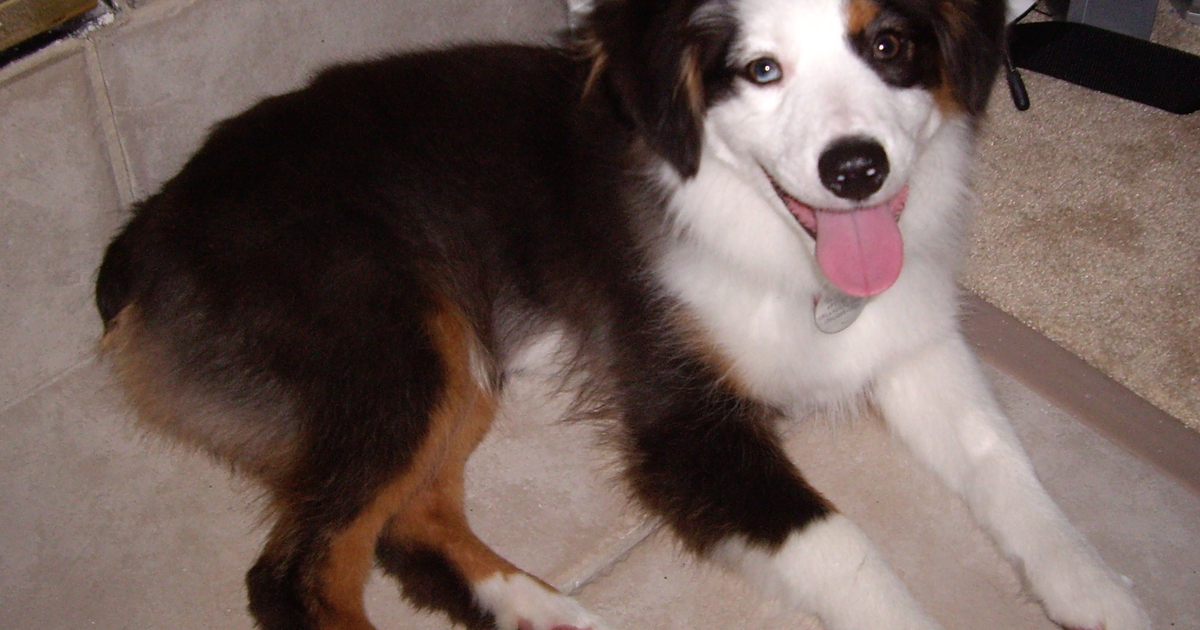
Then a day-blind Miniature Australian Shepherd was worked up through a Cottonwood Heights veterinary practice and an ophthalmology service in Salt Lake City. The dog was homozygous for the Malamute deletion. Yeh and colleagues characterized the lesion precisely: 404,820 base pairs removed from chromosome 29, with breakpoints identical in the affected Malamute and the affected Mini.
The team then asked the obvious follow-up question — where else is this allele hiding? They screened pooled DNA from unrelated purebred Australian Shepherds, Miniature Australian Shepherds, Siberian Huskies, Samoyeds and Alaskan sled dogs. They found one carrier Siberian Husky and three carrier Alaskan sled dogs.
Finally they tested whether these were independent mutational events or one allele with many addresses. Genotyping 147 SNPs across a 3.93 Mb interval on the affected chromosomes of the Malamute, the Mini and the Husky returned a shared 0.5 Mb haplotype in all three. That shared block defines the minimum linkage disequilibrium across breeds and marks the allele as identical by descent — a single ancestral chromosome, distributed by a founder effect into breeds with no documented relationship to one another.
The authors drew the conclusion explicitly: since the Mini “is not known to be genetically related to the AM, other breeds may potentially carry the same cd-allele and be affected by achromatopsia.”
Why the breed’s name is a research problem, not just a trivia question
SamThe paper says “Miniature Australian Shepherd.” My dog is a Miniature American Shepherd. Same thing? Elena MarshSame population, different registry name. That naming split is why some owners never find the research about their own breed.The 2013 paper describes a miniature Australian shepherd. The AKC breed your dog is registered under is the Miniature American Shepherd. These are the same dogs: the small Australian Shepherds bred down in California from the 1960s onward were renamed when the breed entered the AKC’s registry, in part to establish the breed as distinct from the standard Australian Shepherd.
This has a practical consequence that has nothing to do with genetics and everything to do with information retrieval. An owner searching “Miniature American Shepherd cone degeneration” will not surface a paper indexed under “miniature Australian shepherd,” and a laboratory’s breed dropdown may list one name and not the other. When you order a test or search a database — including the OFA‘s public records — check both names. The same caution applies to the older literature on the standard Australian Shepherd, which is a genetically adjacent but separate population.
An ACVO exam and a cheek swab answer two different questions
Because MASCUSA requires an annual ACVO eye exam but not the CD DNA test, a lot of owners assume the eye exam substitutes for the genetic one. It does not, and the reason is worth being precise about.
The ACVO CAER exam (Companion Animal Eye Registry, formerly CERF) is a screening examination by a board-certified veterinary ophthalmologist. It looks at the eye as it is today. It can find an affected dog — cone degeneration produces recognizable findings, and a definitive answer comes from electroretinography (ERG), where cone-driven responses under photopic conditions are lost while rod-driven scotopic responses stay normal. That dissociation is close to diagnostic.
The DNA test looks at the genotype the dog was born with. It identifies carriers, who are clinically normal and will pass through any eye exam ever devised without a mark against them.
For an autosomal recessive disease, the carriers are the entire breeding problem. A clear-by-exam dog that carries one deleted copy of CNGB3, bred to another such dog, produces on average one affected puppy in four. No number of annual eye exams on the parents will predict that litter. Conversely, no DNA test explains why a specific dog is bumping into furniture at noon — Yeh’s own screening design assumed clinical work-up first, genotyping second.
The practical pathway in the US runs the same way as the tooling: your regular veterinarian first — bring a phone video shot outdoors in full sun, because day blindness is close to unreproducible under exam-room lighting — then a referral to a board-certified veterinary ophthalmologist (ACVO Diplomate), typically at a specialty hospital or veterinary teaching hospital, for electroretinography. Bring the DNA report with you; it changes what the specialist is looking for. Both tools, different jobs. A breeder who runs the eye exam because CHIC requires it, and skips the swab because CHIC does not, has covered the affected dogs and left the carriers entirely unexamined.
Where to get it done in the US, and the variant trap that wastes your money
The variant in this breed is the Alaskan Malamute-type whole-gene deletion. Confirming that the test you buy targets that lesion — and not the German Shorthaired Pointer exon 6 missense — is not pedantry. It is the difference between an answer and a receipt.
How easy it is to get this wrong is visible in the catalogues themselves. LABOKLIN’s German price list for January 2026 carries two adjacent positions: “8780 Cone Degeneration (CD)” assigned to the Deutsch Kurzhaar, and “8166 Achromatopsie (Tagblindheit)” assigned to the German Shepherd and Labrador Retriever. Same disease family, different variants, different breeds — and a buyer shopping by disease name rather than by variant walks straight past the one that applies.
Embark is the cleanest option for this breed precisely because it names both. Its public health conditions list carries “Day Blindness, Cone Degeneration, Achromatopsia (CNGB3 Deletion, Alaskan Malamute Variant)” — the one you need — alongside “(CNGB3 Exon 6, German Shorthaired Pointer Variant)” and two CNGA3 entries. The Breed + Health kit is a cheek swab shipped to your door; the list price is $199 and Embark discounts it heavily and often (at the time of writing it was $139 with a promotion code). Payment is a normal US card checkout, and turnaround is typically two to four weeks.
UC Davis Veterinary Genetics Laboratory offers Cone Degeneration as a standalone test — the right shape when you have one specific question, for example confirming a stud dog before a breeding. Ask the laboratory to confirm in writing which variant the assay detects before you submit.
Paw Print Genetics (now part of Orivet) is a CLIA-registered laboratory popular with breeders who want documented chain of custody. Its cone degeneration listing is titled as the German Shorthaired Pointer type, so for a Mini you must confirm deletion coverage specifically rather than assuming the panel is generic.
Whichever you use, check the laboratory is one the OFA recognizes if you intend to post the result publicly — a result from an unlisted lab may not appear in the database. The sample is a cheek swab, no sedation and usually no veterinary visit required, and because the genotype never changes this is a once-per-dog expense.
If you are in the UK: different labs, different registry, different insurance vocabulary
SamI’m in the UK. Can I just use the American labs everyone recommends? Elena MarshYou can, but there’s a UK route that’s cheaper for a single test — with the same variant caveat attached.Almost every online discussion of this condition is written from the US. The British picture differs in four concrete ways.
Testing. LABOKLIN (UK) lists Cone Degeneration (CD) as a single test at £48.00 including VAT, accepting 0.5–1 ml whole blood in an EDTA tube (the tubes are supplied free of charge). Note the difference from the American direct-to-consumer kits described above: a blood sample means a visit to your vet for the draw, so budget the consultation fee on top of the £48 rather than treating it as an all-in price. Read their test description carefully though: it states the disease as “affecting the German Shorthaired Pointer breed,” which means you must confirm with the laboratory whether the assay also covers the deletion your breed carries. If it does not, Embark ships to the UK and names the deletion explicitly.
Registry and breeding schemes. The registry here is The Kennel Club, not the AKC, and the relevant quality mark for buyers is the Assured Breeder Scheme rather than CHIC. Eye screening in the UK runs through the BVA/KC/ISDS Eye Scheme — the British counterpart to the ACVO CAER exam, and subject to exactly the same limitation: a clinical eye examination identifies affected dogs and is blind to carriers. Ask a UK breeder for the DNA certificates themselves, not the eye certificate.
Veterinary pathway. The route is first-opinion practice first, then referral. Ophthalmology referral goes to an RCVS Specialist or a European (ECVO) Diplomate in Veterinary Ophthalmology, usually at a referral hospital or a veterinary school, where electroretinography is available. Most UK insurers require a referral from your own vet before they will consider specialist fees, so going direct can cost you the claim as well as the time.
The law works differently too. In England, Lucy’s Law — brought in under the Animal Welfare (Licensing of Activities Involving Animals) Regulations 2018 and in force since April 2020 — bans commercial third-party sales of puppies, so a buyer must deal directly with the breeder (or a rehoming centre) and see the puppy with its mother. That is not merely an animal-welfare rule: it puts you physically in front of the dam, which is precisely the moment to ask for her DNA certificate. Licensed breeders must hold a local-authority licence displaying a star rating, and a private sale that turns out to be misdescribed falls under the Consumer Rights Act 2015 when the seller is acting as a business. Scotland, Wales and Northern Ireland run their own licensing regimes, so check the rules where the seller is based, not where you live.
Insurance vocabulary. The UK market sorts policies into four named types, and the label matters more than the brand: lifetime (a fresh vet-fee limit each renewal year, the only type that keeps paying for a chronic condition indefinitely), maximum benefit (a fixed pot per condition, exhausted and then gone forever), time-limited (typically twelve months from first sign of the condition) and accident-only. Hereditary conditions are covered in some policies and excluded in others, but pre-existing conditions are excluded essentially everywhere — and, as below, an 8-to-12-week onset makes that clause decisive.
Insurance, contracts and what a US buyer can actually enforce
SamIf the puppy turns out to be affected, is that covered? Elena MarshIt depends on when you bought the policy. A condition that shows at 8 weeks is almost always pre-existing by the time coverage starts.Pet insurance. US insurers differ sharply on hereditary and congenital conditions. Some cover them as standard, some exclude them, some cover them only after a waiting period. What is nearly universal is the pre-existing condition exclusion — and cone degeneration is a brutal test case, because clinical signs appear at 8 to 12 weeks, typically before the puppy has gone home and long before a policy is bound. If signs were noted by the breeder’s veterinarian, an insurer will treat the condition as pre-existing regardless of how the policy handles hereditary disease in the abstract. If you are buying a puppy of a breed with a known recessive eye condition, read the hereditary-condition clause before the puppy arrives, not after.
Contracts and disclosure. Roughly half the states — New York, California, Florida, Pennsylvania, New Jersey, Connecticut and Virginia among them — have “puppy lemon laws” giving a buyer remedies when a dog is delivered with an undisclosed congenital or hereditary defect. The covered window is usually measured in days for illness and months for hereditary conditions, and remedies are typically limited to return, replacement or reimbursement of veterinary costs up to the purchase price. Because the statutes differ substantially, check your own state’s attorney-general or agriculture-department page rather than a national summary — and note that these laws generally bite on sellers and pet dealers, which may or may not capture a small hobby breeder. What is portable across all of them is documentation: copies of both parents’ DNA results, dated and naming the laboratory, obtained before money changes hands.
What to ask a breeder. Not “is this line healthy” but three specific questions: Have the sire and dam been tested for the Alaskan Malamute-type CNGB3 deletion? May I see the certificates? Are the results posted to OFA? A breeder testing for an optional-tier condition is telling you something about how they read their own club’s guidance.
Living with a day-blind dog
There is no treatment. There is, however, a meaningful difference between this diagnosis and the progressive retinal atrophy that MASCUSA does require testing for.
PRA-prcd destroys rods first and eventually takes the whole retina; affected dogs go blind. Cone degeneration takes the cones and stops. Rod-driven night vision remains intact for the dog’s entire life. An affected Mini is not a blind dog — it is a dog that cannot function in bright light and is completely normal at dusk.
That reframes management as environmental rather than medical:
- Shift activity to dawn and dusk. This is when an affected dog is at its best, and it is also when most Minis want to work anyway.
- Reduce glare in bright conditions. Purpose-made canine goggles with tinted lenses are used by working and sporting dogs and can materially reduce photophobia.
- Keep the indoor layout stable and give verbal cues before steps and thresholds outdoors.
- Tell your instructor. In agility, herding and disc sports, a dog that loses a target in full sun is frequently read as distracted or stubborn. A one-sentence explanation prevents a training problem being invented to explain a visual one.
The research frontier, stated honestly
Canine CNGB3 achromatopsia is one of the most intensively studied models in gene therapy, because the dog eye is close enough to the human eye to predict clinical outcomes. Komáromy et al. (2010, Human Molecular Genetics 19:2581-2593) delivered human CNGB3 cDNA to mutant cones using an rAAV5 vector in two canine models and achieved functional and structural rescue — but only in dogs under 0.5 years of age. Treatment in dogs over one year was minimally effective.
Subsequent work combined the vector with ciliary neurotrophic factor (CNTF) to transiently deconstruct the cones before supplementation, and recovered cone function across all age groups, with follow-up reported out to 42 months.
This is genuine progress and it is not a treatment you can buy. No approved gene therapy for canine achromatopsia exists. The two interventions available to an owner today are the ones that have always been available: test before you breed, and adjust the environment for the dog you already have.
FAQ
Q. My dog is CHIC-certified. Does that include cone degeneration?
No. CHIC certification for this breed reflects hips, an annual ACVO eye exam, PRA-prcd, MDR1, HSF-4 hereditary cataracts and neuroaxonal dystrophy. MASCUSA places the Cone Degeneration DNA test in the Optional tier, so a CHIC number tells you nothing about it.
Q. The eye specialist said my dog’s eyes look normal. Can it still be a carrier?
Yes, and this is the central point. Carriers of an autosomal recessive disease are clinically normal and will pass any ophthalmic examination. Only a DNA test identifies them.
Q. Which variant do I order — the Malamute one or the Pointer one?
For a Miniature American Shepherd, the documented lesion is the whole-gene deletion (Alaskan Malamute variant). The German Shorthaired Pointer exon 6 missense is a different mutation and a test for one will not detect the other.
Q. Will an affected dog go completely blind?
No. Cone degeneration destroys cone photoreceptors and spares rods, so night vision is preserved for life. That is a fundamental difference from PRA.
Q. How early can it be detected clinically?
Signs typically appear at 8 to 12 weeks, once retinal development completes. A DNA test can be run at any age, including on a newborn puppy.
Q. Two carriers were bred. What happens?
On average, one puppy in four is affected, two in four are carriers and one in four is clear. Breeding a carrier to a tested-clear dog produces no affected puppies, though roughly half the litter will be carriers.
Q. Should carriers be removed from breeding programs?
Most breed-health guidance advises against eliminating carriers wholesale, because in a numerically small breed that shrinks the gene pool and raises the frequency of other problems. The standard approach is to breed carriers only to tested-clear mates and test the resulting puppies.
Q. My dog is affected and my insurer denied the claim. Is that normal?
It is common. Signs appear at 8 to 12 weeks, which usually precedes the policy start date, making the condition pre-existing under most US policies regardless of how they treat hereditary disease generally.
References
- Yeh CY, Goldstein O, Kukekova AV, Holley D, Knollinger AM, Huson HJ, Pearce-Kelling SE, Acland GM, Komáromy AM. Genomic deletion of CNGB3 is identical by descent in multiple canine breeds and causes achromatopsia. BMC Genetics. 2013;14:27. https://pmc.ncbi.nlm.nih.gov/articles/PMC3639114/
- Sidjanin DJ, Lowe JK, McElwee JL, et al. Canine CNGB3 mutations establish cone degeneration as orthologous to the human achromatopsia locus ACHM3. Human Molecular Genetics. 2002;11(16):1823-1833. https://pubmed.ncbi.nlm.nih.gov/12140185/
- Seddon JM, Hampson EC, Smith RI, Hughes IP. Genetic heterogeneity of day blindness in Alaskan Malamutes. Animal Genetics. 2006;37(4):407-410. https://pubmed.ncbi.nlm.nih.gov/16879359/
- Komáromy AM, Alexander JJ, Rowlan JS, et al. Gene therapy rescues cone function in congenital achromatopsia. Human Molecular Genetics. 2010;19(13):2581-2593. https://academic.oup.com/hmg/article-abstract/19/13/2581/556373
- Online Mendelian Inheritance in Animals. OMIA:001365-9615 — Achromatopsia-3, CNGB3-related in Canis lupus familiaris. https://omia.org/OMIA001365/9615/
- Miniature American Shepherd Club of the USA. Breed Health — required, recommended and optional testing. https://mascusa.org/breed/health
- Orthopedic Foundation for Animals. CHIC Program. https://ofa.org/chic-programs/
- Embark Veterinary. Health Conditions List. https://embarkvet.com/health-conditions-list/
- University of California, Davis, Veterinary Genetics Laboratory. Cone Degeneration. https://vgl.ucdavis.edu/test/cone-degeneration
- Paw Print Genetics. Canine genetic testing. https://www.pawprintgenetics.com/
- American College of Veterinary Ophthalmologists. Companion Animal Eye Registry (CAER). https://www.acvo.org/
How to get your pet tested
Some pet DNA tests screen for hereditary-disease carrier status or genetic risk markers, but the results are information, not a diagnosis. If your pet has symptoms or you need a confirmed diagnosis, please consult your veterinarian.
Below is where Achromatopsia / Cone degeneration (CNGB3) can be tested, grouped by where you live and marked by whether each service explicitly lists this variant (✅ = listed / ❓ = unverified / ❌ = not offered).
In the United States
In the United Kingdom
In India
Elsewhere
Note: even if the kit can be purchased/shipped internationally, the service itself (sample return, analysis, results) is not guaranteed in your country. Check each service’s stated service area and sample-return method before ordering.
Services offered in other regions (may not be available where you live)
Worried about your pet’s health? — Talk to a veterinarian
A confirmed diagnosis and any treatment plan are decisions for a veterinarian, not a test kit. The links below are professional resources.
AVMA — Find a veterinarian (American Veterinary Medical Association)
This section contains advertising (affiliate links); we may earn a commission if you buy through them. As an Amazon Associate, we earn from qualifying purchases. Genetic tests do not guarantee the prevention, diagnosis, or treatment of any disease — results indicate tendencies and provide information only.
This page is educational information, not veterinary diagnosis or advice. Always consult a veterinarian about your pet’s health.
About the author
Elena Marsh
Editor & writer (not a veterinarian)
A writer with a molecular-biology background and a lifelong dog and cat owner. Not a veterinarian — she translates peer-reviewed genetics research and primary data into plain language, always as information rather than diagnosis.