Bottom line: Schipperkes carry a breed-specific variant in the NAGLU gene that causes Mucopolysaccharidosis IIIB (MPS IIIB, Sanfilippo syndrome type B). Affected dogs look and behave normally through puppyhood, then develop a slowly progressive ataxia at around two years of age, with euthanasia typically elected before six years. The variant is an insertion in exon 6 of NAGLU — a 40–70 bp poly-A tract plus an 11 bp duplication of the exonic sequence in front of it — identified by Raj, Ellinwood and Giger (2020, Scientific Reports 10:3170). Inheritance is autosomal recessive: only carrier-to-carrier matings can produce an affected puppy. Three things matter most for a US Schipperke owner or breeder. (1) This is not a hypothetical risk — among 3,219 Schipperkes genotyped between 2003 and 2019, 1.5% were affected and 23.6% were carriers. Roughly one in four Schipperkes tested carried it. (2) It is also the clearest success story in the breed’s health record: both affected and carrier numbers fell sharply once the breed community screened systematically. (3) A DNA test is inexpensive and widely available in the US — PennGen at the University of Pennsylvania and commercial labs such as GenSol Diagnostics offer it. This article is not a diagnosis. If your Schipperke is losing coordination, see your veterinarian first.
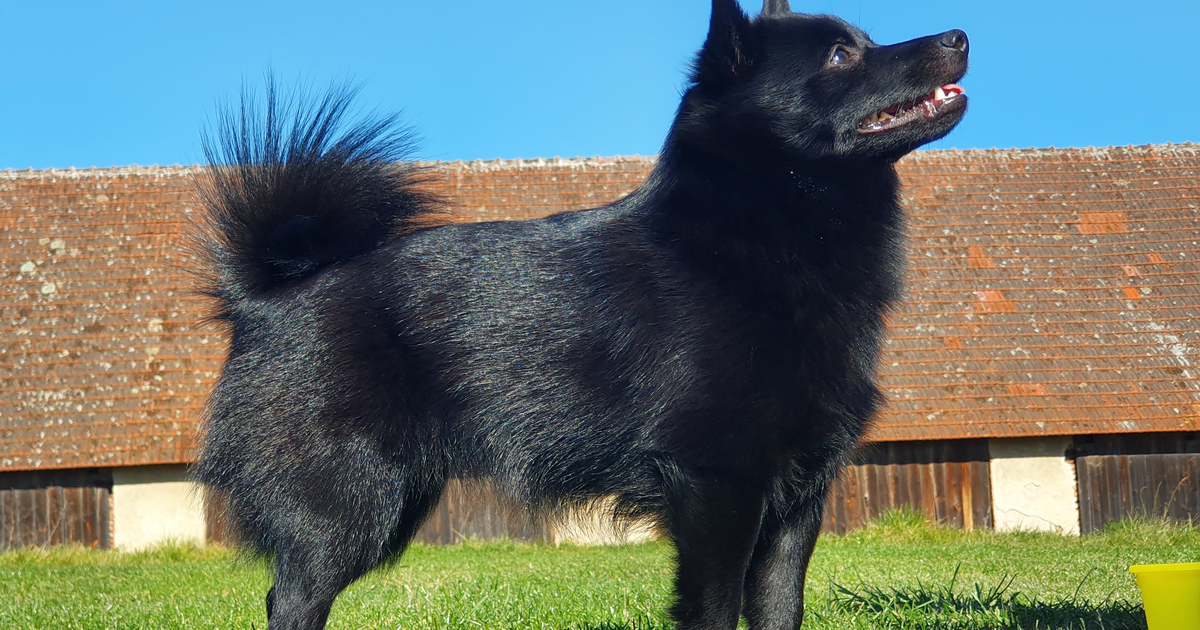
Photo: JezevecStendencíLouhovatČaj / Wikimedia Commons, CC BY-SA 4.0
- A breed of about 3,000 tested dogs — and why that number is the story
- What mucopolysaccharidosis actually is
- The variant: an insertion that jams the end of the enzyme
- The clinical course: normal for two years, then a slow decline
- Where to get tested in the United States
- Testing and referral in the United Kingdom
- What the result means for breeding decisions
- Insurance and cost planning in the US
- Working with your veterinary team
- Frequently asked questions
- References
- How to get your pet tested
A breed of about 3,000 tested dogs — and why that number is the story


Most canine genetic diseases are described in a handful of dogs and then studied no further. MPS IIIB in Schipperkes is different, and the difference is worth understanding before any of the clinical detail.
Raj and colleagues (2020) reported genotypes for 3,219 Schipperkes tested between 2003 and 2019. The breakdown:
- Homozygous for the insertion (affected): 1.5% — 48 dogs.
- Heterozygous (carriers, clinically healthy): 23.6% — 760 dogs.
- Homozygous wild-type (clear): 74.9% — 2,411 dogs.
Nearly a quarter of tested Schipperkes carried a variant that kills dogs before six years of age. In a numerically small breed, that is a serious allele frequency. And yet the paper’s most important finding is what happened next: the number of dogs homozygous and heterozygous for the insertion declined rapidly after the initial years of genotyping. The authors present this explicitly as documentation of what a DNA screening program achieves in a breed with a small gene pool.
That is the frame for everything below. This is not a disease you are helpless against. It is one of the few canine genetic diseases where the community response is already measurable in the data.
What mucopolysaccharidosis actually is
SamWhat does “mucopolysaccharidosis” mean in plain terms? Elena MarshOne enzyme in the cell’s recycling center is missing, so a partly-digested sugar chain piles up inside cells until they stop working.Cells contain lysosomes — compartments that break down worn-out molecules so their parts can be reused. Among the molecules routed there are glycosaminoglycans (GAGs), the long sugar chains that give cartilage, cornea, blood vessel walls and skin their structure.
GAGs are dismantled by a relay of enzymes acting in a fixed order. If any one enzyme in the relay is missing, degradation stalls at that step and the partially degraded chain accumulates inside the lysosome. The cell swells and loses function. That is a mucopolysaccharidosis, and which enzyme is missing determines the type number.
The types reported in dogs are distinct diseases with distinct genes, breeds and clinical pictures:
- MPS IIIA (Sanfilippo A) — SGSH. Dachshund, New Zealand Huntaway. Predominantly neurological (Fischer et al. 1998).
- MPS IIIB (Sanfilippo B) — NAGLU. Schipperke. Predominantly neurological.
- MPS VI (Maroteaux-Lamy) — ARSB. Miniature Pinscher, Miniature Schnauzer. Predominantly skeletal deformity and corneal clouding (Raj et al. 2020, Animal Genetics 51:982-986).
- MPS VII (Sly syndrome) — GUSB. German Shepherd Dog, Brazilian Terrier. Skeletal, ocular and neurological (OMIA:000667-9615).
The Sanfilippo types (III) are the neurological mucopolysaccharidoses. In MPS IIIB the missing enzyme is alpha-N-acetylglucosaminidase (NAGLU), and the substrate that accumulates is heparan sulfate — abundant in the central nervous system. That is why Schipperkes lose coordination rather than developing the dwarfed, coarse-featured skeleton seen in MPS VI and VII.
The variant: an insertion that jams the end of the enzyme
SamIs it a single letter change, like most of the mutations I read about? Elena MarshNo — it is a messy insertion, which is why the lab method for this test is different from a standard SNP assay.Raj et al. (2020) found a single variant in exon 6 of NAGLU in affected Schipperkes: an insertion consisting of a 40–70 bp poly-A tract together with an 11 bp duplication of the exonic region immediately preceding it.
The consequence at the protein level is predicted to be a run of 13 or more lysine residues inserted near the C-terminus, followed by either an in-frame repeat of the four preceding amino acids or a frameshift. Either way, the C-terminal end of the enzyme is disrupted and NAGLU activity is lost.
Two practical points follow from the structure of this variant:
- The insertion is variable in length (40–70 bp), so a test has to size a fragment rather than read a single base. European laboratories describe their method for MPS IIIB as fragment length polymorphism analysis — Laboklin lists “FLP” for the Schipperke test, as opposed to the sequencing they use for MPS IIIA.
- Genotype and phenotype lined up cleanly in the original study. Clinically affected Schipperkes were homozygous for the insertion, and sequenced healthy dogs were either heterozygous or homozygous wild-type. This is a well-behaved recessive variant, not a risk factor with murky penetrance.
The clinical course: normal for two years, then a slow decline
SamWould I notice anything when the puppy is young? Elena MarshAlmost certainly not. That is exactly why the DNA test matters more than observation in this breed.Affected Schipperkes develop a slowly progressive ataxia at approximately two years of age, and the disease leads to humane euthanasia before six years of age (Raj et al. 2020). Reported signs include tremor, difficulty with balance and loss of coordination.
Several features of that timeline have practical consequences:
- A puppy cannot be cleared by observation. An affected Schipperke is indistinguishable from its littermates for roughly two years — well past the age at which puppies are placed in homes and, critically, past the age at which many dogs are first bred.
- The onset is insidious, not sudden. Early signs are easy to attribute to a slippery floor, a minor injury, or simply an individual quirk of gait. Owners often recognize the change only in retrospect, comparing videos.
- Progression is slow. Unlike a rapidly fatal storage disease, MPS IIIB gives families years of gradually declining function — which is its own kind of difficulty, and one worth discussing with your veterinarian early rather than late.
If you notice a change in coordination, the single most useful thing you can do before your appointment is record video of your dog walking and turning on a non-slip surface. Neurological signs frequently fail to appear in an exam room, and dated video lets your veterinarian judge the rate of progression. Ataxia in a young adult dog has many causes — cerebellar disease, spinal cord compression, inflammatory and infectious conditions among them — and distinguishing between them is a clinical task, not something a genetic test settles on its own.
Where to get tested in the United States
SamWhere do I actually send a sample? Elena MarshFor Schipperkes there is a real choice of US labs, which is not true for every breed-specific test.- PennGen (University of Pennsylvania School of Veterinary Medicine) — the academic laboratory whose group published the variant. PennGen accepts cheek brushes/swabs and fresh EDTA blood. Note that PennGen does not supply collection kits: you collect the sample yourself following their published instructions and ship it before ordering.
- GenSol Diagnostics — offers the test explicitly as “Mucopolysaccharidosis IIIB Schipperke Type (MPS-IIIB-SCHP)”.
- Laboklin — a European option listing Schipperke as the breed, using FLP analysis, with results 1–2 weeks after the sample reaches the lab.
Specify the test by breed and type when you order. “MPS testing” is ambiguous — the mucopolysaccharidoses are separate diseases with separate genes. Write “MPS IIIB, Schipperke type, NAGLU“ on the submission form. Ordering the MPS IIIA (Dachshund) or MPS VI (Miniature Schnauzer) test will return “no variant detected”, which tells you nothing about your dog.
Costs are modest relative to the rest of dog ownership — PennGen prices its MPS DNA tests in the $75 range, and commercial single-gene tests are broadly comparable. Check current pricing directly with the laboratory; figures change.
Testing and referral in the United Kingdom
SamI’m in the UK. Do I have to ship a sample to America? Elena MarshNo. There is a UK laboratory that lists this exact test, so you can stay domestic and pay in sterling.Schipperke owners in Britain have a domestic route, which matters because international sample shipping adds cost, customs paperwork and days of transit.
- Laboklin UK, based in Manchester, lists Mucopolysaccharidosis type IIIb (MPS3b) with Schipperke named as the breed, priced at £48.00 including VAT (test no. 8299). Samples can be submitted by post or through your own veterinary practice, and the order form is downloadable from the site. Billing in sterling removes both the currency conversion and the international shipping problem.
- This is the point that matters most for UK breeders: that test is part of the Official UK Kennel Club DNA Testing Scheme for the Schipperke. For UK-registered dogs, Laboklin can send the result directly to the Kennel Club to be recorded and published against the dog. Two conditions are easy to miss and both are strict: the report must carry the dog’s microchip or tattoo number together with its registered name or registered number, and you must sign the declaration section on the order form giving permission to forward the result. Results lacking those identifiers are not recorded by the Kennel Club — so a test that cost you the same money ends up invisible to everyone planning a mating with your dog.
- Referral pathway. In the UK, veterinary specialists are regulated through the Royal College of Veterinary Surgeons (RCVS), which maintains recognised specialist status; neurology referrals commonly go to RCVS Specialists or holders of European College of Veterinary Neurology (ECVN) diplomas, typically via your own practice rather than by self-referral.
- Breed records. The Kennel Club is the UK registry and publishes breed health information and DNA testing resources; check the current Schipperke breed page for which DNA tests are recorded or required at the time you breed, because these lists are revised periodically. In the US the equivalent record-keeping runs through OFA and its CHIC programme, which compiles the health tests a parent club designates for the breed.
Costs differ between the two markets, and not only by exchange rate. A US single-gene test is priced around $75; the UK equivalent is £48.00 including VAT. Either may be invoiced directly to you or through your veterinary practice, which affects whether consultation and sampling fees are added on top. Confirm with the laboratory whether the quoted figure covers the test alone or includes sampling and reporting — that distinction, not the headline price, is what usually surprises people. Prices are those published at the time of writing; check the current figure before ordering.
What the result means for breeding decisions
SamIf a dog comes back a carrier, should it be removed from the breeding program? Elena MarshNo — and in a breed this small, removing every carrier would do more harm than the disease.With a 23.6% carrier rate, excluding all carriers would eliminate roughly a quarter of the Schipperke breeding population in a single generation. The genetic diversity cost of that is severe, and the standard recessive-disease strategy avoids it entirely:
- Clear × Clear — no affected puppies, no carriers.
- Clear × Carrier — no affected puppies. On average half the litter are carriers, which is a manageable outcome, not a failure.
- Carrier × Carrier — on average one in four puppies affected. This is the only mating to avoid.
The goal is to manage pairings, not to purge alleles. A carrier Schipperke with excellent structure, temperament and health elsewhere is a valuable dog; bred to a clear mate, it produces no affected puppies. This is precisely the strategy that produced the decline documented by Raj et al. (2020) — carriers were bred responsibly rather than eliminated.
For breeders working within US structures, health testing results are recorded in the Orthopedic Foundation for Animals databases, and buyers increasingly expect to see documentation. Publishing results — including carrier status — is what makes informed pairings possible across a breed rather than within one kennel.
A note of caution about interpretation: Moses, Niemi and Karlsson (2018, Nature 559:470-472) documented cases where healthy dogs were euthanized on the basis of poorly validated genetic results, and argued for quality standards in pet genomics. The Schipperke MPS IIIB variant is well validated — a clean recessive with genotype-phenotype concordance in the original study — but the general principle stands: a genotype is interpreted alongside the clinical picture, by a veterinarian.
Insurance and cost planning in the US
SamWould pet insurance cover a dog that develops this? Elena MarshIt depends heavily on when you enrolled. Hereditary conditions and pre-existing conditions are handled very differently.US pet insurance policies vary widely, and the details matter more than usual for a late-onset genetic disease:
- Pre-existing conditions are excluded across the industry. Once a Schipperke shows ataxia, or once a diagnosis is recorded, treatment for that condition is generally not covered by a policy purchased afterward.
- Hereditary and congenital condition coverage is a differentiator between carriers. Some plans include it, some exclude it, and some offer it only on higher tiers or after a waiting period. Read the specific policy wording for “hereditary” and “congenital” before enrolling — do not rely on a summary page.
- Whether a DNA result alone creates a pre-existing condition is a question to put to the insurer in writing. A carrier is a healthy dog and will never develop the disease, but insurers differ in how they treat documented genetic findings.
The financial reality of MPS IIIB is worth stating plainly. There is no curative treatment. The costs that accumulate are diagnostic — neurological examination, advanced imaging such as MRI, and referral consultations, which in the US commonly run into four figures — and then supportive care over several years of decline. A $75 test in a breeding animal is the only intervention in this entire sequence that changes outcomes, because it prevents affected puppies from being born.
Working with your veterinary team
SamIs this something a regular vet would recognize? Elena MarshA general practitioner will recognize ataxia. Pinning it to a rare storage disease usually needs a neurologist — and your knowing the breed risk speeds that up considerably.The realistic path in the US runs from a general practice veterinarian to a board-certified veterinary neurologist, found through the American College of Veterinary Internal Medicine, which certifies the neurology specialty. Referral is usually initiated by your regular veterinarian.
What you can contribute is specific and genuinely valuable:
- Say the breed and the known variant out loud. “This is a Schipperke, and there is a known NAGLU variant causing MPS IIIB in this breed with a published carrier rate around 24%” is information many general practitioners will not have at hand for a numerically small breed.
- Bring dated video showing gait over weeks or months. Rate of progression is diagnostic information.
- Bring the pedigree and any relatives’ test results. A litter-mate’s diagnosis is a powerful clue.
Diagnosis of a mucopolysaccharidosis is not purely genetic. Urinary GAG excretion screening and leukocyte enzyme activity assays are the biochemical counterparts to DNA testing, and PennGen offers metabolic screening alongside DNA testing for exactly this reason. Which tests to run, and in what order, is a decision for the clinician managing the case.
Frequently asked questions
Q. My Schipperke is four years old and completely normal. Could it still be affected?
Affected dogs show a slowly progressive ataxia from around two years of age, so a genuinely normal four-year-old is unlikely to be affected. That said, “normal” is a judgement made by eye, and early ataxia is subtle. If you have any doubt, the DNA test resolves it definitively and inexpensively.
Q. My dog tested as a carrier. Will it get sick?
No. MPS IIIB is autosomal recessive — carriers are clinically healthy for life. In the original study, sequenced healthy dogs were heterozygous or homozygous wild-type. Carrier status matters only for breeding decisions.
Q. Both parents tested clear. Do I need to test the puppies?
For this variant, no. Two clear parents cannot produce a carrier or affected puppy. This is the mechanism that lets the breed reduce disease frequency without discarding dogs — and it is why testing breeding animals matters far more than testing pets.
Q. Is there any treatment?
There is no curative treatment available for MPS IIIB in dogs. Enzyme replacement therapy exists for some human mucopolysaccharidoses, but the Sanfilippo types are neurological and the blood-brain barrier makes them particularly difficult targets; nothing of the kind is routinely available in veterinary practice. Care is supportive, and its planning belongs with your veterinarian.
Q. Does a general canine DNA panel cover this?
Coverage varies by provider and changes over time, so verify the specific variant is on the panel before relying on it. Breed-specific tests from PennGen or GenSol Diagnostics name the Schipperke type explicitly, which removes the ambiguity.
Q. Why does a rare breed have such a high carrier frequency?
Small founding populations concentrate whatever alleles the founders carried — the same mechanism that fixes desirable breed traits also fixes recessive disease variants. This is not a failure specific to Schipperkes; it is a structural feature of closed breed registries, and it is exactly why systematic screening and diversity-preserving pairings matter so much in numerically small breeds.
References
- Raj K, Ellinwood NM, Giger U (2020) An exonic insertion in the NAGLU gene causing Mucopolysaccharidosis IIIB in Schipperke dogs. Scientific Reports 10:3170.
- Raj K, Ellinwood NM, Giger U (2020) An exonic insertion in the NAGLU gene causing Mucopolysaccharidosis IIIB in Schipperke dogs. PubMed record (PMID 32081995).
- Fischer A, Carmichael KP, Munnell JF, Jhabvala P, Thompson JN, Matalon R, Jezyk PF, Wang P, Giger U (1998) Sulfamidase deficiency in a family of Dachshunds: a canine model of mucopolysaccharidosis IIIA (Sanfilippo A). Pediatric Research 44(1):74-82.
- Raj K, Berman-Booty L, Foureman P, Giger U (2020) ARSB gene variants causing Mucopolysaccharidosis VI in Miniature Pinscher and Miniature Schnauzer dogs. Animal Genetics 51(6):982-986.
- Silverstein Dombrowski DC, Carmichael KP, Wang P, O’Malley TM, Haskins ME, Giger U (2004) Mucopolysaccharidosis type VII in a German Shepherd Dog. Journal of the American Veterinary Medical Association 224(4):553-557.
- Moses L, Niemi S, Karlsson E (2018) Pet genomics medicine runs wild. Nature 559:470-472.
- OMIA:000667-9615 — Mucopolysaccharidosis VII in Canis lupus familiaris.
- PennGen, University of Pennsylvania School of Veterinary Medicine — Mucopolysaccharidosis DNA and metabolic testing.
- GenSol Diagnostics — Mucopolysaccharidosis IIIB Schipperke Type (MPS-IIIB-SCHP).
- Laboklin — Mucopolysaccharidosis type IIIb (MPS3b): breed, method and turnaround.
- Orthopedic Foundation for Animals — health testing databases and CHIC requirements.
- American College of Veterinary Internal Medicine — locating a board-certified veterinary neurologist.
How to get your pet tested
Some pet DNA tests screen for hereditary-disease carrier status or genetic risk markers, but the results are information, not a diagnosis. If your pet has symptoms or you need a confirmed diagnosis, please consult your veterinarian.
Below is where Mucopolysaccharidosis (MPS) can be tested, grouped by where you live and marked by whether each service explicitly lists this variant (✅ = listed / ❓ = unverified / ❌ = not offered).
In the United States
In the United Kingdom
In India
Elsewhere
Note: even if the kit can be purchased/shipped internationally, the service itself (sample return, analysis, results) is not guaranteed in your country. Check each service’s stated service area and sample-return method before ordering.
Services offered in other regions (may not be available where you live)
Worried about your pet’s health? — Talk to a veterinarian
A confirmed diagnosis and any treatment plan are decisions for a veterinarian, not a test kit. The links below are professional resources.
AVMA — Find a veterinarian (American Veterinary Medical Association)
This section contains advertising (affiliate links); we may earn a commission if you buy through them. As an Amazon Associate, we earn from qualifying purchases. Genetic tests do not guarantee the prevention, diagnosis, or treatment of any disease — results indicate tendencies and provide information only.
This page is educational information, not veterinary diagnosis or advice. Always consult a veterinarian about your pet’s health.
About the author
Elena Marsh
Editor & writer (not a veterinarian)
A writer with a molecular-biology background and a lifelong dog and cat owner. Not a veterinarian — she translates peer-reviewed genetics research and primary data into plain language, always as information rather than diagnosis.