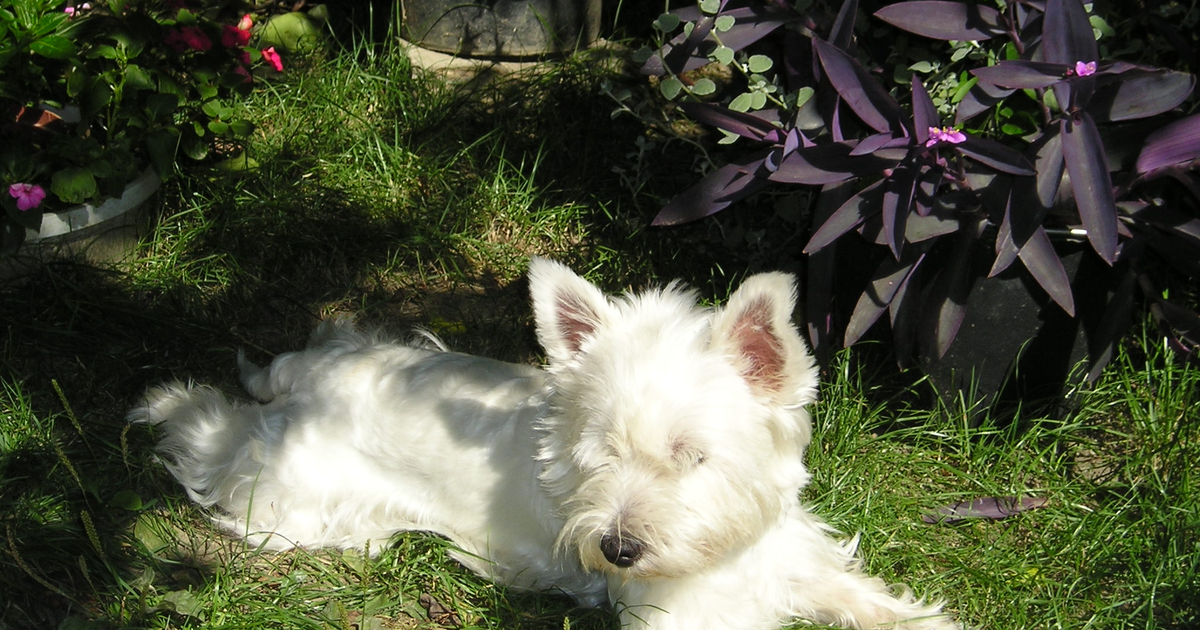


Conclusion: West Highland White Terriers can carry globoid cell leukodystrophy (GCL, also called Krabbe disease), caused by the GALC:c.473A>C (p.Y158S, exon 5) mutation — the identical variant found in Cairn Terriers, a molecular fingerprint of the two breeds’ shared origin. It is autosomal recessive, symptoms typically start between 1 and 6 months of age, and there is no cure. The good news is that the causal mutation is known and testable: a cheek-swab DNA test from Embark, Orivet/PawPrint Genetics, or the AKC DNA + Health Kit tells you a puppy’s or breeding dog’s genotype before any symptom ever appears. Any concern about gait or tremor still needs a veterinarian, not a DNA report.
- What Krabbe disease looks like in a Westie puppy, and when it starts
- The molecular story: why Westies and Cairn Terriers share one mutation
- How to actually get a Westie tested in the US and UK
- Carrier, clear, or affected: what the genotype means for breeding
- Insurance and the real cost of testing
- What to bring to the vet if you notice symptoms
- Frequently asked questions
- References
- How to get your pet tested
What Krabbe disease looks like in a Westie puppy, and when it starts
Globoid cell leukodystrophy is a storage disease. The GALC gene normally makes an enzyme called galactocerebrosidase, which breaks down a fatty molecule produced during the normal turnover of myelin, the insulating sheath around nerve fibers. When the enzyme doesn’t work, that fatty molecule (and its toxic byproduct, psychosine) builds up instead of clearing, and it damages the very myelin the enzyme was supposed to help maintain. The result is a progressive breakdown of the nervous system’s wiring.
In affected puppies, signs typically begin between 1 and 6 months of age, with several sources emphasizing an even narrower window of 1 to 3 months. The first thing an owner usually notices is weakness or unsteadiness in the hind legs, sometimes with tremor. Because the disease is progressive, it does not plateau — it moves on to vision problems, more general weakness or paralysis, and behavioral changes as more of the nervous system is affected. There is no cure, and supportive care is the only option available in ordinary veterinary practice; affected dogs are commonly euthanized well before their first birthday, often by 10 to 12 months. Researchers at Penn Vet have reported that combining AAV-delivered gene therapy with a hematopoietic stem cell transplant extended survival past four years in a natural-disease dog model — a genuinely encouraging research result, but an experimental one, not something available at a general or even specialty veterinary clinic today.
The molecular story: why Westies and Cairn Terriers share one mutation
SamIf Cairns and Westies didn’t exist as separate breeds until the 1900s, how are their genes already different diseases? Elena MarshThey’re not different — that’s the point. Same base pair change, same amino acid swap, in both breeds.This is the detail that makes GCL in terriers a genuinely interesting case study rather than just another single-gene disease. Wenger et al. (1999, Journal of Heredity), building on the cloning work of Victoria, Rafi & Wenger (1996, Genomics), identified the causal mutation as GALC c.473A>C, producing the amino acid substitution p.Y158S in exon 5 of the gene — and found it to be the exact same base-pair change in both Cairn Terriers and West Highland White Terriers. That is not a coincidence of two breeds independently developing similar mutations. It is a single founder mutation, carried forward from a common ancestral population.
The history lines up with the genetics. Cairn Terriers and West Highland White Terriers both trace back to the same landrace of small working terriers from the Scottish Highlands, before selective breeding split them into today’s recognized breeds — the Cairn Terrier around 1912–13, the West Highland White Terrier a few years earlier, around 1907. A mutation present in that shared founding population before the split would be expected to show up, unaltered, in both descendant breeds. That is exactly what Wenger and Victoria’s molecular work found — a genetic fingerprint of a breed history that was otherwise only documented in club records and breeder memory.
Contrast that with the Irish Setter, a breed with no such shared ancestry with the terriers. Irish Setters that develop GCL carry a completely different mutation: a 78-base-pair insertion at c.790_791 (c.790_791ins78), identified by McGraw & Carmichael (2006, The Veterinary Journal). The clinical picture in an affected Irish Setter looks the same as in an affected Westie — progressive hind-limb weakness, tremor, and decline — but the underlying DNA lesion is unrelated. This matters practically as well as academically: a laboratory testing an Irish Setter for the terrier-type variant, or a Westie for the Irish Setter-type variant, would report a false clear. Test methodology has to match the breed.
The story doesn’t end with two variants. In 2023, Hammack et al. (Journal of Veterinary Internal Medicine) described a third, independent GALC variant in a family of mixed-breed dogs with apparent Collie-lineage ancestry. Within that one extended family, of 37 related dogs genotyped, 7 were homozygous affected and 7 were heterozygous carriers; among 278 unrelated dogs tested as controls, none carried the variant. Those numbers describe that specific pedigree only — they are not a population carrier rate for Collies or mixed breeds generally — but the finding reinforces a useful principle for owners of any breed with unexplained neurological decline: “GCL” is not one mutation, it’s a clinical syndrome that different breeds have arrived at through different broken copies of the same gene, or in the case of Hammack’s family, potentially a related gene pathway. A DNA test only clears the mutation it was designed to detect.
How to actually get a Westie tested in the US and UK
The terrier-type GCL mutation is well covered by mainstream US testing options, so getting a definitive genotype does not require anything exotic.
- Embark includes GCL/GALC in its broad health panel — the company markets coverage of 270+ health conditions in a single Breed + Health test, with globoid cell leukodystrophy among them.
- PawPrint Genetics, which merged with Orivet in 2024, previously ran separate breed-specific test pages for Cairn Terrier and West Highland White Terrier listing the Terrier Type GCL variant directly. Panel pricing under the combined Orivet/PawPrint offering starts at roughly $139.
- The AKC DNA + Health Kit lists GCL as two separate entries — “GCL (Irish Setter Type)” and “GCL (Terrier Type)” — reflecting the two distinct mutations described above. The kit currently retails for $135.99 through the AKC Shop, and the Cairn Terrier AKC Parent Club officially designates the Terrier Type GCL test as “Recommended” — a designation the West Highland White Terrier Club of America owner should read as directly applicable, since it is the same mutation.
Outside the US, Laboklin (service ID 8007) offers the terrier-type test via TaqMan SNP genotyping with a 3–5 business day turnaround, and runs the Irish Setter-type variant separately by Sanger sequencing over 1–2 weeks — again, two tests for two mutations. Genomia (Czech Republic) offers a Cairn Terrier / West Highland White Terrier-specific GLD test at roughly 56 euros excluding tax, with a typical 12 business day turnaround on a cheek swab, and ships internationally. Antagene (France) covers both the terrier-type and Irish Setter-type variants and cites the same Victoria (1996) and McGraw (2006) papers referenced above.
UK owners have a straightforward domestic route. Laboklin UK lists the Globoid Cell Leukodystrophy (Krabbe Disease) mutation test at £48.00 including VAT, with a stated turnaround of 2–3 weeks, and the listing explicitly covers all three known-mutation breeds — Cairn Terrier, West Highland White Terrier, and Irish Setter — as a single mutation-based test that reports affected/carrier/clear. One caveat worth flagging directly: as of this writing, the Kennel Club (UK) does not list a recommended pre-breeding DNA testing scheme for the West Highland White Terrier the way the AKC’s Cairn Terrier Parent Club does for the Terrier Type GCL test in the US — the KC’s own breed health guidance notes there is currently no mandated pre-breeding screen in place for this breed, though that can change as evidence accumulates. That does not mean the test is unavailable or pointless in the UK; it means a UK breeder testing for GCL is currently acting on the same peer-reviewed molecular evidence as their US counterpart, just without an official club “Recommended” stamp attached to it yet. Results from any lab can still be kept with a dog’s paperwork and shared with puppy buyers directly, and the Kennel Club’s own DNA testing shop and Health Test Results Finder can be used to look up whichever official schemes do exist for a specific registered dog.
Whichever lab you use, the practical question to ask before ordering is the same one raised in the previous section: confirm the listing explicitly names “Terrier Type” or the GALC c.473A>C variant, not a generic “GCL” line item that may default to the Irish Setter-type assay.
Carrier, clear, or affected: what the genotype means for breeding
SamMy Westie tested as a carrier. Does that mean she’s sick, or will get sick later? Elena MarshNo — one copy doesn’t cause disease. It only matters when you’re choosing a mate for her.GCL is autosomal recessive, so a dog needs two copies of the mutated GALC allele to be affected. A dog with one mutated copy and one normal copy is a carrier (N/P): clinically healthy for life, with zero risk of developing the disease itself, but able to pass the mutated copy to roughly half of its offspring. A dog with two normal copies is clear (N/N) and cannot pass on the mutation at all.
The standard Mendelian arithmetic follows directly from that: pairing two carriers (N/P × N/P) produces, on average, 25% affected, 50% carrier, 25% clear puppies per litter. Pair a carrier with a clear dog and you get carriers and clears in roughly equal numbers, but zero affected puppies — because an affected puppy requires a mutated copy from both parents, and the clear parent has none to give. In other words, as long as at least one parent in a mating has tested genotype-confirmed clear, no puppy from that litter can be affected, regardless of the other parent’s status. This is precisely why AKC-affiliated parent club guidance for Cairn Terriers recommends testing rather than exclusion of carriers from breeding programs outright — removing every carrier from a limited gene pool has its own costs, while testing lets breeders pair carriers safely against confirmed-clear mates.
One caveat worth restating from the shared research record: no peer-reviewed, population-level carrier frequency (the percentage of Cairn Terriers, West Highland White Terriers, or Irish Setters carrying one copy in the general population) has been published for this mutation. Wenger et al. (1999) reported having identified more than 50 Cairn Terrier carriers through their screening effort — a cumulative count of dogs tested, not a random-sample carrier rate — and no comparable figure exists for Westies specifically. If a breeder or seller quotes you a specific carrier percentage for the breed as a whole, ask for the source; it is not in the literature.
Insurance and the real cost of testing
The DNA test itself is inexpensive relative to what a symptomatic workup or ongoing supportive care would cost. In the US, panel-based consumer tests that include GCL run in the neighborhood of $110–$200 depending on the provider and current promotions (Embark’s Breed + Health test has listed around $199, with frequent sale pricing), the AKC DNA + Health Kit is $135.99, and the Orivet/PawPrint Genetics panel starts near $139. In the UK, Laboklin UK’s single-condition GCL test is £48.00 including VAT on a cheek swab — cheaper than any US panel, because it answers one question rather than bundling in breed identity and hundreds of other conditions. Breed-specific, single-condition tests from EU labs such as Genomia run similarly low (roughly 56 euros for the GLD test alone) if you only need the one answer.
Pet insurance is a separate question, and the honest answer is that coverage of hereditary and congenital conditions like GCL varies widely by US insurer, by plan tier, and often by state. Some policies include hereditary conditions in standard coverage, others exclude them outright or require a specific rider, and the difference is rarely obvious from a marketing page — it shows up in the exclusions schedule. What is consistent across essentially every US pet insurer is the pre-existing condition exclusion: once a veterinarian has documented ataxia, tremor, or a related neurological sign in a dog’s clinical record, that condition becomes uninsurable going forward, on that policy and typically on any new one. That makes the practical timing point more important than the exact dollar figures: the DNA test itself is not something insurance reimburses — it’s a breeding and risk-management decision, not treatment — but insuring a Westie puppy before any symptom appears, ideally in the first weeks after it comes home, is the only way to make sure a later diagnosis is actually covered rather than excluded as pre-existing. If you’re evaluating a policy for a Westie puppy, read the hereditary/congenital exclusion language directly rather than relying on the summary page, and ask the insurer in writing whether GCL specifically is covered under that plan.
UK pet insurance norms differ in a way that is worth knowing before you buy a policy. Major UK insurers including Petplan and Agria generally state that they cover hereditary and congenital conditions as standard, provided the condition was not already showing symptoms or diagnosed before the policy started — the exclusion in UK practice tends to attach to the specific dog’s pre-existing status, not to hereditary conditions as a category. That is more generous on paper than the US pattern of category-wide exclusions or paid riders, but the same practical rule still applies: the protection only exists if the policy is in force before any sign appears, so insuring a Westie puppy early, before any gait or tremor issue is ever recorded, remains the decisive action regardless of which country you’re in. As with the US, always read a specific UK insurer’s policy wording and exclusions schedule rather than relying on marketing copy, since practice can vary between providers and policy tiers (for example, whether cover is lifetime, time-limited, or maximum-benefit affects how long a chronic diagnosis stays covered).
What to bring to the vet if you notice symptoms
Because early GCL signs in a young Westie can look like ordinary puppy clumsiness at first, and because dogs — like people — often move more normally in a stressful, unfamiliar exam room than they do at home, the single most useful thing an owner can do before an appointment is record video. Two short clips help a great deal: the dog walking in a straight line on a flat, non-slip floor from the side, and a close view of the hind legs and back while the dog is standing still or resting, since tremor and weakness are sometimes more obvious at rest than in motion.
Beyond video, bring a written timeline: the age when you first noticed anything, whether it has been getting worse week to week, and whether any littermate has shown similar signs (a real signal in a recessive disease, not just a coincidence). If you or the breeder has DNA test results for the puppy or its parents, bring those too — a documented carrier or affected genotype changes how quickly a veterinarian moves toward a neurological workup rather than first ruling out more common, treatable causes of hind-limb weakness such as an orthopedic problem, an ear or vestibular issue, or a metabolic condition. A DNA test result is not a diagnosis, and this article is not a substitute for veterinary evaluation. Any Westie showing gait changes, tremor, or weakness needs to see a veterinarian directly — ideally one who can refer to a board-certified veterinary neurologist if the picture doesn’t resolve quickly.
Frequently asked questions
Q. Is GCL the same disease as “Krabbe disease” in humans?
They are the same underlying enzyme deficiency — a GALC mutation causing galactocerebrosidase deficiency — but they are separate mutations in separate species. The canine terrier-type mutation (GALC c.473A>C) is specific to dogs; it is not the same DNA change found in human Krabbe disease patients, even though the biology of demyelination is closely comparable.
Q. My Westie tested clear (N/N). Can I stop worrying about GCL entirely?
For this specific mutation, yes — a confirmed clear genotype means the dog cannot develop or pass on terrier-type GCL. It does not rule out unrelated neurological conditions, and it doesn’t cover a different disease from a different gene, so unexplained gait changes still warrant a veterinary visit regardless of DNA test history.
Q. Should carriers be removed from breeding entirely?
Breed club guidance generally advises against blanket exclusion of carriers, since removing every carrier at once can narrow an already limited gene pool. The standard approach is to breed carriers only to genotype-confirmed clear mates, which mathematically guarantees zero affected puppies while preserving genetic diversity.
Q. Does pet insurance cover the DNA test?
No, in essentially every US plan. The DNA test is treated as a preventive/breeding decision rather than treatment for an existing condition, so it falls outside what mainstream pet insurance reimburses. Coverage of the disease itself, if a dog is later diagnosed, depends heavily on the specific policy and whether symptoms were documented before the policy started.
Q. Why does a Westie need the “Terrier Type” test specifically, not just any “GCL” test?
Because GCL is caused by different, breed-specific mutations. The AKC DNA + Health Kit and several international labs list “GCL (Terrier Type)” and “GCL (Irish Setter Type)” as two separate tests for exactly this reason. Ordering the wrong one, or a generic listing that defaults to the Irish Setter variant, will not detect the Cairn/Westie mutation.
Image credit: Wikimedia Commons, West Highland White Terrier, public domain / CC0, centre-cropped to 1200×630.
References
- Wenger DA, Victoria T, Rafi MA, et al. Globoid cell leukodystrophy in cairn and West Highland white terriers. J Hered. 1999;90(1):138-142. https://pubmed.ncbi.nlm.nih.gov/9987921/
- Victoria T, Rafi MA, Wenger DA. Cloning of the canine GALC cDNA and identification of the mutation causing globoid cell leukodystrophy in West Highland White and Cairn Terriers. Genomics. 1996;33(3):457-462. https://www.researchgate.net/publication/13301376_Globoid_Cell_Leukodystrophy_in_Cairn_and_West_Highland_White_Terriers
- McGraw RA, Carmichael KP. Molecular basis of globoid cell leukodystrophy in Irish setters. Vet J. 2006;171(2):370-372. https://pubmed.ncbi.nlm.nih.gov/16490723/
- Hammack J, et al. Novel genetic variant associated with globoid cell leukodystrophy in a family of mixed breed dogs. J Vet Intern Med. 2023;37(5):1710-1715. https://pmc.ncbi.nlm.nih.gov/articles/PMC10473001/
- OMIA 000578-9615: Krabbe disease in Canis lupus familiaris. https://www.omia.org/OMIA000578/9615/
- Laboklin — Globoid cell leucodystrophy (Krabbe disease), dog. https://laboklin.com/en/products/genetics/hereditary-diseases/dog/globoid-cell-leucodystrophy-krabbe-disease/
- Laboklin UK — Globoid Cell Leukodystrophy (Krabbe Disease) test, dog. https://www.laboklin.co.uk/laboklin/showGeneticTest.jsp?testID=8007
- The Kennel Club (Royal Kennel Club, UK) — Breed health information and DNA testing schemes, West Highland White Terrier. https://www.royalkennelclub.com/health-and-dog-care/health-testing/dna-testing-schemes/
- Petplan UK — Hereditary and congenital condition cover. https://www.petplan.co.uk/
- Agria Pet Insurance — Does pet insurance cover pre-existing conditions? https://www.agriapet.co.uk/pre-existing-conditions/
- Genomia — GLD (Globoid Cell Leukodystrophy) test. https://www.genomia.cz/en/test/gld/
- Antagene — Globoid Cell Leukodystrophy. https://antagene.com/en/disease/globoid-cell-leukodystrophy
- American Kennel Club — AKC DNA + Health Kit Included Tests. https://www.akc.org/breeder-programs/dna/dna-resource-center/akc-dna-health/akc-dna-health-kit-included-tests/
- LabGenVet — Globoid Cell Leukodystrophy (Krabbe Disease, Terrier-type). https://labgenvet.ca/en/disease/globoid-cell-leukodystrophy-krabbe-disease-terrier-type/
- VCA Animal Hospitals — Globoid-cell Leukodystrophy in Dogs. https://vcahospitals.com/know-your-pet/globoid-cell-leukodystrophy-in-dogs
- Embark Veterinary — Dog DNA health testing (270+ health conditions panel, includes GCL/GALC). https://embarkvet.com/
- AKC Shop — AKC DNA + Health Kit. https://shop.akc.org/products/proshop-dna-plus-health-kit
How to get your pet tested
Some pet DNA tests screen for hereditary-disease carrier status or genetic risk markers, but the results are information, not a diagnosis. If your pet has symptoms or you need a confirmed diagnosis, please consult your veterinarian.
Below is where GALC (Krabbe disease / Globoid Cell Leukodystrophy) can be tested, grouped by where you live and marked by whether each service explicitly lists this variant (✅ = listed / ❓ = unverified / ❌ = not offered).
In the United States
In the United Kingdom
In India
Elsewhere
Note: even if the kit can be purchased/shipped internationally, the service itself (sample return, analysis, results) is not guaranteed in your country. Check each service’s stated service area and sample-return method before ordering.
Services offered in other regions (may not be available where you live)
Worried about your pet’s health? — Talk to a veterinarian
A confirmed diagnosis and any treatment plan are decisions for a veterinarian, not a test kit. The links below are professional resources.
AVMA — Find a veterinarian (American Veterinary Medical Association)
This section contains advertising (affiliate links); we may earn a commission if you buy through them. As an Amazon Associate, we earn from qualifying purchases. Genetic tests do not guarantee the prevention, diagnosis, or treatment of any disease — results indicate tendencies and provide information only.
This page is educational information, not veterinary diagnosis or advice. Always consult a veterinarian about your pet’s health.
About the author
Elena Marsh
Editor & writer (not a veterinarian)
A writer with a molecular-biology background and a lifelong dog and cat owner. Not a veterinarian — she translates peer-reviewed genetics research and primary data into plain language, always as information rather than diagnosis.