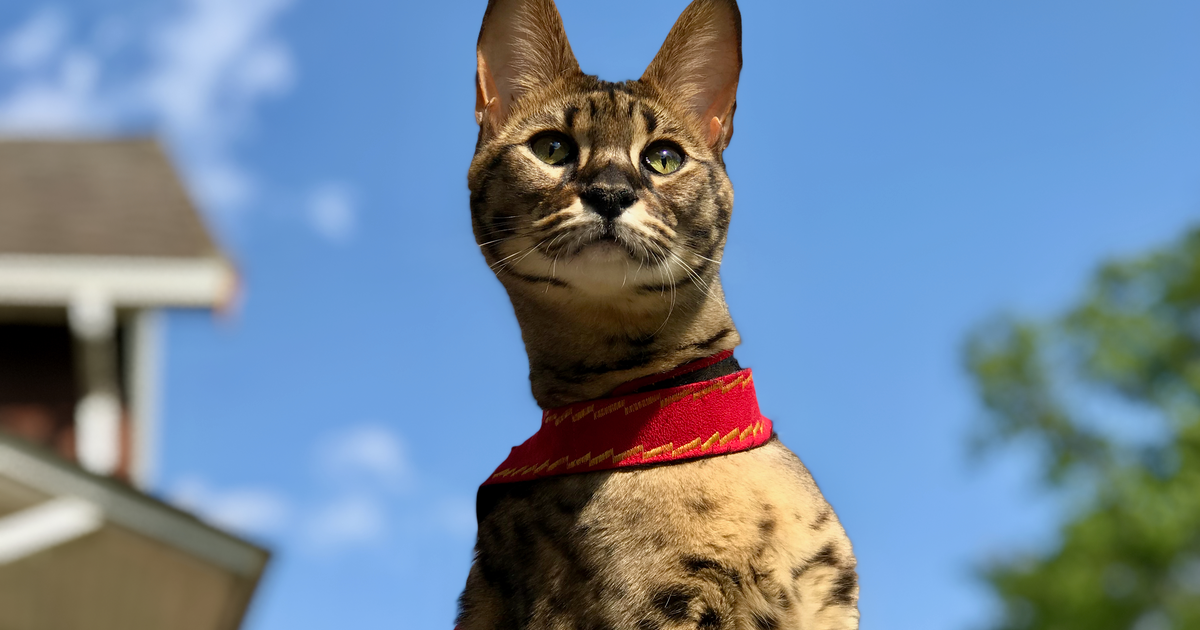
Bottom line: The Savannah is on the published list of breeds that should be tested for erythrocyte pyruvate kinase deficiency (PK deficiency, PKLR) — but the evidence behind that recommendation is thinner than for any other breed on the list. In the largest feline survey ever run on this mutation, Grahn et al. (2012, BMC Veterinary Research 8:207) genotyped 14,179 cats across 38 breeds — and only 11 of them were Savannahs. One carrier turned up in those 11. That single positive is why the breed appears in the authors’ testing recommendation, and it is also why nobody can honestly quote you a carrier rate for the breed: with 1 positive out of 11, the exact 95% confidence interval runs from 0.2% to 41%. What is documented is how the allele could have arrived. TICA’s permissible outcrosses for the Savannah were the Egyptian Mau, the Ocicat, the Oriental Shorthair and the Domestic Shorthair — and of those four, the Egyptian Mau (10% allele frequency) and the Domestic Shorthair are both established carriers of this exact mutation, while the Ocicat (0 carriers in 69 cats) and the Oriental Shorthair (1 in 337) are effectively clear. In the United States the test costs about $60; in the United Kingdom the same test runs at £42.96 including VAT from the Bristol laboratory that co-produced the survey — and Langford’s own test notes say it works in Savannahs and will even detect the serval allele in F1/F2 cats. Either way it is a cheek swab, done once. This article is information, not a diagnosis; if your cat shows pale gums, jaundice or unexplained lethargy, contact your veterinarian rather than a genetics website.
- Eleven cats: the entire evidence base for this breed
- How the mutation could have reached a serval hybrid
- Championship status closed the gene pool — and locked in whatever was already inside
- What the mutation does inside a red blood cell
- Six months to five years — and eleven affected cats with no signs at all
- Testing in the United States: about and a cheek swab
- Testing in the United Kingdom: Bristol, GBP prices and a registry that made it compulsory
- The legality layer: F1 to F5, and why it shows up in an emergency
- Insurance: hereditary cover exists, but the clock matters
- What to tell your veterinarian
- FAQ
- References
- How to get your pet tested
Eleven cats: the entire evidence base for this breed


Grahn RA, Grahn JC, Penedo MCT, Helps CR and Lyons LA (2012, BMC Veterinary Research 8:207) is the reference survey for this mutation. The UC Davis and Bristol groups genotyped 14,179 cats representing 38 breeds — nothing else in feline genetics comes close for a single recessive variant.
Ranked by mutant allele frequency, the breeds that carried it were: Singapura 23%, Bengal 16.4%, La Perm 14%, Abyssinian 12.6%, Egyptian Mau 10%, Norwegian Forest Cat 10%, Somali 8.5%, Maine Coon 6.4%, Savannah 5% and Siberian 2.4%.
At first glance the Savannah sits comfortably near the bottom. But look at the denominators. Abyssinians: 1,955 cats. Bengals: 1,340. Somalis: 633. Siberians: 377. Savannahs: 11.
One of those eleven was a carrier. That is where the 5% comes from — a single heterozygote divided by 22 chromosomes. It is an honest number and the authors report it honestly, but it is not a population estimate.
Here is what the arithmetic actually supports. With 1 positive in 11 animals, the exact (Clopper–Pearson) 95% confidence interval for the carrier rate runs from 0.23% to 41.28%. In plain English: the survey cannot distinguish “vanishingly rare in Savannahs” from “more common in Savannahs than in Abyssinians.” Both are inside the interval.
That uncertainty is the practical finding for a Savannah owner. Nobody — not a breeder, not a website, and not this article — can tell you the breed-level risk. What a $60 swab can tell you is your own cat’s genotype, which is the only number that governs your cat’s medical care.
How the mutation could have reached a serval hybrid
The Savannah is a hybrid breed founded on crosses between the African serval and domestic cats, and the domestic side of that cross is documented in the registry’s own rules rather than in folklore.
TICA’s permitted domestic outcrosses for the Savannah were the Egyptian Mau, the Ocicat, the Oriental Shorthair and the Domestic Shorthair. Now put that list next to the 2012 survey results:
- Egyptian Mau — mutation present. 36 cats tested: 27 clear, 9 carriers, no affected; allele frequency reported at 10% in the main table and 13% in the unbiased subset.
- Domestic Shorthair and Longhair — mutation present. 76 cats tested: 62 clear, 13 carriers and one affected cat; allele frequency 9.9%. The random-bred population is a genuine reservoir of this allele, not a theoretical one.
- Ocicat — 69 cats tested, not a single carrier.
- Oriental Shorthair — 337 cats tested, exactly one carrier: an allele frequency of 0.1%, statistically indistinguishable from absent.
So of the four breeds a Savannah breeder was allowed to use, two carry this allele at roughly one-in-ten frequency and two effectively do not. A Savannah pedigree that leans on Egyptian Mau or random-bred domestic foundation cats has a plausible route for the variant; one built on Ocicat and Oriental Shorthair lines does not. That is not proof of how any individual line acquired it — but it is the difference between “a mystery” and “a traceable founder effect.”
It also explains why the eleven-cat sample matters so much. If the allele entered through a small number of foundation queens, its distribution across modern Savannah lines will be lumpy rather than uniform — concentrated in some catteries and absent from others. A random sample of eleven cats is close to useless for detecting that pattern.
Championship status closed the gene pool — and locked in whatever was already inside
SamIf breeders stopped outcrossing, doesn’t the problem breed itself out? Elena MarshIt works the other way. A closed pool cannot dilute a founder allele — it can only redistribute it.TICA advanced the Savannah to Championship status in 2012, and with that recognition the permitted domestic outcrosses ended. Registration codes still record how far each cat sits from the foundation: A means one parent was a non-Savannah outcross, B means both parents were Savannahs, C means parents and grandparents were, and SBT means three full generations of Savannah ancestry.
For a recessive disease allele, a closing gene pool has a specific and counter-intuitive consequence. Outcrossing to unrelated cats dilutes a founder allele; closing the pool does not remove it, it simply reshuffles it among a finite set of related animals. As popular sires are used repeatedly — the standard structure of any young breed — the allele frequency in the descendants of those sires rises even while the breed-wide average looks unchanged.
This is the classic mechanism behind founder effects, and it is exactly what the same survey shows at the other end of the table. The Singapura, founded on a famously tiny import population, carries this allele at 23% overall and, in the biased UK sampling, close to 42% — the highest figure for any breed in the study. The Singapura is what a founder bottleneck looks like after several decades.
The Savannah is a younger breed with a smaller published dataset. The honest position is not “it is safe” — it is “we do not yet know, and the population structure is the kind that concentrates recessive alleles rather than spreading them thin.”
What the mutation does inside a red blood cell
Pyruvate kinase is the last enzyme in glycolysis, and red blood cells depend on it completely: mature erythrocytes have no mitochondria and generate all of their ATP through the glycolytic pathway. Take the enzyme away and the cell cannot maintain itself.
The causal variant is a single nucleotide change in intron 5 of PKLR, c.693+304G>A. It disrupts splicing, producing a 13 base-pair deletion at the 3′ end of exon 5. The frameshift introduces a premature stop codon at amino acid 248, which removes the terminal 57% of the mature PKLR type-R protein (Grahn et al., 2012).
The result is a chronic, regenerative haemolytic anaemia: red cells are destroyed faster than they should be, and the bone marrow compensates by pushing out immature cells. Inheritance is autosomal recessive — two copies are needed for disease, and carriers are clinically normal but pass the allele to half of their offspring.
Six months to five years — and eleven affected cats with no signs at all
The most useful clinical study for owners is Kohn B and Fumi C (2008, Journal of Feline Medicine and Surgery 10(2):145-153), which followed 25 genetically confirmed PK-deficient cats for 0.8 to 11.3 years (median 4.3).
The headline finding is not the symptom list. It is this: 11 of the 25 affected cats showed no owner-visible signs at all during the follow-up period, at ages ranging from 0.8 to 7.8 years.
In the 14 cats whose owners did notice something, the complaints were lethargy (10), diarrhoea (7), pale mucous membranes (6), inappetence (6), poor coat quality (6), weight loss (4), jaundice (4) and pica (2). Laboratory abnormalities were far more consistent than the clinical picture: anaemia in 70%, increased aggregate reticulocyte counts in 94%, hyperglobulinaemia in 80%, hyperbilirubinaemia in 53% and raised liver enzymes in 47%.
Grahn et al. put the timing in the same range: in their cohort of affected cats, clinical signs appeared as early as six months and as late as five years, with some cats dying or being euthanised while others maintained an adequate quality of life. The authors suggest that additional factors such as stress and activity level may be needed to tip a genetically affected cat into clinical disease.
For an owner of an active, high-energy hybrid breed, that last sentence is worth reading twice. “My cat has never had a sick day” is not evidence of a clear genotype, and a kitten that sails through its first year is not out of range.
Testing in the United States: about and a cheek swab
SamIs a $60 swab really worth it for a rare variant? Elena MarshIt is the only number that is about your cat. The breed figure rests on eleven animals; your genotype rests on one — yours.The test itself is unglamorous and cheap. Orivet’s feline Pyruvate Kinase Deficiency test — Orivet now also operates Paw Print Genetics — is listed at $60.00, reports the variant c.693+304G>A and states the mode of inheritance as autosomal recessive. Sample collection is a cheek swab you take at home.
The UC Davis Veterinary Genetics Laboratory — one of the two labs that produced the 2012 survey — offers the same test and lists the breeds it considers appropriate for testing: Abyssinian, Australian Mist, Bengal, Domestic Shorthair and Longhair, Egyptian Mau, La Perm, Maine Coon, Norwegian Forest, Savannah, Siberian, Singapura, Somali and Toyger. Turnaround is longer than a consumer kit — plan for around 15 business days — and samples are cheek swabs collected from the cat’s mouth.
Two practical points for Savannah owners specifically:
- Consumer breed-and-health panels are not a substitute for a targeted test unless the panel names this variant. Check that PK deficiency (PKLR) appears explicitly on the panel’s disease list, rather than assuming a “40+ health markers” claim covers it.
- Ask the breeder before you buy. If both parents are tested clear, no kitten from that pairing can be affected. That single question does more than any amount of post-purchase testing, and it costs nothing.
Testing in the United Kingdom: Bristol, GBP prices and a registry that made it compulsory
SamI’m in the UK. Do I have to post a swab to America? Elena MarshNo — Bristol’s own laboratory co-authored the 2012 survey and runs the test domestically for about forty-three pounds.British owners are often sent to US labs by American-written articles, which is odd, because one of the two laboratories behind the 2012 survey is in England. Chris Helps of Bristol’s Molecular Diagnostic Unit is a co-author, and Langford Vets offers the PKDef test as a PCR-based pyrosequencing assay that distinguishes Affected, Carrier and Normal cats.
Two details on that page matter specifically to Savannah owners:
- The test is validated for this breed. Langford states that it “also works in Bengal and Savannah cats, and detects the Asian Leopard Cat or Serval gene if present (i.e. in F1/F2 cats)” — and adds that there is no point testing servals themselves, because the mutant gene came from the domestic cat population. That is the same founder route the pedigree rules imply, stated by a laboratory rather than inferred.
- A UK registry has already made this test compulsory for one breed. For Somali cats, PKDef testing is required for registration on the GCCF active register if the cat is to be used for breeding. No such requirement exists for Savannahs — but it shows that a British registry treats this variant as consequential enough to gate breeding on it.
UK pricing is published rather than quoted on request (Langford cat genetics price list):
- One test per cat: £35.80 excluding VAT, £42.96 including VAT.
- Members of registered breed societies get 20% off with a breed society promotional code: £28.64 excluding VAT, £34.37 including VAT.
- Bundling is cheaper per test — four tests per cat are £87.40 excluding VAT (£104.88 including VAT).
So a UK owner pays roughly the same as a US owner, in sterling, without an international shipment or a customs declaration — and a UK breeder in a registered society pays about a third less.
The legality layer: F1 to F5, and why it shows up in an emergency
Only one other breed in this survey comes with a jurisdiction problem attached — the Bengal, the other wild-hybrid breed on the list — and for the Savannah it is the sharper of the two. It deserves a section of its own.
Savannah ownership in the United States is regulated by filial generation. F1 means one parent was a serval, F2 a serval grandparent, F3 a serval great-grandparent, and so on. All generations are prohibited in Georgia, Hawaii, Nebraska and Rhode Island. California regulates wild–domestic hybrids as restricted species: Fish and Game Code §2118 is the enabling statute, and the operative list sits in the Department of Fish and Wildlife’s implementing regulations. The filial cut-off is not written into §2118 itself — in practice CDFW has treated early-generation Savannahs as restricted, with later generations more likely to be permitted subject to local ordinance, so confirm your generation’s status with CDFW rather than with a breeder. New York and Massachusetts restrict by generation. Many states that ban F1 will permit F2 or F3 with a permit, proof of lineage and evidence the animal is safe to keep. County and municipal rules can be stricter than the state rule.
The United Kingdom draws the line in a different place, and draws it once. Wildcat hybrids are governed by the Dangerous Wild Animals Act 1976, which requires a licence — issued and enforced by your local authority, at its discretion — to keep any animal on the Act’s schedule. DEFRA has regarded the Savannah as wild rather than domesticated despite its recognition by North American registries, and in practice F1 cats fall under the licensing requirement while F2 and later generations have been clarified as not requiring a DWA licence. Because the decision sits with the council rather than a national registry, two owners in neighbouring boroughs can get different answers — ask your council’s licensing team in writing before you buy.
Why this belongs in an article about a blood enzyme: a PK-deficient cat may eventually need a transfusion, which means an emergency or referral hospital rather than a routine clinic. Paperwork that is fine at home is not automatically fine across a state line, and a 2 a.m. transfer is the worst possible moment to discover a permit issue. If you own an early-generation Savannah, know before you need it which 24-hour facility in your state will admit your cat, and keep your registration and permit documents where you can grab them.
The supply side differs by country, too. In the UK, feline blood has been the scarce half of veterinary transfusion medicine for years: cat blood banking required Veterinary Medicines Directorate approval, and until recently the national service run by Pet Blood Bank UK — operating since 2007 — covered dogs only, leaving most cat transfusions dependent on donors recruited inside individual practices. PBBUK has since launched a national cat blood donation service following VMD approval. For an owner, the practical question is unchanged on both sides of the Atlantic: which hospital near you can actually source feline blood tonight?
Transfusion itself has feline-specific constraints. Cats have blood types A, B and AB, and there is no universal feline donor — cats carry naturally occurring alloantibodies against the antigens they lack, so a mismatched first transfusion can trigger a severe reaction. Blood typing plus a crossmatch is standard before administration, as set out in the 2021 ISFM Consensus Guidelines on the Collection and Administration of Blood and Blood Products in Cats. Feline blood is a limited resource supplied by donor programmes at referral hospitals and regional blood banks, which is another reason to identify your referral centre in advance.
Insurance: hereditary cover exists, but the clock matters
Hereditary condition coverage is one of the axes on which US and UK policies compete, and it is also one of the easiest things to lose by acting in the wrong order.
Take a concrete example. Trupanion states that hereditary and congenital conditions are covered under its standard policy — with the qualification that no signs or symptoms may have been present before the policy’s effective date. Its waiting periods are 5 days for accidents and 30 days for illnesses, and its pre-existing definition looks back 18 months before the effective date. Note also that not every product in a company’s range behaves the same way: Trupanion’s Major Medical plan does not cover congenital or hereditary conditions.
Read across that example and four rules fall out:
- Enrol before symptoms, not after. A cat already under investigation for anaemia will have that condition — and often anything a reviewer connects to it — excluded from a new policy.
- Check the hereditary clause on the specific plan you are buying, not on the brand. Tiers within one insurer differ.
- Ask in writing how a DNA result is treated. A genotype is not a diagnosis and a carrier has no disease, but you want the insurer’s position on record before you claim, not after.
- Expect the test itself to be out of pocket. Screening a healthy animal is not treatment, which is the category policies pay under.
UK buyers should check one extra thing: whether the policy is lifetime (the annual limit refreshes each year for ongoing conditions) or time-limited (a condition is covered for 12 months from first claim and then excluded). PK deficiency is by definition a lifelong condition, so a time-limited policy stops paying for it exactly when a chronic haemolytic anaemia would start costing money. Petplan’s Covered For Life is the standard example of the lifetime shape — the annual vet-fee limit resets every year so a recurring condition can be claimed for year after year — and Petplan states that its policies cover hereditary, congenital and chronic conditions, which not every UK insurer does. Its pre-existing definition is worth reading closely, because it captures conditions that first showed clinical signs before the policy start or within the first fourteen days of it.
What to tell your veterinarian
If your Savannah is ever presented for lethargy, pale gums or jaundice, the differential list a US practice will work through starts with the common causes: feline leukaemia virus and feline immunodeficiency virus, haemoplasma infection, immune-mediated haemolytic anaemia, toxins and blood loss. That order is correct, and an inherited enzyme defect sits further down it.
Three sentences change how quickly the list gets worked through:
- “She’s a Savannah — a breed on the UC Davis PK deficiency testing list.”
- “Her PKLR c.693+304G>A genotype is [clear / carrier / affected], tested at [lab] on 2026/09/07.”
- “Please check a reticulocyte count with the CBC — the published series had regenerative changes in 94% of affected cats but overt anaemia in only 70%.”
Ask for the genotype to be recorded in the chart rather than mentioned verbally. Emergency visits and referrals are exactly the situations where a line in the record outperforms an owner’s memory.
FAQ
Q. My Savannah’s parents were both registered SBT. Does that mean they were tested?
No. Registration records ancestry, not health testing. SBT status describes three generations of Savannah-only pedigree and says nothing about PKLR genotype. Ask for the test certificates themselves.
Q. Only 11 Savannahs were tested. Doesn’t that mean the risk is basically zero?
It means the risk is unmeasured. With one carrier in eleven cats, the exact 95% confidence interval for the carrier rate is 0.23% to 41.28%. A wide interval is not the same as a low number.
Q. My cat is a carrier. Will he get sick?
Carriers of an autosomal recessive condition are not expected to develop disease. The genotype matters for breeding decisions: a carrier bred to another carrier produces, on average, one affected kitten in four.
Q. How often does the test need repeating?
Never. A genotype is fixed for life, so one cheek swab at any age covers every future decision.
Q. What does it cost and how long does it take?
In the US, Orivet lists the feline PK deficiency test at $60.00 and UC Davis VGL runs the same test with a turnaround of roughly 15 business days. In the UK, Langford Vets charges £35.80 excluding VAT (£42.96 including VAT) for a single test, or £28.64/£34.37 for members of registered breed societies. All use cheek swabs.
Q. My cat tested affected but has never been ill. Should I start treatment?
There is nothing to treat in the absence of clinical or laboratory abnormalities — 11 of 25 affected cats in the published series stayed symptom-free. Your veterinarian will want periodic bloodwork (PCV and reticulocytes) so that any change is caught early rather than at a crisis.
Q. Does an F1 versus SBT designation change the genetic risk?
Not directly for this variant, which comes from the domestic side of the pedigree. It does change the legal and logistical picture — which state and county rules apply, and which emergency facility can admit your cat.
References
- Grahn RA, Grahn JC, Penedo MCT, Helps CR, Lyons LA. Erythrocyte pyruvate kinase deficiency mutation identified in multiple breeds of domestic cats. BMC Veterinary Research. 2012;8:207. https://pmc.ncbi.nlm.nih.gov/articles/PMC3534511/
- Kohn B, Fumi C. Clinical course of pyruvate kinase deficiency in Abyssinian and Somali cats. Journal of Feline Medicine and Surgery. 2008;10(2):145-153. https://journals.sagepub.com/doi/10.1016/j.jfms.2007.09.006
- Taylor S, Spada E, Callan MB, et al. 2021 ISFM Consensus Guidelines on the Collection and Administration of Blood and Blood Products in Cats. Journal of Feline Medicine and Surgery. 2021;23(5):410-432. https://journals.sagepub.com/doi/full/10.1177/1098612X211007071
- Online Mendelian Inheritance in Animals. OMIA:000844-9685 — Pyruvate kinase deficiency of erythrocyte in Felis catus. https://omia.org/OMIA000844/9685/
- University of California, Davis, Veterinary Genetics Laboratory. Erythrocyte Pyruvate Kinase Deficiency (PK Deficiency). https://vgl.ucdavis.edu/test/pk-deficiency-cat
- Orivet Genetic Pet Care. Pyruvate Kinase Deficiency (Feline) — DNA test. https://www.orivet.com/store/pyruvate-kinase-deficiency-feline-/p/251
- Merck Veterinary Manual. Blood Groups and Blood Transfusions in Cats. https://www.merckvetmanual.com/cat-owners/blood-disorders-of-cats/blood-groups-and-blood-transfusions-in-cats
- California Fish and Game Code §2118 (restricted live wild animals). https://leginfo.legislature.ca.gov/faces/codes_displaySection.xhtml?lawCode=FGC§ionNum=2118
- Langford Vets (University of Bristol). Pyruvate Kinase Deficiency — feline genetic test. https://www.langfordvets.co.uk/diagnostic-laboratories/cat-genetic-testing/genetic-disease-and-trait-tests/pyruvate-kinase-deficiency/
- Langford Vets. Cat genetics price list. https://www.langfordvets.co.uk/diagnostic-laboratories/cat-genetic-testing/cat-genetics-prices/
- Dangerous Wild Animals Act 1976 (UK). https://www.legislation.gov.uk/ukpga/1976/38
- The International Cat Association (TICA). Savannah breed. https://tica.org/breed/savannah/
- Petplan (UK). Covered For Life lifetime cat insurance. https://www.petplan.co.uk/cat-insurance/covered-for-life.html
- Trupanion. Hereditary and congenital conditions; waiting periods; pre-existing conditions (FAQ). https://www.trupanion.com/pet-insurance-faq/article/hereditary-and-congenital-conditions
How to get your pet tested
Some pet DNA tests screen for hereditary-disease carrier status or genetic risk markers, but the results are information, not a diagnosis. If your pet has symptoms or you need a confirmed diagnosis, please consult your veterinarian.
Below is where PK deficiency (PKLR) can be tested, grouped by where you live and marked by whether each service explicitly lists this variant (✅ = listed / ❓ = unverified / ❌ = not offered).
In the United States
In the United Kingdom
In India
We could not verify a service in this region that explicitly lists this variant. Please ask your veterinarian.
Elsewhere
Note: even if the kit can be purchased/shipped internationally, the service itself (sample return, analysis, results) is not guaranteed in your country. Check each service’s stated service area and sample-return method before ordering.
Services offered in other regions (may not be available where you live)
Worried about your pet’s health? — Talk to a veterinarian
A confirmed diagnosis and any treatment plan are decisions for a veterinarian, not a test kit. The links below are professional resources.
AVMA — Find a veterinarian (American Veterinary Medical Association)
This section contains advertising (affiliate links); we may earn a commission if you buy through them. As an Amazon Associate, we earn from qualifying purchases. Genetic tests do not guarantee the prevention, diagnosis, or treatment of any disease — results indicate tendencies and provide information only.
This page is educational information, not veterinary diagnosis or advice. Always consult a veterinarian about your pet’s health.
About the author
Elena Marsh
Editor & writer (not a veterinarian)
A writer with a molecular-biology background and a lifelong dog and cat owner. Not a veterinarian — she translates peer-reviewed genetics research and primary data into plain language, always as information rather than diagnosis.