Bottom line: the Curly-Coated Retriever is the one breed in the world in which glycogen storage disease type IIIa (GSD IIIa, Cori-Forbes disease) has been characterised at the DNA level, and it is the second collapse gene this breed carries. The cause is a single adenine deletion in exon 32 of AGL (c.4223del, p.K1408Sfs*6), which truncates the glycogen debranching enzyme so that stored glycogen can be trimmed but never fully released. Gregory et al. (2007, Journal of Veterinary Internal Medicine 21:40-46) found undetectable debranching enzyme activity in liver and muscle of affected dogs and identified carriers in the United States, New Zealand, Australia and Finland. It is autosomal recessive, so only carrier-to-carrier matings can produce an affected puppy. Three practical points for owners and breeders in the English-speaking world. (1) Collapse in a Curly is a veterinary problem first. If your dog goes down after exercise, the clinic comes before the DNA panel. (2) The reason to know the name is that this breed has two separate recessive collapse variants — DNM1 for exercise-induced collapse and AGL for GSD IIIa — and they are told apart by blood chemistry, not by the story of the collapse. (3) Testing is cheap and easy to order. Genomia lists the CCR test at USD 56 with a 12-business-day turnaround, and CombiBreed, LabGenVet and Embark all carry it. This article is not a diagnosis. If your dog is collapsing, see your veterinarian.
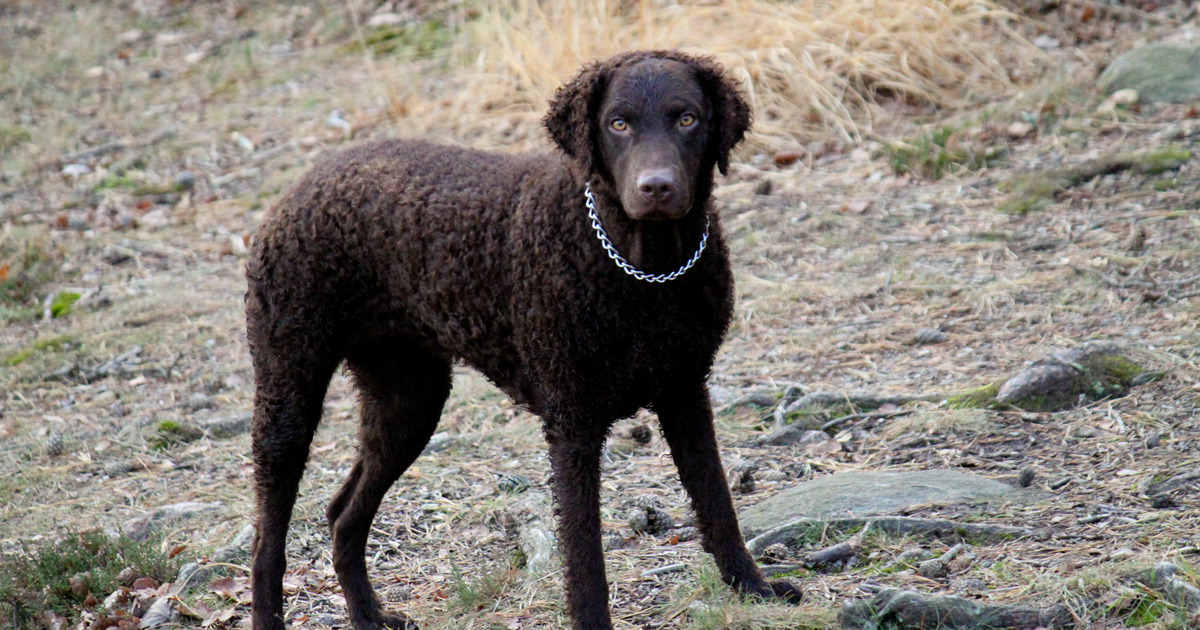
Photo: Mattias Agar / Wikimedia Commons, CC BY-SA 2.0
- A vulnerable native breed with two recessive collapse genes
- What the debranching enzyme actually does
- What the natural history looks like — and why it is a blood test, not a story
- The US route: the breed club already runs a screening programme
- The UK route: the Kennel Club records EIC for this breed — but not GSD IIIa
- What it costs, and where the swab actually goes
- Two timing decisions that are easy to get wrong
- What a carrier result means in a breed this small
- If the diagnosis is confirmed
- Frequently asked questions
- References
- How to get your pet tested
A vulnerable native breed with two recessive collapse genes


The Curly-Coated Retriever sits on the UK Kennel Club’s list of vulnerable British and Irish native breeds. The threshold for that list is blunt: 300 or fewer puppy registrations in the UK in the previous year, a bar that 35 breeds fell below in 2024. Small registration numbers mean a small breeding population, and a small breeding population is exactly the condition under which a single recessive variant can reach a meaningful frequency without anyone noticing.
That is the background against which two facts about this breed should be read together:
- DNM1 — exercise-induced collapse (EIC). The classic retriever collapse variant, and the first thing most owners and vets reach for.
- AGL — GSD IIIa. A metabolic disease whose presenting complaint in Gregory et al. (2007) was, in the authors’ own words, “episodic exercise intolerance, collapse, and lethargy”.
Read those two descriptions cold and they are almost the same sentence. The history alone will not separate them. That is why this article exists — not to replace the EIC test, but to say what to do when the EIC result comes back clear and the dog keeps going down.
What the debranching enzyme actually does
SamSo the dog stores sugar but cannot use it? Elena MarshAlmost. It can strip the outer branches, then stops dead at the branch points, so most of the fuel stays locked in.Glycogen is not a simple chain. It is a tree, with branch points roughly every ten glucose units. Releasing glucose from it takes two enzymes working in relay: phosphorylase chews down the straight outer chains, and then the debranching enzyme — the product of AGL — has to move and cut the branch before phosphorylase can continue.
In GSD IIIa that second enzyme is absent. The dog can strip the outer twigs of every glycogen tree and then stops. Gregory’s team measured exactly this: debranching activity was undetectable in both liver and skeletal muscle, and the glycogen that accumulated had “absent or short outer chains” — chewed-down stumps that cannot be taken any further. The fuel is present, in large amounts, and unavailable.
That explains the two organs that suffer. The liver fills with unusable glycogen and leaks enzymes. Skeletal muscle, which needs glycogen precisely during sustained work, runs out mid-effort. The “a” in IIIa means both liver and muscle are involved; in the human disease, type IIIb spares muscle.
What the natural history looks like — and why it is a blood test, not a story
SamIs there anything a vet can see before the dog is obviously ill? Elena MarshYes. Liver enzymes climb from puppyhood, and muscle enzyme follows about a year later. That order is the clue.Yi et al. (2012, Disease Models & Mechanisms 5:804-811) followed eight affected Curly-Coated Retrievers with monthly blood chemistry from 2 to 16 months of age. The pattern they recorded is the single most useful clinical fact in this whole article:
- ALT, AST and ALP were already elevated and rose steadily across the follow-up period.
- CPK (creatine phosphokinase, the muscle enzyme) only exceeded the normal range after 12 months.
- Biopsies at 4, 12 and 16 months showed abnormally high glycogen content in liver and muscle in every dog.
Now compare that with EIC. A dog with the DNM1 variant is metabolically normal between episodes; its routine chemistry panel is unremarkable. A young Curly with a persistently raised ALT that nobody can explain is not a typical EIC dog. That is the discriminator — an ordinary in-house biochemistry panel, run when the dog is well rather than when it is collapsed.
This also reframes what a raised ALT means in this breed. In a young sporting dog it is easy to write off as post-exercise muscle leakage or a transient insult. In a Curly-Coated Retriever, “unexplained and persistent” deserves a different response than “unexplained and transient”.
The US route: the breed club already runs a screening programme
SamIs anyone in the US actually organising this, or am I on my own? Elena MarshThe breed club runs it. The screening goes to the same Michigan State lab that published the variant.American owners have an unusually direct path, because the Curly-Coated Retriever Club of America (CCRCA) maintains a dedicated GSD IIIa screening programme and publishes the protocol on its health page. The samples go to Dr John C. Fyfe’s Laboratory of Comparative Medical Genetics at Michigan State University — the co-author of the 2007 paper — and the club spells out exactly what to send:
- Two cheek brush samples, a five-generation pedigree, and a cheque made out to Michigan State University for USD 85.00.
- If you need the brushes supplied, make the cheque out for USD 90.00; it is cashed when the brushes come back.
- Frozen semen from deceased dogs and blood samples can also be screened — contact the CCRCA Health Committee for instructions.
The club’s own guidance on who to test is worth quoting in substance, because it is more efficient than blanket testing: if both sire and dam are clear, there is no need to test the offspring; if either parent is a carrier, all offspring should be tested so carriers can be identified before the next generation. That is a screening cascade, not a panel purchase.
Separately, the CCRCA sets the breed’s criteria for the CHIC database, run jointly by the OFA and the AKC Canine Health Foundation. Note what a CHIC number does and does not tell you: it certifies that the breed-required tests were performed and the results made public — not that the results were normal. When a US breeder gives you a CHIC number, the number is a pointer to the OFA record; read the record.
The UK route: the Kennel Club records EIC for this breed — but not GSD IIIa
SamMy breeder showed me a Kennel Club record with an EIC result on it. Is that the whole picture? Elena MarshNo. The Kennel Club runs an official scheme for EIC in this breed. There is no equivalent scheme for the AGL variant.This is the single most useful thing a UK owner can know, and it is easy to get wrong. On 4 May 2023 the Kennel Club approved an official DNA test recording scheme for Exercise-Induced Collapse in Curly Coated Retrievers, after consultation with the breed health co-ordinator. Because EIC behaves differently in this breed than in Labradors and Clumber Spaniels — environmental and additional genetic factors influence whether an affected dog shows signs — results are recorded as EIC_IncP in three risk classes:
- Minimal risk (0) — no copies of the variant
- Minimal risk (1) — one copy
- Increased risk (2) — two copies, elevated risk of disease
Because the result is a measure of risk rather than a certainty, the Kennel Club cannot assign progeny as “hereditary clear” for this test — only individual dogs’ own results are published. You can look up any KC-registered dog’s records through the Health Test Results Finder using its registered name or stud book number.
What follows from that is the trap. A Curly’s KC record can legitimately show an EIC result and say nothing whatsoever about AGL, because there is no Kennel Club recording scheme for GSD IIIa in this breed. A dog that looks “health tested” on the Finder may have an entirely unknown GSD IIIa status. For that one, you need the laboratory certificate itself.
What it costs, and where the swab actually goes
SamHow much, and does the lab have to be in my own country? Elena MarshIt does not. This is a posted cheek swab, and the useful options sit in three different countries.Prices as published by the laboratories:
- Michigan State University (East Lansing, MI, USA) — USD 85 via the CCRCA protocol above, or USD 90 including brushes. Payment by cheque to the university.
- Laboklin UK — Glycogen Storage Disease (GSDIIIa), test 8156, £48.00. EIC is test 8152 at £66.00, and the Curly Coated Retriever DNA bundle (8817) is £138.00 incl. VAT, covering DM (exon 2), EIC, cord1-PRA and GSD IIIa. For a UK owner who wants both collapse genes plus the eye test, the bundle is the obvious route.
- Genomia (Pilsen, Czech Republic) — USD 56 excluding VAT, usual turnaround 12 business days, swab kits supplied, owner-orderable.
- CombiBreed (VHL, Netherlands) — EUR 47.50, listed specifically as “GSD IIIa — Curly Coated Retriever”.
- LabGenVet (Quebec, Canada) — mail-in; confirm sample type and international shipping with the lab.
- Embark — included in the breed-and-health panel rather than sold standalone, which suits owners who also want a DNM1 result from the same swab.
Practicalities that catch people out. Dry cheek brushes post fine; they are not a biological hazard and do not need cold chain, but a lab outside your own country will tell you how it wants the outer packet described — follow its wording rather than inventing your own. Since Brexit, a swab posted from Great Britain to an EU lab needs a customs declaration; for the same reason a UK owner will usually find Laboklin UK simpler than a continental lab, even where the headline price is similar. US owners posting to MSU should remember the five-generation pedigree is part of the submission, not an optional extra.
Order both collapse tests together. If you are paying for a swab and postage anyway, running DNM1 and AGL at once removes the sequential-testing trap in which a clear EIC result is read as “not genetic” and the search stops. The Laboklin UK bundle does this in one order.
One caution when you order. Some catalogues list a GSD IIIa test under other retriever breeds. The characterised, published variant is the Curly-Coated Retriever one; a test run under a different breed heading may or may not be interrogating the same position. Specify “Curly-Coated Retriever, GSD IIIa, AGL c.4223del” on the order.
Two timing decisions that are easy to get wrong
SamIs there any reason not to just wait until something goes wrong? Elena MarshYes — insurance. Once a raised liver enzyme is in the clinical history, most policies treat it as pre-existing.Insurance first. In the UK, the lifetime policies that owners buy for exactly this kind of chronic condition are underwritten on the clinical history at the point the cover starts. An unexplained raised ALT noted in the record before the policy begins is the kind of entry that gets excluded afterwards, and the same principle applies to most US policies. Read your own policy wording before the first work-up, not after it — the sequence in which the investigation and the cover happen can matter more than the price of either.
Referral second. The blood picture that separates GSD IIIa from EIC — a persistently raised ALT in a young, well dog — is one a first-opinion practice can generate in-house, but interpreting it alongside a collapse history is internal medicine. In the UK that means asking your practice about referral to an RCVS Specialist in Small Animal Medicine; in the US, an ACVIM diplomate or a veterinary teaching hospital. Neither route needs the DNA result first; the DNA result makes the referral conversation much shorter.
Finally, a note on when this surfaces. Curlies are worked, and the collapse tends to be noticed in the field — during gundog working tests and shooting-season work in the UK, or hunt tests in the US. That is precisely the season in which “he just got tired” is the most available explanation and the least useful one. If it happens twice, run the bloods before the next outing.
What a carrier result means in a breed this small
SamIf my bitch is a carrier, is she out of the gene pool? Elena MarshNo. In a breed under 300 puppies a year, removing carriers wholesale costs more health than the variant does.Carriers are clinically normal for life. The only mating that can produce an affected puppy is carrier to carrier, and that mating gives an expected 1 in 4 affected, 2 in 4 carriers, 1 in 4 clear. Pair a carrier with a tested-clear partner and no affected puppy is possible — every pup is clear or a carrier, and all are healthy.
That distinction matters more here than in a numerous breed. The vulnerable-breed threshold of 300 registrations describes a population in which every excluded dog is a measurable fraction of the available genetic diversity. Culling carriers from a breed this small trades a known, avoidable recessive for an unknown, unavoidable loss of diversity. The operational rule is simply: know the status, and never double up.
The same logic applies to DNM1. A Curly can be a carrier of one, both, or neither; the two genes assort independently, and a clear result on one says nothing at all about the other.
If the diagnosis is confirmed
SamThere is no cure, is there? So what does a diagnosis change? Elena MarshIt changes the exercise plan, the feeding plan and the monitoring plan — and it stops the search for a cause.There is no established curative treatment. Management is supportive and follows the metabolism: because the dog cannot mobilise stored glycogen, it depends on a steadier supply of glucose from the gut and on not being asked for the kind of sustained output that a retriever is bred to give. Feeding frequency and exercise limits are decisions for your veterinarian, made with the dog’s own chemistry panel in front of them.
Research is active but preclinical. A review of large-animal models for glycogen storage disease places the Curly-Coated Retriever alongside the GSD Ia dog as one of the naturally occurring models used to test therapies for the corresponding human disease — including a 2014 study of rapamycin in this exact canine model. That is a real reason for the breed’s registry to keep testing: the pedigree data is worth something beyond the individual dog.
And the mundane value stands. A confirmed diagnosis ends the cycle of repeat work-ups, gives the owner a reason for the exercise restriction that is otherwise hard to accept in a working breed, and settles the status of both parents and every littermate at a stroke.
Frequently asked questions
Q. My Curly tested clear for EIC. Does that rule out a genetic cause of collapse?
No. DNM1 and AGL are different genes on different chromosomes and a clear result on one carries no information about the other. If collapse continues after a clear EIC result — particularly with a persistently raised ALT — the published GSD IIIa progression data is the reason to ask about AGL.
Q. How common is the variant in the breed?
No breed-wide carrier frequency has been published. What is documented is that Gregory et al. (2007) identified carriers in the United States, New Zealand, Australia and Finland once the DNA test existed — that is, the variant was already distributed across the international population, not confined to one kennel. Absence of a published frequency is not evidence of rarity.
Q. Can I order “a GSD test” and be done?
No. GSD is a family name, not a disease. Type Ia is G6PC1, type IIIa is AGL, type IV is GBE1, type II (Pompe) is GAA — different genes, different organs, different ages of onset. A panel that reports “GSD” without naming the type and gene is not answering the question you asked.
Q. At what age can the test be run?
Any age. It reads DNA, not enzyme activity or blood chemistry, so a cheek swab from an eight-week-old puppy gives the same answer as one from a ten-year-old dog. For breeding decisions the useful time to test is before the mating, not after the litter.
References
- Gregory BL, Shelton GD, Bali DS, Chen YT, Fyfe JC (2007) Glycogen storage disease type IIIa in curly-coated retrievers. Journal of Veterinary Internal Medicine 21(1):40-46.
- Yi H, Thurberg BL, Curtis S, et al. (2012) Characterization of a canine model of glycogen storage disease type IIIa. Disease Models & Mechanisms 5(6):804-811.
- OMIA:001577-9615 — Glycogen storage disease IIIa in Canis lupus familiaris (variant NM_001048096.1:c.4223del, p.K1408Sfs*6).
- Large animal models and new therapies for glycogen storage disease (review of naturally occurring canine models, including the Curly-Coated Retriever).
- Kishnani PS, Bao Y, Wu JY, et al. (2001) Canine model and genomic structural organization of glycogen storage disease type Ia (GSD Ia). Pediatric Research 49(4):518-525.
- The Kennel Club — Vulnerable British and Irish Breeds (300-registration threshold; 35 breeds in 2024).
- Curly-Coated Retriever Club of America — Health: GSD IIIa screening protocol (Michigan State University, USD 85/90, two cheek brushes + five-generation pedigree) and CHIC criteria.
- The Kennel Club — New DNA test for Curly Coated Retrievers (EIC recording scheme approved 4 May 2023; EIC_IncP risk classes).
- The Royal Kennel Club — Health Test Results Finder (look up a registered dog’s DNA and screening records).
- OFA — CHIC Program (a CHIC number certifies that the required tests were done and published, not that results were normal).
- Laboklin UK — DNA tests for the Curly Coated Retriever (GSDIIIa test 8156 £48.00; breed bundle 8817 £138.00 incl VAT).
- Genomia — GSD IIIa test for the Curly Coated Retriever (AGL c.4223delA, price and turnaround).
- CombiBreed — Glycogen Storage Disease IIIa (GSD IIIa), Curly Coated Retriever.
- LabGenVet — Glycogen Storage Disease Type IIIa (breed and variant listing).
- Embark — Glycogen Storage Disease Type IIIA condition page.
How to get your pet tested
The services below let you explore your pet’s breed ancestry, coat and body traits at home. These reveal tendencies and ancestry — they are not a medical diagnosis.
Below is where Glycogen storage disease (GSD) can be tested, grouped by where you live and marked by whether each service explicitly lists this variant (✅ = listed / ❓ = unverified / ❌ = not offered).
In the United States
In the United Kingdom
In India
Elsewhere
Note: even if the kit can be purchased/shipped internationally, the service itself (sample return, analysis, results) is not guaranteed in your country. Check each service’s stated service area and sample-return method before ordering.
Services offered in other regions (may not be available where you live)
Worried about your pet’s health? — Talk to a veterinarian
A confirmed diagnosis and any treatment plan are decisions for a veterinarian, not a test kit. The links below are professional resources.
AVMA — Find a veterinarian (American Veterinary Medical Association)
This section contains advertising (affiliate links); we may earn a commission if you buy through them. As an Amazon Associate, we earn from qualifying purchases. Genetic tests do not guarantee the prevention, diagnosis, or treatment of any disease — results indicate tendencies and provide information only.
This page is educational information, not veterinary diagnosis or advice. Always consult a veterinarian about your pet’s health.
About the author
Elena Marsh
Editor & writer (not a veterinarian)
A writer with a molecular-biology background and a lifelong dog and cat owner. Not a veterinarian — she translates peer-reviewed genetics research and primary data into plain language, always as information rather than diagnosis.