

Bottom line: The Toyger appears on the PK deficiency testing lists of UC Davis and Langford (University of Bristol), but almost no Toyger-specific frequency data exists. The landmark 14,179-cat survey by Grahn et al. (2012) contains no Toygers at all, and a 2022 analysis of 11,036 commercially tested cats found the variant in one of 13 Toygers — too few cats to estimate any rate. The breed is listed because of its Bengal ancestry, not because Toyger frequency was measured. In the UK, the GCCF’s Toyger registration policy makes an N/N result for both PKDef and Bengal PRA the gate to its Active (breeding) Register; in the US there is no equivalent registry rule. A DNA result is risk information, not a diagnosis — if your cat seems weak, pale or unwell, take that to your veterinarian.
- The evidence ledger: what research actually holds on Toygers
- Why a breed with so little data is on the list: the Bengal in the foundation
- Six reference sources, two answers on whether Toyger is “a PK breed”
- The disease in one paragraph — and what is known only from other breeds
- Reading the certificate: N/N, N/K, K/K and what each does not tell you
- United Kingdom: the strictest PKDef rule for Toygers is a registry rule, not a law
- United States: no registry gate, so the questions fall to you
- Insurance on both sides of the Atlantic: enroll before anything is noted
- If something seems wrong: the route to a veterinary answer
- Frequently asked questions
- References
- How to get your pet tested
The evidence ledger: what research actually holds on Toygers
Start with the largest feline study of this mutation. Grahn, Grahn, Penedo, Helps and Lyons (2012, BMC Veterinary Research 8:207) genotyped 14,179 cats representing 38 breeds, using samples submitted to the Veterinary Genetics Laboratory at UC Davis and to Langford at the University of Bristol.
The Toyger does not appear in any of its frequency tables — not as a low number, not as a zero. It simply was not sampled as a breed, so any “Toyger carrier rate from the UC Davis study” is quoting something that does not exist.
The only Toyger figure we could confirm comes from a different kind of source. Anderson and colleagues (2022, PLOS Genetics 18(6):e1009804) analysed results from 11,036 domestic cats that had gone through a commercial DNA panel. In their table of breeds where the PK variant turned up beyond the classically known ones, the Toyger entry reads 1/13: one cat carrying the variant among 13 cats recorded as Toygers.
Three things limit that figure:
- Thirteen cats is a tiny sample. The authors themselves did not attach a percentage to breeds with 15 or fewer animals. Converting 1/13 into a breed percentage would claim a precision the study never offered.
- Who was sampled. Breed came from the owner, backed by registration paperwork (TICA, FIFe, CFA or WCF) according to the authors, but the cats were submitted to commercial DNA panels rather than drawn in a structured breed survey.
- The people who buy panels are not a random sample. Owners who test are a self-selected group, so even a large count would not automatically represent the whole breed.
The same paper adds that for these additional breeds, the clinical manifestation of PK deficiency “has not been documented in the scientific literature.” We could not find a published report of a Toyger with clinically confirmed PK deficiency either.
So the honest ledger is short: zero Toygers in the 2012 survey, one variant-positive cat in 13 in the 2022 panel data, no clinical case reports found. That is neither reassurance nor alarm; it is an evidence gap.
Why a breed with so little data is on the list: the Bengal in the foundation
SamIf nobody measured it in Toygers, why does UC Davis tell me to test? Elena MarshThe lab page does not say why. But the breed’s history and Grahn’s 2012 conclusion point the same way: a Bengal sits in the Toyger foundation, and that paper advised testing breeding programs built from affected breeds.The International Cat Association’s Toyger breed page names the two cats that formed the cornerstone of the breed: a striped domestic shorthair called Scrapmetal and a big-boned Bengal called Millwood Rumpled Spotskin. TICA accepted the Toyger for registration in 1993 and granted championship status in 2007. The GCCF’s own breed profile adds that the breed was developed in the USA by Judy Sugden, daughter of Bengal founder Jean S Mill, and that a street cat from Kashmir, Jammu Blu, was imported in 1993.
Now set that beside the discussion section of Grahn 2012. The authors wrote that breeds derived from Abyssinian crosses “and novel breed development or out-crossing programs using Bengals or other affected breeds should test as well.” The Bengal was one of the breeds in which they found the variant.
So the logic for listing the Toyger is ancestry-based: a founder breed carries the allele, so a breed built partly from it could too. That is a reasonable precaution, but note what it is not. The UC Davis VGL test page (as captured on 29 January 2026) lists the Toyger under “Breeds appropriate for testing,” yet the same page’s separate list of breeds in which the mutation was found at significant frequency in its 38-breed study does not include the Toyger. The lab gives no stated reason for the listing.
It is tempting to borrow the Bengal’s numbers. Grahn 2012 reported a mutant allele frequency of 0.130 in 320 Bengals from an unbiased sample, and 0.1724 among 2,230 Bengals submitted specifically for PK testing. Those are Bengal figures and they cannot be transferred to the Toyger. With one Bengal founder among several lines and decades of selection since, nobody can calculate how much of that frequency, if any, survived into today’s Toygers.
The GCCF breed profile is unusually candid here. It says the Bengal “is the main breed used to develop the Toyger,” so breeders should do the same health screening, including DNA testing for PKDef and Bengal PRA. Then it adds: “anecdotal reports indicate that the incidence of all these conditions is significantly lower than in the Bengal due to the influence of domestic shorthair outcrosses.”
The registry chose the word anecdotal, and it is the right word: there is no survey behind the claim. There is also reason to be cautious about the “diluted by domestic shorthairs” argument. In Grahn 2012, random-bred cats carried the same variant: the allele frequency in 76 random-bred cats was 0.099 in the overall table. A domestic shorthair outcross is therefore not automatically a clean outcross for this particular gene. Whether the Toyger’s frequency today is lower or higher than the Bengal’s is, on present evidence, simply unknown.
Six reference sources, two answers on whether Toyger is “a PK breed”
Published breed lists disagree:
- List the Toyger: UC Davis VGL (breeds appropriate for testing), Langford Vets at the University of Bristol (“What breeds are affected”), and the OMIA database entry for the feline variant, which cites the 2022 panel data as its source for the additional breeds.
- Do not list the Toyger: PennGen at the University of Pennsylvania, LABOKLIN, and Orivet.
Does that mean half the labs cannot test a Toyger? No. In cats, the published research describes one PK variant shared across all affected breeds: an intronic change that Grahn 2012 named c.693+304G>A. OMIA records it under a newer reference coordinate (c.707-53G>A), and PennGen lists it as c.695-53G>A. These are three names for one splice-site change, which deletes 13 bases from the end of exon 5 in processed mRNA and creates a premature stop codon. Because the variant is the same whatever the breed, a lab can genotype a Toyger even if its list omits the name.
PennGen’s page adds one instruction worth following: if you adjust the breed on submission, “note the true breed in the comments—because a normal result only means those specific variants were not found in this patient.” Write “Toyger” there.
The disease in one paragraph — and what is known only from other breeds
Pyruvate kinase catalyses the last step of glycolysis, the red blood cell’s energy pathway. When the red-cell form encoded by PKLR fails, the cells run short of ATP and are destroyed early: hemolytic anemia. Inheritance in cats is autosomal recessive: a cat needs two copies of the variant to be affected, carriers stay healthy, and two carriers mated together are predicted to produce about 25% affected kittens on average, as the UC Davis page puts it.
What does the feline disease look like? Laboratories describe it as milder and more variable than the canine form. LABOKLIN’s cat page states that affected cats “can have a normal life span, only intermittently have anemia,” and PennGen notes that, unlike in dogs, clinical signs may not be noted at all in some cats.
The best-known clinical follow-up — Kohn and Fumi (2008) in Germany — tracked 25 affected Abyssinian and Somali cats; 11 of them showed no signs their owners noticed. That is a reference point for those two breeds, not a Toyger prognosis; no published clinical cohort exists for the Toyger.
Reading the certificate: N/N, N/K, K/K and what each does not tell you
SamThe certificate says “N/K.” Does that mean my cat is going to get sick? Elena MarshNo. On the UC Davis scale, N/K is a carrier: one normal and one variant copy. Carriers are not expected to develop the disease; the result matters mainly if the cat will be bred.The UC Davis VGL reports feline PK results in three categories:
- N/N — no copies of the variant detected.
- N/K — one copy; the cat is a carrier.
- K/K — two copies; per the lab, cats with this genotype “will have PK deficiency,” with the explicit caveat that “severity of symptoms cannot be predicted.”
Other labs use different notation (PennGen reports affected cats as “2-2”; the GCCF writes carriers as N/PKDef), so check the key printed on the report.
Each result has limits. An N/N result covers one variant at one gene; it does not rule out other causes of anemia, which in cats are many. A K/K result is a genetic prediction, not a diagnosis of current illness. And because the clinical picture in “additional” breeds such as the Toyger is undocumented, a K/K Toyger has no breed-specific track record to compare against.
Watch the wording in consumer reports. Wisdom Panel’s UK condition page describes PK deficiency with “High likelihood — At risk cats are highly likely to show signs of this disease in their lifetime.” That is the company’s phrasing; set it beside the Abyssinian/Somali data above, where nearly half the affected cats had no owner-noticed signs. Basepaws’ PK page goes further and suggests most untreated cats require euthanasia by five years of age — a claim that conflicts with PennGen’s description of feline life expectancy as “most often normal.” Neither is a clinical estimate for your cat; a K/K result is a reason to talk to your veterinarian.
United Kingdom: the strictest PKDef rule for Toygers is a registry rule, not a law
SamIs DNA testing for this actually required anywhere, or is it all optional? Elena MarshIn the UK, the GCCF’s published Toyger registration policy ties the breeding register to N/N results for PKDef and Bengal PRA. It is a registry rule rather than statute, but for breeders it has real teeth.The GCCF’s Toyger registration policy (agreed 16 October 2019) says that Toygers registered from June 2016 may be placed on the Active Register — the register whose kittens can themselves be registered — only if one of three conditions is met:
- the cat has been DNA-tested normal (N/N) for both Bengal PRA (BPRA) and PKDef; or
- both parents have been tested N/N; or
- the parents are deemed N/N because cats on every pedigree line in previous generations were tested.
Cats tested as carriers (N/PKDef) go on the Genetic Register instead. The policy “strongly recommended” that homozygous cats are not used for breeding and are neutered, and that carrier-to-carrier matings are avoided because of the 1-in-4 risk. Any Bengal used as an outcross must itself have tested normal for PKDef and PRA. Oriental Shorthair outcrosses need a normal PRA result only, the policy noting there is no evidence that Oriental Shorthairs suffer from either condition.
Two practical details from the same document. First, the approved laboratories are named: Langford Veterinary Services in Bristol and the Veterinary Genetics Laboratory at UC Davis. Second, the cat must be microchipped for its certificate to be valid. A caveat in fairness: the PDF linked from the GCCF’s Toyger page carries a “Proposed … DRAFT” header alongside its 2019 agreed date. We could not confirm whether a later final version exists, so ask the breeder which version their registration followed.
Langford’s own test page adds the step many owners miss: for a cat to go on the GCCF or ICC negative register, the swab or blood sample must be taken by a vet who confirms identity from the microchip, using a dedicated submission form. A home swab answers your own question but does not produce a breeding certificate.
Costs, from Langford’s Cat Genetics Prices 2025/26 (checked 3 October 2026): because GCCF registration needs two tests, the relevant line is the two-test bundle — £53.00 ex VAT / £63.60 inc VAT per cat, or £42.40 ex VAT / £50.88 inc VAT with a breed-society promotional code (members of registered breed societies receive a 20% discount). The vet’s sampling appointment is a separate charge.
How large is the UK population these rules govern? The GCCF’s registration statistics record 13 Toygers in 2025 (rank 36) and 12 in 2024, against 17,464 GCCF registrations overall in 2025; the 2023 report showed 10 in 2023 and 15 in 2022. For comparison, 86 Bengals were registered in 2025. In a population this small, no survey will produce a reliable carrier rate, which is why testing individual breeding cats carries the weight. The GCCF has recognised the Toyger since 2015.
The law itself is quieter. Under England’s Animal Welfare (Licensing of Activities Involving Animals) (England) Regulations 2018, the breeding-licence schedule (Schedule 6) applies to breeding dogs. Cats appear only under Schedule 3, selling animals as pets, for licensed sellers: animals must be in good health, an animal with a condition likely to affect its quality of life must not be offered, and kittens under 8 weeks may not be sold. No statute requires a Toyger breeder to DNA-test. The CFSG Code of Practice on Cat Breeding asks breeders to use available DNA tests and store results against each cat’s microchip, but it is a voluntary code. Separately, the Microchipping of Cats and Dogs (England) Regulations 2023 made cat microchipping compulsory from 10 June 2024, giving every certificate a chip number to match.
United States: no registry gate, so the questions fall to you
The American picture starts with the registries. According to the World Cat Congress breed comparison, the Toyger is recognised by TICA, ACF, GCCF and NZCF, but not by the CFA, FIFe or WCF. In practice, a US Toyger is a TICA cat. We found no US breed-club or TICA document that requires or recommends PKDef testing for Toygers, and TICA’s site could not be accessed to check its standard this round. US registration counts for the breed could not be confirmed.
Testing options available to US owners, with prices checked on 3 October 2026 (US dollars, no tax shown):
- PennGen (University of Pennsylvania): $75 for the DNA test, using cheek brushes or swabs or EDTA blood. PennGen does not supply kits, and Toyger is not on its listed breeds — note the true breed in the comments.
- Orivet: $60 for its feline PK test; Toyger is not among its associated breeds.
- UC Davis VGL: lists Toyger and is one of the two GCCF-approved labs. Its live page was not accessible when we checked, so we could not confirm the current price or turnaround.
- Basepaws Breed + Health Cat DNA Test: $103.99 on sale (from $159.00), which its PK page says screens for PK deficiency among other markers. Sale prices change frequently.
Without a registry gate, purchase law is the other lever, and it varies by state. Florida Statutes §828.29 covers cats: if, within one year of sale, a licensed veterinarian of the buyer’s choosing certifies the animal unfit for purchase due to a congenital or hereditary disorder that adversely affects its health, the pet dealer must offer a refund on return, an exchange, or reimbursement of reasonable veterinary costs. Two conditions limit this. A “pet dealer” means someone selling more than three litters or 30 dogs or cats per year, whichever is greater — so a small hobby cattery may fall outside it (our inference, not a legal ruling). And the remedy does not apply to a disorder the dealer disclosed in writing at the time of sale, where the buyer signed a notification that a veterinarian had examined the animal and identified that disorder. The statute also requires the dealer to provide copies of tests done before sale — ask for the PKDef certificate.
New York General Business Law §753 also covers cats: 14 business days for illness and 180 calendar days for a congenital malformation, with refund, exchange or veterinary reimbursement (capped at the purchase price) as remedies. The statute does not address whether an affected but symptom-free kitten counts under either heading.
Insurance on both sides of the Atlantic: enroll before anything is noted
In the US, the NAIC Pet Insurance Model Act (2022) gives a shared vocabulary. It defines a “hereditary disorder” as an abnormality genetically transmitted from parent to offspring that may cause illness, and a “preexisting condition” as one for which, before the policy’s effective date or during a waiting period, a veterinarian gave medical advice, the pet received treatment, or the pet showed related signs. It caps illness waiting periods at 30 days, prohibits accident waiting periods, requires insurers to disclose whether they exclude hereditary disorders, and provides a 15-day free look. It is a model law that applies only where a state enacts it; we could not confirm which states have.
Among individual insurers, Embrace covers hereditary and congenital conditions “when not pre-existing at the time of enrollment,” treats anything noted by you or your vet before the waiting period ends as pre-existing, and allows only curable conditions to return to cover after 12 months free of symptoms and treatment. Our inference (not the insurer’s statement): a lifelong genetic condition would not qualify for that curable route, so enrolling before any blood-work abnormality is noted is the safer sequence. Ask any insurer in writing how it treats a DNA result alone.
In the UK, the GCCF endorses Agria (the GCCF is an Introducer Appointed Representative of Agria, a commercial tie worth knowing). According to the GCCF’s kitten insurance page for breeders, registered breeders can issue five weeks of free kitten cover with vet-fee cover up to £5,000, and Agria’s lifetime policies offer up to £20,000 of vet fees each year. We could not retrieve Agria’s own policy wording on hereditary conditions, so we cannot say how it handles a PKDef result; converting the free cover to a lifetime policy before any anemia is recorded mirrors the US advice.
If something seems wrong: the route to a veterinary answer
SamMy cat has had a couple of tired, off days. Should I order a DNA test first? Elena MarshSee your vet first. The 2022 panel study stresses that cats genetically at risk who show symptoms still need clinical examination to confirm the variant’s effect — a swab cannot explain today’s symptoms.Anemia in cats has many causes, and a vet will normally begin with an examination and blood work before any genetic question. Bring the breeder’s certificate, both parents’ results if you have them, the lab’s name and report key, and any consumer panel report — but do not let a panel substitute for the clinical work-up.
In the US, if your general-practice vet wants a second opinion on unexplained anemia, board-certified internists in the specialties of the American College of Veterinary Internal Medicine can be searched on VetSpecialists.com. PennGen also invites contact for consultation when a cat tests affected.
In the UK, owners cannot book specialist hospitals directly. The Langford Vets Small Animal Referral Hospital on the University of Bristol campus — the same institution that runs the PKDef test — accepts appointments only on referral from your usual practice, and takes emergency referrals 24 hours a day.
The most useful habit is simple: ask for parents’ certificates before buying, and treat “on the list” and “measured in the breed” as two different statements. For the Toyger, only the first is currently true.
Frequently asked questions
Q. What percentage of Toygers carry the PK deficiency variant?
Nobody knows. The 2012 survey of 14,179 cats included no Toygers, and the 2022 commercial panel data recorded one variant-positive cat among 13 Toygers — too small a sample to convert into a percentage. Do not substitute Bengal figures; they come from a different breed.
Q. If my Toyger is N/N, does that mean it cannot have anemia?
No. An N/N result means the known feline PK variant was not detected. Cats can become anemic for many other reasons, so any signs of illness should still be assessed by your veterinarian.
Q. My kitten is a carrier (N/K or N/PKDef). Is it unhealthy?
Carriers have one normal copy and are not expected to develop the disease. The result matters for breeding: under the GCCF’s Toyger policy, carriers are placed on the Genetic Register rather than the Active Register.
Q. Can I use a lab that does not list Toyger as a breed?
The feline variant is the same across breeds, so a lab can genotype a Toyger even if its list omits the name. If a form forces you to choose a listed breed, note “Toyger” in the comments, as PennGen advises. For GCCF registration, use one of the two approved labs (Langford or UC Davis VGL) with a vet-taken, microchip-verified sample.
Q. My Toyger tested K/K but seems perfectly healthy. What now?
Book a conversation with your veterinarian rather than acting on the result alone. UC Davis states that severity cannot be predicted from the genotype, and clinical disease in Toygers has not been documented in the literature. Your vet can decide whether monitoring is appropriate; the GCCF policy also recommends that homozygous cats are not bred.
Q. Does the breeder have to tell me the PK status?
It depends on where you are. In England there is no statutory DNA-testing requirement for cat breeders; the GCCF registration policy is the main rule. In Florida, pet dealers covered by §828.29 must give copies of tests done before sale. Whatever the law, asking for both parents’ certificates in writing is reasonable.
References
- Grahn RA, Grahn JC, Penedo MCT, Helps CR, Lyons LA (2012). Erythrocyte pyruvate kinase deficiency mutation identified in multiple breeds of domestic cats. BMC Veterinary Research 8:207.
- Anderson H, Davison S, Lytle KM, Honkanen L, Freyer J, Mathlin J, Kyöstilä K, Inman L, Louviere A, Chodroff Foran R, Forman OP, Lohi H, Donner J (2022). Genetic epidemiology of blood type, disease and trait variants, and genome-wide genetic diversity in over 11,000 domestic cats. PLOS Genetics 18(6):e1009804.
- Kohn B, Fumi C (2008). Clinical course of pyruvate kinase deficiency in Abyssinian and Somali cats. Journal of Feline Medicine and Surgery 10(2):145-153.
- OMIA 000844-9685: Pyruvate kinase deficiency of erythrocyte in Felis catus (cat). Online Mendelian Inheritance in Animals (accessed 2026-10-03).
- UC Davis Veterinary Genetics Laboratory. Erythrocyte Pyruvate Kinase Deficiency (PK Deficiency) — Cat. (live 403; Wayback snapshot 2026-01-29)
- Langford Vets (University of Bristol) Molecular Diagnostic Unit. Pyruvate Kinase Deficiency (cat genetic test) (accessed 2026-10-03).
- LABOKLIN. Pyruvate kinase deficiency (PK) — Cat (Service ID 8047) / Dog (Service ID 8015) (accessed 2026-10-03).
- PennGen, University of Pennsylvania School of Veterinary Medicine. Pyruvate Kinase (PK) Deficiency (test id 30) (accessed 2026-10-03).
- The International Cat Association (TICA). Toyger breed page (Wayback snapshot 2026-04-30).
- Governing Council of the Cat Fancy (GCCF). Registration Policy for Toyger Cats (agreed 16 October 2019; document headed “Proposed … DRAFT”) (accessed 2026-10-03).
- GCCF. Toyger breed profile (accessed 2026-10-03).
- GCCF. Registered Cats by Breed 2024-2025 (accessed 2026-10-03).
- Langford Vets. Cat Genetics Prices 2025/26 (accessed 2026-10-03).
- Orivet. Pyruvate Kinase Deficiency (Feline) (accessed 2026-10-03).
- World Cat Congress. Toyger breed recognition comparison (accessed 2026-10-03).
- The Cat Group / CFSG. Code of Practice on Cat Breeding (accessed 2026-10-03).
- The Animal Welfare (Licensing of Activities Involving Animals) (England) Regulations 2018, Schedule 3 — selling animals as pets.
- The Animal Welfare (Licensing of Activities Involving Animals) (England) Regulations 2018, Schedule 6 — breeding dogs.
- The Microchipping of Cats and Dogs (England) Regulations 2023 (SI 2023/468), explanatory note.
- Florida Statutes §828.29 — Dogs and cats transported or offered for sale.
- New York General Business Law §753 — Sale of dogs and cats; consumer remedies.
- National Association of Insurance Commissioners. Pet Insurance Model Act (MO-633, 2022).
- Embrace Pet Insurance. Coverage (accessed 2026-10-03).
- GCCF. Kitten insurance for breeders (accessed 2026-10-03).
- GCCF. Registered Cats by Breed 2023 (accessed 2026-10-03).
- GCCF. Agria Pet Insurance for cat owners (accessed 2026-10-03).
- VetSpecialists.com (ACVIM). Find a specialist.
- Langford Vets Small Animal Referral Hospital (accessed 2026-10-03).
- Basepaws. Pyruvate Kinase (PK) Deficiency (accessed 2026-10-03).
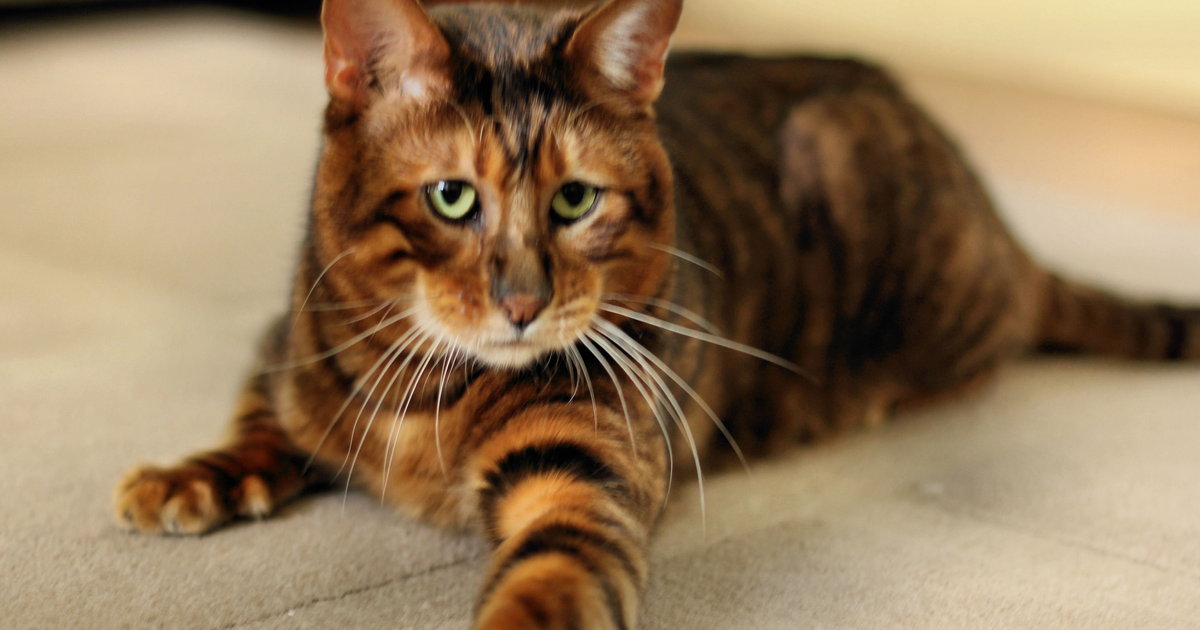
Photo: Gaynorjl, CC BY-SA 3.0, via Wikimedia Commons.
How to get your pet tested
Some pet DNA tests screen for hereditary-disease carrier status or genetic risk markers, but the results are information, not a diagnosis. If your pet has symptoms or you need a confirmed diagnosis, please consult your veterinarian.
Below is where PK deficiency in cats (PKLR) can be tested, grouped by where you live and marked by whether each service explicitly lists this variant (✅ = listed / ❓ = unverified / ❌ = not offered).
In the United States
In the United Kingdom
In India
We could not verify a service in this region that explicitly lists this variant. Please ask your veterinarian.
Elsewhere
Note: even if the kit can be purchased/shipped internationally, the service itself (sample return, analysis, results) is not guaranteed in your country. Check each service’s stated service area and sample-return method before ordering.
Services offered in other regions (may not be available where you live)
Worried about your pet’s health? — Talk to a veterinarian
A confirmed diagnosis and any treatment plan are decisions for a veterinarian, not a test kit. The links below are professional resources.
AVMA — Find a veterinarian (American Veterinary Medical Association)
This section contains advertising (affiliate links); we may earn a commission if you buy through them. As an Amazon Associate, we earn from qualifying purchases. Genetic tests do not guarantee the prevention, diagnosis, or treatment of any disease — results indicate tendencies and provide information only.
This page is educational information, not veterinary diagnosis or advice. Always consult a veterinarian about your pet’s health.
About the author
Elena Marsh
Editor & writer (not a veterinarian)
A writer with a molecular-biology background and a lifelong dog and cat owner. Not a veterinarian — she translates peer-reviewed genetics research and primary data into plain language, always as information rather than diagnosis.