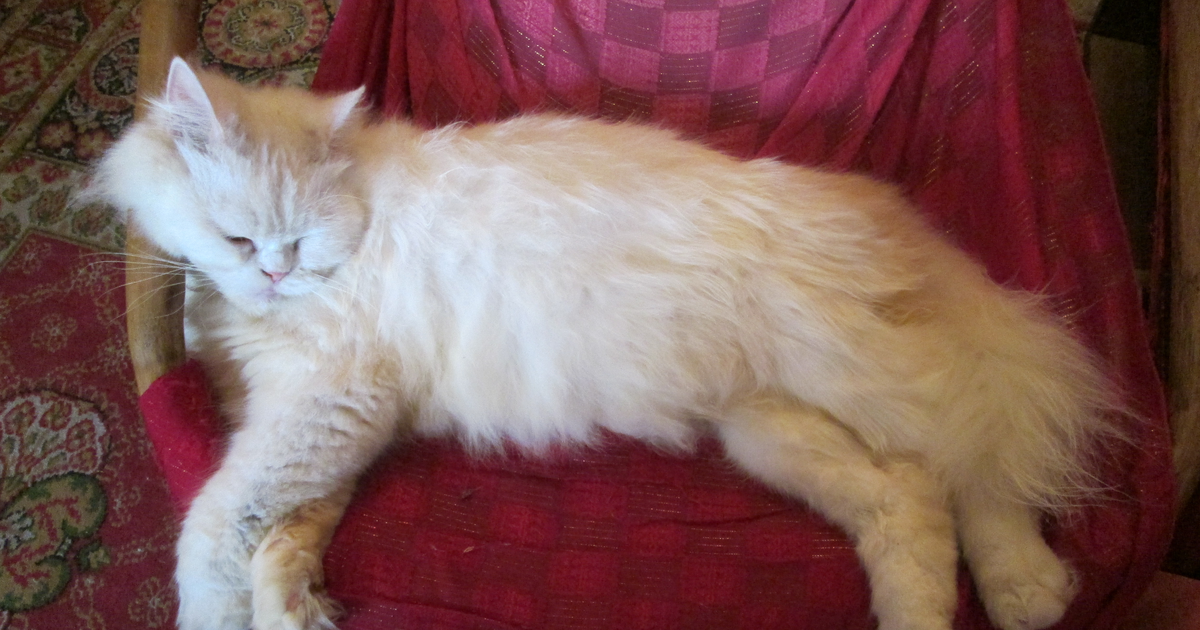
The short answer: The Persian is one of the most popular cats in the US (CFA reports it among the top breeds, ranking #4 in 2024), and polycystic kidney disease (PKD) is a common inherited kidney condition in Persians and Persian-derived breeds. Research reports it is caused by a mutation in the PKD1 gene (Lyons et al. 2004) and is inherited in an autosomal dominant pattern — one copy is enough, and historically about 38% of Persians have been reported to carry it. Because the mutation is dominant, a positive DNA result means the cat carries it and will very likely form fluid-filled kidney cysts over time, though the severity and speed of progression vary a great deal. A DNA test is one-time genetic information; it is not a clinical diagnosis. Ultrasound and kidney-function tests performed by a veterinarian assess the actual kidneys and guide monitoring and care such as diet, hydration, and follow-up. It is not a substitute for veterinary diagnosis.
What PKD and the PKD1 Gene Are


Polycystic kidney disease is a condition in which small, fluid-filled sacs called cysts form and grow within the kidneys. Over time these cysts can enlarge and multiply, gradually crowding out and replacing healthy kidney tissue. In cats, the disease is strongly associated with a specific inherited change in the DNA.
Research reports that feline PKD is caused by a single mutation in the PKD1 gene, which was identified by Lyons and colleagues in 2004. Because the underlying cause is genetic, a laboratory can look directly at a cat’s DNA to determine whether it carries this known variant, independent of whether cysts have yet appeared.
The Persian and PKD1
SamMy neighbor has a British Shorthair — could this even apply to a cat that isn’t a Persian? Elena MarshYes — because breeds like the British Shorthair and Himalayan share Persian ancestry, the same PKD1 variant can be carried in those lines too.PKD is particularly associated with the Persian breed. Research has historically reported that around 38% of Persians carry the PKD1 mutation, making it one of the most widespread inherited conditions in the breed and a key reason responsible breeders screen their cats.
Because many modern breeds were developed using Persian lines, the same mutation can appear in Persian-derived breeds. These include the Exotic Shorthair, British Shorthair, Scottish Fold, and Himalayan, so testing is relevant well beyond the Persian itself.
Why PKD Matters
SamIf the cysts grow so slowly, does that mean there’s plenty of time to act? Elena MarshOften there is monitoring time, since progression can take years — but because it can advance to chronic kidney disease, ultrasound and regular veterinary checks help track it early.PKD matters because it is progressive. The cysts typically enlarge slowly over a period of years, and as they replace functioning kidney tissue they can lead to chronic kidney disease and eventually kidney failure. Signs often become apparent in mid-life, though the timeline varies between individual cats.
This is where veterinary assessment is essential. Ultrasound imaging can detect the actual cysts in the kidneys, and kidney-function tests help a veterinarian judge how well the kidneys are working, which is something a DNA test alone cannot reveal.
Dominant Inheritance
SamA friend from my running club has a Persian and just learned it carries the kidney gene. Elena MarshBecause PKD1 is dominant, that does mean cysts are likely over time (Lyons 2004) — but severity varies a lot, and ultrasound plus veterinary monitoring guide the actual care.PKD1 is inherited as an autosomal dominant trait, which means a single copy of the mutation is enough to cause the disease. This is why the mutation is described as high-penetrance: most cats carrying even one copy go on to develop kidney cysts over time. (Two copies are thought to be embryonic-lethal, so living affected cats carry one copy.)
This differs sharply from recessive traits, where a “carrier” with one copy stays healthy and only cats with two copies are affected. With a dominant condition like PKD, carrying the mutation effectively means being affected — although the age of onset and the severity of disease still vary considerably from cat to cat.
What the DNA Test Can and Cannot Tell
SamSo once I have the DNA result, is that basically the whole picture? Elena MarshIt’s an important piece, but only genetic status — ultrasound and kidney-function tests from a veterinarian are what actually assess the kidneys and guide care.A DNA test for PKD1 tells you the cat’s genetic status: whether it carries this known, well-characterized variant. That information is one-time and stable, useful for understanding risk and for informing responsible breeding decisions. Because PKD is dominant, a positive result strongly indicates that cysts are likely to develop over time.
What the test cannot do is assess the kidneys themselves or predict exactly when or how severely disease will progress. For that, ultrasound and kidney-function tests performed by a veterinarian are needed. The most useful approach pairs the one-time DNA result with ongoing veterinary monitoring so care can be adjusted as the cat ages.
FAQ — Frequently Asked Questions
Q. My Persian looks healthy — should I still consider testing?
A healthy appearance does not rule out PKD, because cysts can grow for years before signs appear. A DNA test reports genetic status at any age, and discussing results with your veterinarian can help decide whether ultrasound monitoring is worthwhile.
Q. If the result is positive, will my cat definitely get kidney failure?
Not necessarily on any fixed timeline. Because PKD1 is dominant, a positive result means cysts are very likely to form over time, but the severity and speed of progression to chronic kidney disease vary widely between cats. Veterinary monitoring is how the actual course is tracked.
Q. Can the cysts be prevented or the gene changed?
No. A DNA test cannot prevent, treat, or cure PKD, and it cannot change the gene. It provides genetic information only. A veterinarian can advise on supportive care such as diet, hydration, and monitoring to help manage kidney health.
Q. Is the DNA result valid for life?
Yes. Genetic status does not change, so a PKD1 result is stable over the cat’s lifetime. The state of the kidneys, however, can change with age, which is why one-time DNA information is best paired with ongoing veterinary checks.
References
- Lyons LA, et al. (2004) Feline polycystic kidney disease mutation identified in PKD1. J Am Soc Nephrol 15(10):2548-2555. https://pubmed.ncbi.nlm.nih.gov/15466259/
- International Cat Care — Polycystic kidney disease (PKD). https://icatcare.org/
- UC Davis Veterinary Genetics Laboratory — Feline PKD1. https://vgl.ucdavis.edu/
- Cat Fanciers’ Association — Most Popular Breeds. https://cfa.org/
How to get your pet tested
Some pet DNA tests screen for hereditary-disease carrier status or genetic risk markers, but the results are information, not a diagnosis. If your pet has symptoms or you need a confirmed diagnosis, please consult your veterinarian.
Below is where PKD (PKD1) can be tested, grouped by where you live and marked by whether each service explicitly lists this variant (✅ = listed / ❓ = unverified / ❌ = not offered).
In the United States
In the United Kingdom
In India
We could not verify a service in this region that explicitly lists this variant. Please ask your veterinarian.
Elsewhere
Note: even if the kit can be purchased/shipped internationally, the service itself (sample return, analysis, results) is not guaranteed in your country. Check each service’s stated service area and sample-return method before ordering.
Services offered in other regions (may not be available where you live)
Worried about your pet’s health? — Talk to a veterinarian
A confirmed diagnosis and any treatment plan are decisions for a veterinarian, not a test kit. The links below are professional resources.
AVMA — Find a veterinarian (American Veterinary Medical Association)
This section contains advertising (affiliate links); we may earn a commission if you buy through them. As an Amazon Associate, we earn from qualifying purchases. Genetic tests do not guarantee the prevention, diagnosis, or treatment of any disease — results indicate tendencies and provide information only.
This page is educational information, not veterinary diagnosis or advice. Always consult a veterinarian about your pet’s health.
About the author
Elena Marsh
Editor & writer (not a veterinarian)
A writer with a molecular-biology background and a lifelong dog and cat owner. Not a veterinarian — she translates peer-reviewed genetics research and primary data into plain language, always as information rather than diagnosis.