The short answer: The Manchester Terrier is a documented, breed-club-active von Willebrand Disease Type 1 (vWD1) breed carrying the VWF variant c.7437G>A. vWD1 shows incomplete penetrance and variable expression, so the genotype does not map cleanly onto bleeding severity — even two-copy dogs are often clinically mild until a surgical or trauma challenge. A DNA test is a genetic risk screen, not a diagnosis: it shows whether the variant is present, not how much von Willebrand factor the dog makes. Tell your veterinarian your dog’s vWD1 status before any surgery or dental procedure.
- What vWD Type 1 and the VWF gene actually are
- Inheritance: why it is not “simple recessive”
- How common vWD1 is in Manchester Terriers — and why the number needs a caveat
- Clear, carrier, affected — what the genotype does and does not say
- What the test can and cannot tell you — and the surgery rule
- FAQ — Frequently Asked Questions
- References
- How to get your pet tested
What vWD Type 1 and the VWF gene actually are


Von Willebrand factor (vWF) does two jobs in clotting. First, it is the “glue” of primary hemostasis — it lets platelets stick to the wall of an injured vessel so a plug can form. Second, it carries and stabilizes clotting Factor VIII. In Type 1 disease, the structure of vWF is normal but the quantity is reduced, which produces a mild-to-moderate bleeding tendency: prolonged bleeding after surgery or injury, nosebleeds, bleeding gums, and easy bruising. Crucially, many Type-1 dogs look completely normal day to day and only bleed abnormally under a challenge such as surgery, dental work, or a spay/neuter. The variant behind it in this breed is VWF c.7437G>A, catalogued as OMIA:001057-9615, with the Manchester Terrier explicitly listed. (Type 2, poor-quality vWF, and Type 3, essentially absent vWF, are more severe and affect other breeds — this article stays on Type 1.) For background, see the Cornell Comparative Coagulation clinical topic on canine von Willebrand disease.
Inheritance: why it is not “simple recessive”
SamSo two copies means the dog will definitely bleed, and one copy is safe? Elena MarshNot that clean — Type 1 has incomplete penetrance and variable expression, and in Dobermans and Kromfohrländer it behaves closer to autosomal dominant (Crespi et al. 2018, PMID 29271313; Segert et al. 2019, PMID 31131110).Labs report three results — clear (N/N), carrier (N/vWF), and affected (vWF/vWF) — but the genotype does not translate directly into how much a dog will bleed. Type 1 shows incomplete penetrance and variable expression: even two-copy “affected” dogs are frequently clinically mild or entirely asymptomatic until a surgical or trauma challenge exposes the deficit. In some breeds the trait behaves closer to autosomal dominant with incomplete penetrance rather than a tidy recessive — this has been documented in Dobermans and Kromfohrländer (Crespi et al. 2018, PMID 29271313; Segert et al. 2019, PMID 31131110). The practical takeaway: read the DNA result as a risk level, not a verdict, and confirm actual bleeding tendency with protein testing rather than assuming it from the number of copies.
How common vWD1 is in Manchester Terriers — and why the number needs a caveat
SamIs this actually common in the breed, or a rare curiosity? Elena MarshTesting-lab data report roughly 37% of tested Manchester Terriers as carriers and about 4% at-risk — but that is a convenience sample of submitted dogs, not a true population survey (Paw Print Genetics/Orivet).Breed-test data from Paw Print Genetics/Orivet report that about 37% of tested Manchester Terriers were carriers and roughly 4% were at-risk/affected among the samples submitted. Read that figure carefully: it is a testing-lab convenience sample — dogs whose owners or breeders chose to screen — not a random survey of every Manchester Terrier. The true population frequency is not established from these numbers. What the data do support is a modest but real conclusion: this is a documented, breed-club-active vWD1 breed (the American Manchester Terrier Club is active, and the breed is AKC-recognized), so the variant is present in the gene pool often enough that pre-surgical awareness is worthwhile — even though the breed itself is niche and sits at a low registration rank, not in any “top-10 popular” tier.
Clear, carrier, affected — what the genotype does and does not say
SamIf a dog tests “affected,” does that mean it’s a bleeder right now? Elena MarshNo — it’s a genotype, not a bleeding measurement; even affected dogs are often clinically mild, which is why a vet uses a vWF:Ag assay and a bleeding-time test (Brooks et al. 2001, PMID 11277201).A DNA result places a dog in one of three genotype buckets, but because of incomplete penetrance those buckets describe risk, not guaranteed clinical status. A “clear” (N/N) dog does not carry c.7437G>A. A “carrier” (N/vWF) has one copy. An “affected” (vWF/vWF) dog has two copies and the highest genetic risk of reduced vWF — yet may still be asymptomatic day to day. What the genotype cannot tell you is how much vWF the dog actually makes or whether it will bleed under challenge. That is measured, not inferred: a veterinarian uses a vWF:Ag protein assay to quantify circulating vWF and a buccal mucosal bleeding time (BMBT) as a functional check, alongside clinical history (Brooks et al. 2001, PMID 11277201; UC Davis VGL vWD Type 1).
| Genotype (result) | What it means | What it does NOT tell you (penetrance caveat) |
|---|---|---|
| Clear (N/N) | No copies of VWF c.7437G>A | Lowest genetic risk for this variant; not a guarantee against every cause of bleeding |
| Carrier (N/vWF) | One copy; can pass it to offspring | Because Type 1 can behave dominantly with incomplete penetrance, discuss vWF:Ag testing before surgery rather than assuming “one copy = safe” |
| Affected / at-risk (vWF/vWF) | Two copies; highest genetic risk of reduced vWF | Does not measure vWF level or predict severity — many are clinically mild/asymptomatic until a surgical or trauma challenge |
What the test can and cannot tell you — and the surgery rule
SamSo what is the test actually good for, then? Elena MarshInformation and surgical planning — the DNA result flags the variant so your vet can order a pre-op vWF:Ag and have plasma or DDAVP ready; the diagnosis of bleeding risk itself is the vet’s, not the swab’s (Cornell; UC Davis VGL).A DNA test for c.7437G>A is a genetic risk screen, not a diagnosis. It tells you only whether the variant is present (0, 1, or 2 copies) — it does not measure how much vWF the dog makes or whether it will bleed. The value of the test is information plus surgical planning, not a health verdict. The single most important action is simple and prominent: tell your veterinarian your dog’s vWD1 status before any surgery or dental procedure. With that knowledge, a vet can order a pre-operative vWF:Ag assay, assess a buccal mucosal bleeding time, and arrange to have plasma or DDAVP on hand should bleeding be prolonged. Diagnosis and bleeding-risk management belong to the veterinarian, using the protein and functional tests described by Cornell and UC Davis VGL — the DNA test complements, and never replaces, that clinical workup.
FAQ — Frequently Asked Questions
Q. My Manchester Terrier tested “affected” (two copies). Is it going to bleed badly?
Not necessarily. Type 1 has incomplete penetrance and variable expression, so even two-copy dogs are frequently clinically mild or asymptomatic until a surgical or trauma challenge. The genotype flags risk; a vet measures actual bleeding tendency with a vWF:Ag assay and a bleeding-time test. This is information, not a diagnosis — discuss it with your veterinarian.
Q. My dog needs a spay/dental soon. What should I do?
Tell your veterinarian your dog’s vWD1 status before the procedure. That lets them run a pre-operative vWF:Ag protein assay, check a buccal mucosal bleeding time, and have plasma or DDAVP available if needed. Surgical, dental, and spay/neuter procedures are exactly the “challenge” moments where Type-1 dogs that look normal can bleed abnormally, so pre-op knowledge matters most here.
Q. If my dog tests “clear,” can I stop worrying about bleeding entirely?
A clear (N/N) result means the c.7437G>A variant was not found, which is the lowest genetic risk for this specific Type-1 variant. It is not an absolute guarantee against every cause of bleeding, and it does not replace normal veterinary care. If your dog ever shows unexplained prolonged bleeding, bruising, or nosebleeds, see a vet regardless of the DNA result.
Q. Does the DNA test replace the vet’s blood tests?
No. The DNA test reports a genotype and informs breeding and surgical-planning decisions — it does not measure vWF level or diagnose a bleeding disorder. A veterinarian assesses bleeding risk with a vWF:Ag protein assay and a buccal mucosal bleeding time plus clinical history. Use the DNA test alongside that workup, never instead of it.
References
- American Kennel Club — Manchester Terrier (Standard): https://www.akc.org/dog-breeds/manchester-terrier-standard/
- OMIA:001057-9615 — von Willebrand disease I, VWF (dog): https://omia.org/OMIA001057/9615/
- Cornell Animal Health Diagnostic Center, Comparative Coagulation — Canine von Willebrand Disease: https://www.vet.cornell.edu/animal-health-diagnostic-center/laboratories/comparative-coagulation/clinical-topics/canine-von-willebrand-disease
- Brooks MB et al. 2001 (PMID 11277201): https://pubmed.ncbi.nlm.nih.gov/11277201/
- Crespi JA et al. 2018 (PMID 29271313): https://pubmed.ncbi.nlm.nih.gov/29271313/
- Segert J et al. 2019 (PMID 31131110): https://pubmed.ncbi.nlm.nih.gov/31131110/
- UC Davis Veterinary Genetics Laboratory — von Willebrand Disease Type 1: https://vgl.ucdavis.edu/test/vwd-type-1
- Paw Print Genetics — von Willebrand Disease Type 1 (Manchester Terrier breed-test data): https://www.pawprintgenetics.com/products/tests/details/157/
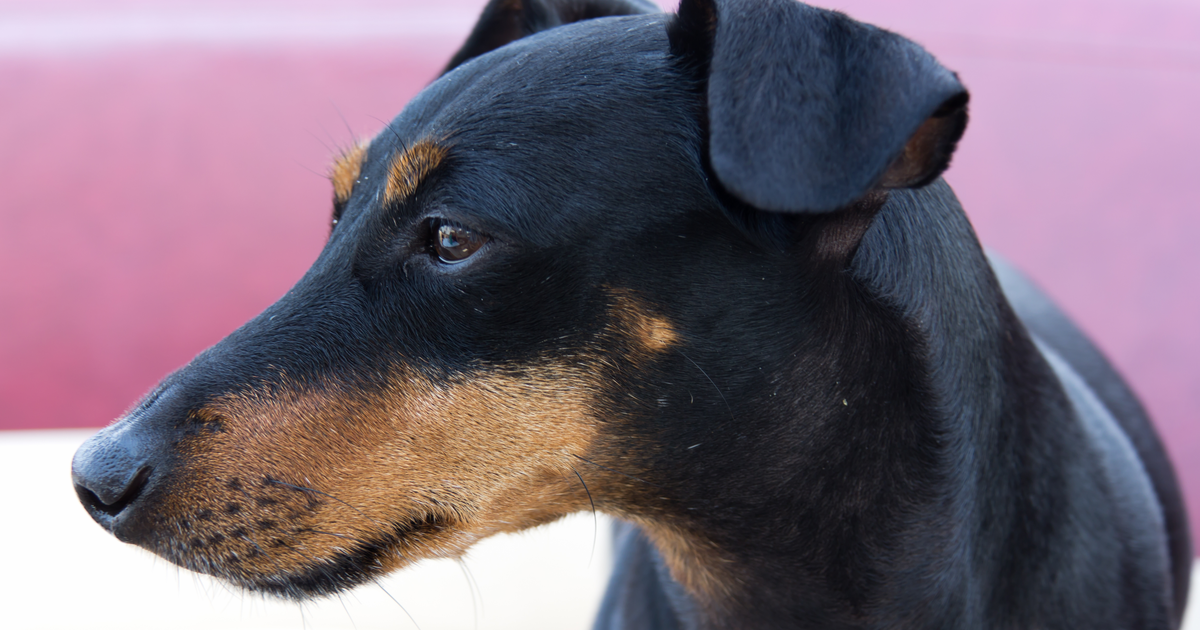
Eyecatch photo: Manchester Terrier by Roger Ahlbrand, CC BY 2.0, via Wikimedia Commons.
How to get your pet tested
Some pet DNA tests screen for hereditary-disease carrier status or genetic risk markers, but the results are information, not a diagnosis. If your pet has symptoms or you need a confirmed diagnosis, please consult your veterinarian.
Below is where von Willebrand disease type 1 (VWF) can be tested, grouped by where you live and marked by whether each service explicitly lists this variant (✅ = listed / ❓ = unverified / ❌ = not offered).
In the United States
In the United Kingdom
In India
Elsewhere
Note: even if the kit can be purchased/shipped internationally, the service itself (sample return, analysis, results) is not guaranteed in your country. Check each service’s stated service area and sample-return method before ordering.
Services offered in other regions (may not be available where you live)
Worried about your pet’s health? — Talk to a veterinarian
A confirmed diagnosis and any treatment plan are decisions for a veterinarian, not a test kit. The links below are professional resources.
AVMA — Find a veterinarian (American Veterinary Medical Association)
This section contains advertising (affiliate links); we may earn a commission if you buy through them. As an Amazon Associate, we earn from qualifying purchases. Genetic tests do not guarantee the prevention, diagnosis, or treatment of any disease — results indicate tendencies and provide information only.
This page is educational information, not veterinary diagnosis or advice. Always consult a veterinarian about your pet’s health.
About the author
Elena Marsh
Editor & writer (not a veterinarian)
A writer with a molecular-biology background and a lifelong dog and cat owner. Not a veterinarian — she translates peer-reviewed genetics research and primary data into plain language, always as information rather than diagnosis.