SamMy Black Russian Terrier breeder mentioned an “HU test.” Is that really a thing in this breed?
Elena MarshYes — a 2008 PLoS Genetics study found Black Russian Terriers among the non-Dalmatian breeds carrying the exact same mutation.
SamWait, isn’t that a Dalmatian-only problem? I thought it was basically their signature disease.
Elena MarshIt used to be treated that way, but researchers found the identical mutation in a couple of other breeds too — including BRTs that had already formed stones.
SamSo how worried should a BRT owner actually be about bladder stones?
Elena MarshWorth testing for, not panicking over — a US lab survey put the at-risk rate around 27% of the breed, and it’s manageable once you know the status.


Bottom line: Hyperuricosuria (HUU) in the Black Russian Terrier traces to the same exon-5 mutation in the SLC2A9 gene first characterized in Dalmatians by Bannasch et al. (2008, PLoS Genetics), who found urate-stone-forming Black Russian Terriers homozygous for the identical mutation and haplotype. A 2010 study (Karmi et al., American Journal of Veterinary Research) of 101 Black Russian Terriers found roughly 50% carriers and 27% at-risk (homozygous), figures also republished on Paw Print Genetics’ testing page. A cheek-swab DNA test can identify a dog’s genetic status; only a veterinarian can confirm an actual urinary stone diagnosis.
The Black Russian Terrier (“BRT,” sometimes called the “Chornyi Terrier”) is a large, powerful working breed developed in the Soviet Union starting in the 1940s at the Red Star military kennel in Moscow, using Giant Schnauzer and Rottweiler foundation stock, among other breeds. It was recognized by the Russian Ministry of Agriculture in 1981, gained FCI international recognition in 1984, and entered the American Kennel Club’s Miscellaneous Class in 2001 before being fully accepted into the AKC Working Group on July 1, 2004. It remains a numerically small breed in the US, which makes tracking hereditary disease in the population especially important for anyone buying, breeding, or already living with one.
One of those hereditary conditions is hyperuricosuria and hyperuricemia (HUU), an inherited disorder that raises uric acid levels in the blood and urine and predisposes affected dogs to urate crystal and stone formation in the bladder or kidneys. HUU is best known as an essentially universal trait in Dalmatians, but the Black Russian Terrier is one of a small number of other breeds where the same underlying mutation has been documented with real testing data — not folklore. This article walks through the genetics, the discovery research that put the BRT on the map for this condition, and what US owners can actually do about it today.
- How the SLC2A9 gene and HUU actually work
- The 2008 discovery: why the Black Russian Terrier is one of the implicated breeds
- Signs and how a diagnosis is actually made
- How to get a Black Russian Terrier tested in the US and UK
- Breeding, AKC/Kennel Club context, and US/UK regulation
- Impact on US and UK pet insurance
- What Black Russian Terrier owners can do today
- Frequently asked questions
- References
- How to get your pet tested
How the SLC2A9 gene and HUU actually work
SLC2A9 encodes a urate transporter protein that normally helps the kidneys and liver reabsorb uric acid, a waste product of purine metabolism, before it is excreted in urine. In dogs carrying the causative mutation, this transporter does not function normally, so far more uric acid than usual ends up in the urine (hyperuricosuria) and, in some dogs, in the blood (hyperuricemia). Persistently high urinary uric acid can crystallize and combine with ammonium to form urate uroliths — stones that can obstruct the urinary tract, particularly in males, and cause pain, straining, and recurrent urinary tract signs. Cornell University’s Riney Canine Health Center describes HUU as an uncommon inherited condition in dogs generally, but one that becomes a real, manageable clinical issue in the specific breeds where the mutation is common.
The condition is inherited in an autosomal recessive pattern: a dog needs two copies of the mutated gene (one from each parent) to be at genetic risk of forming urate stones. A dog with one copy (a carrier) is not expected to show clinical signs itself but can pass the mutation to roughly half of its offspring, which is exactly why breed clubs track carrier and at-risk rates separately rather than only screening for visibly affected dogs.
The 2008 discovery: why the Black Russian Terrier is one of the implicated breeds
The mutation was identified by Danika Bannasch and colleagues in “Mutations in the SLC2A9 Gene Cause Hyperuricosuria and Hyperuricemia in the Dog,” published in PLoS Genetics in 2008. The core finding was a missense mutation in exon 5 of SLC2A9 — a single DNA change, c.563G>T, that swaps one amino acid for another (cysteine to phenylalanine, sometimes written C188F) in the transporter protein. All 247 Dalmatians tested in the study were homozygous for this mutation, consistent with HUU being essentially fixed in that breed.
What makes the study relevant to Black Russian Terrier owners specifically is what happened next: the researchers additionally screened 378 non-Dalmatian dogs across 58 breeds for the mutation as a general population sample, and found none — every one of those 378 dogs was wild-type. Separately, they specifically tested individual dogs from breeds already known to form urate stones clinically: two Bulldogs and two Black Russian Terriers that had already formed urate uroliths. All four of those disease-ascertained dogs were homozygous for the exact same exon-5 mutation — sharing the identical haplotype seen in Dalmatians. The authors interpreted this as evidence of a single ancient mutation, inherited by descent from a shared ancestor that predates modern breed formation, rather than three separate breeds independently developing the same mutation by coincidence. In practical terms, that means a Black Russian Terrier that tests homozygous for this mutation carries the same molecular defect as an affected Dalmatian, not a distinct, BRT-specific variant.
SamSo the mutation didn’t start in Black Russian Terriers at all?
Elena MarshRight — and it only showed up in dogs that had already formed stones, not in the broad 378-dog screen. Bannasch et al. read it as one ancient mutation shared by descent.
Signs and how a diagnosis is actually made
Owners typically notice the same signs regardless of the breed involved: frequent urination, straining to urinate, blood in the urine, licking at the genital area, or in more urgent cases, a male dog unable to pass urine at all, which is a medical emergency. According to Paw Print Genetics, the most common clinical presentation reported in tested Black Russian Terriers is recurrent, urinary-tract-inflammation-like signs — frequent urination, hematuria, and straining — rather than a single dramatic obstruction event, although obstruction can and does occur. Because these signs overlap heavily with ordinary urinary tract infections, bladder inflammation, and other stone types (calcium oxalate and struvite stones look clinically similar from the outside), a genetic test result is not a substitute for veterinary diagnosis — a genetically clear (N/N) dog can still form stones for unrelated reasons (for example, a portosystemic liver shunt disrupting urate metabolism independently of SLC2A9), so a clear result doesn’t rule out urate stones on its own. Confirming an actual stone requires imaging (X-ray or ultrasound) and, ideally, stone analysis if one is removed or passed, since treatment differs meaningfully by stone type. In practice, a male BRT straining to urinate or unable to pass urine at all should go to a 24-hour emergency animal hospital rather than wait for a next-day primary-care appointment; once stabilized, primary vets commonly refer complex or recurrent cases to a board-certified veterinary internist (ACVIM Diplomate) for stone prevention management. For the stone-analysis step itself, most US clinics submit removed or voided stones to the Minnesota Urolith Center at the University of Minnesota, which performs quantitative urolith analysis at no charge to the submitting clinic or owner (funded by donations and an educational grant from Hill’s Pet Nutrition) — the clinic only pays for shipping the sample.
SamIf my dog tests homozygous, does that mean stones are inevitable?
Elena MarshNo — it’s a predisposition, not a guarantee. Many HUU/HUU dogs never form a stone if diet and hydration are managed early.
How to get a Black Russian Terrier tested in the US and UK
HUU/SLC2A9 testing uses a simple, non-invasive cheek swab, and several US-based labs offer it directly to owners and breeders. UC Davis’s Veterinary Genetics Laboratory lists the Hyperuricosuria (HUU) test at $58 as a standalone test (with a volume discount for three or more dogs, and a reduced $27 add-on price when ordered alongside another test on the same animal), with a standard turnaround of at least 15 business days. Paw Print Genetics also offers a dedicated Black Russian Terrier HUU panel, and general-purpose consumer panels such as Embark and Wisdom Panel include HUU/SLC2A9 status as part of their broader breed-and-health screens. None of these require a veterinary visit to collect the sample, though many owners have their vet collect it as part of a routine appointment.
Results are reported as one of three genotypes: N/N (clear), no copies of the mutation detected; N/HUU (carrier), one copy, clinically normal but able to pass the mutation to offspring; and HUU/HUU (at-risk/affected), two copies, genetically predisposed to elevated uric acid and stone formation. The Black Russian Terrier Club of America (BRTCA) lists Hyperuricosuria (HU) among the health tests it recommends for the breed, alongside hip and elbow evaluations, cardiac and eye exams, and JLPP (Juvenile Laryngeal Paralysis and Polyneuropathy) DNA testing, and it encourages breeders to publish results through the Orthopedic Foundation for Animals (OFA) database rather than keep them private.
UK-based owners have a comparably direct route: the Russian Black Terrier Club (UK) and the Kennel Club jointly recognize four health tests for the breed — hip and elbow scoring under the BVA/KC schemes (from 12 months of age) and cheek-swab DNA tests for HUU and JLPP — and breeders are expected to record results with the Kennel Club so buyers can check them directly rather than relying on a breeder’s word. In June 2025 the Kennel Club added a fifth recommended test, prcd-PRA, to the breed’s Health Standard. None of this is framed as a strict legal “requirement” the way a US state law would be — the Kennel Club’s own language is “should,” not “must” — but it gives UK buyers a concrete, named checklist to ask breeders about. The Kennel Club’s own DNA-testing shop offers the Hyperuricosuria test directly, and EasyDNA UK advertises the same cheek-swab HUU test at £55 with results in about 7 working days — broadly comparable in cost and turnaround to the US options above, just billed and shipped domestically within the UK instead of to a US lab.
SamSo the AKC actually requires this test before registering a litter?
Elena MarshNo — registration itself doesn’t require it. The push comes from the breed club’s own CHIC health panel, not AKC paperwork.
Breeding, AKC/Kennel Club context, and US/UK regulation
The BRTCA’s recommended health panel — hip, elbow, cardiac, eye, JLPP, and HU testing, plus color-locus DNA tests — feeds into the Orthopedic Foundation for Animals’ Canine Health Information Center (CHIC) database, where breeders can obtain a CHIC number once the required tests are on file and publicly viewable, whether the results are normal or not. This is a voluntary, breed-club-driven system rather than an AKC registration requirement: the AKC itself does not require genetic testing to register a litter, but its own Working Group breed-testing guidance for the Black Russian Terrier lists hip, elbow, cardiac, eye, and JLPP evaluations as the club-recommended baseline, and prospective buyers are encouraged to ask breeders for CHIC-documented results directly.
Unlike a national breeding law, US dog-breeding oversight is a patchwork: the federal Animal Welfare Act and USDA licensing apply mainly to commercial breeders selling wholesale (for example, to pet stores or sight-unseen online buyers), not to most hobby or show breeders who sell directly to the public. Where US law does give buyers a direct, hereditary-disease-specific remedy is at the state level, through so-called “pet lemon laws.” Florida’s Pet Purchaser Protection statute, for instance, gives buyers a window of one year from purchase to have a veterinarian document a congenital or hereditary defect and seek a refund, replacement, or reimbursement of veterinary costs — a meaningfully longer window than the 14-day period the same law allows for a contagious illness, reflecting how much later a hereditary condition like HUU can surface. New York and California have comparable pet purchaser protection statutes, though the exact deadlines and remedies differ by state, so a buyer’s actual rights depend on where the sale takes place.
The UK has no direct equivalent of a state “pet lemon law,” and the protection that does exist is narrower than it first sounds. Lucy’s Law bans third-party sales of puppies and kittens by pet shops and commercial dealers in England, pushing buyers toward licensed breeders or rehoming centres — but it is a sales-channel rule, not a health-defect remedy, and it does not apply to private individual sellers at all. The more relevant law for a hereditary condition like HUU is the Consumer Rights Act 2015, which requires goods (including a puppy bought from a business seller) to be “of satisfactory quality” and gives buyers a right to a repair, replacement, or refund if that standard isn’t met — but pursuing this route for a genetic condition that surfaces months or years after purchase means proving the defect was already present at the time of sale, which is a real practical hurdle compared with Florida’s simple one-year documentation window.
Impact on US and UK pet insurance
Whether HUU-related treatment is covered by pet insurance in the US comes down almost entirely to timing, not the diagnosis itself. Trupanion states that its policies cover hereditary and congenital conditions as long as there were no signs or symptoms of the condition before the policy’s effective date — a hereditary label alone does not exclude a condition, but symptoms appearing (or being recorded by a vet) before enrollment do. Healthy Paws describes its position similarly: coverage applies to hereditary and congenital conditions as long as signs and symptoms first appear after enrollment (and after any applicable waiting period), while a condition already showing symptoms before enrollment is treated as pre-existing and excluded. Nationwide, by contrast, generally treats congenital and hereditary condition coverage as an add-on rather than something bundled automatically into its base illness plan, so a Black Russian Terrier owner shopping Nationwide specifically should confirm whether that rider is included or needs to be purchased separately.
In practice, this means a young, apparently healthy Black Russian Terrier enrolled in a qualifying plan before any urinary signs appear is generally the best-positioned scenario for coverage if HUU-related stones ever do develop, while a dog already showing urinary symptoms (or already diagnosed HUU/HUU with a documented stone history) at the time of enrollment is likely to have that specific condition excluded going forward. UK owners see a similar timing rule under a different label: Petplan UK covers hereditary and congenital conditions as standard as long as no signs or symptoms appeared before the policy’s start date (or within the first 14 days, which it treats as a pre-existing-condition window), so the practical advice — insure early, before any urinary signs appear — holds on both sides of the Atlantic even though the insurers and terminology differ. As with any insurance question, the exact wording of a given policy — not this article — is the authority on what is and isn’t covered.
What Black Russian Terrier owners can do today
- Ask breeders for the HUU/SLC2A9 test results (N/N, N/HUU, or HUU/HUU) of a puppy’s parents before committing to a purchase, and check whether the breeder publishes results through OFA/CHIC.
- If you already own a Black Russian Terrier without documented results, order a cheek-swab test from UC Davis VGL, Paw Print Genetics, Embark, or Wisdom Panel — no vet visit is strictly required to collect the sample.
- Watch for frequent urination, straining, or blood in the urine, and treat a male dog unable to urinate as an emergency requiring immediate veterinary care.
- If you’re insuring a puppy, enroll before any urinary signs appear and read the hereditary/congenital condition clause directly rather than assuming coverage.
- Know your state’s pet purchaser protection (“lemon law”) rights if a hereditary condition surfaces after purchase — the documentation window varies significantly by state.
- UK owners: check whether HUU/JLPP/prcd-PRA results are recorded on the dog’s Kennel Club record before buying, and remember Lucy’s Law only restricts commercial third-party sales — it does not itself guarantee a health-tested puppy from a private breeder.
- This article is for general information; diagnosis and treatment decisions should always involve your veterinarian.
Frequently asked questions
Q. Is hyperuricosuria only a Dalmatian condition?
No. Bannasch et al. (2008) found the identical SLC2A9 exon-5 mutation and haplotype in urate-stone-forming Bulldogs and Black Russian Terriers, in addition to it being essentially universal in Dalmatians, and interpreted it as one ancient mutation shared by descent across the breeds.
Q. How common is the HUU mutation in Black Russian Terriers specifically?
Karmi et al. (2010) tested 101 Black Russian Terriers and found approximately 50% carriers (N/HUU) and 27% at-risk/homozygous (HUU/HUU) in that US sample; Paw Print Genetics republishes the same figures on its testing page.
Q. Does a homozygous (HUU/HUU) result mean my dog definitely has bladder stones?
No. It means the dog is genetically predisposed to elevated uric acid and stone formation; only veterinary imaging and, ideally, stone analysis can confirm an actual urolith.
Q. Is HUU testing required to register a Black Russian Terrier with the AKC?
No. AKC registration does not require genetic testing, but the Black Russian Terrier Club of America recommends HU testing as part of its CHIC health panel, and responsible breeders are encouraged to publish results through OFA regardless of outcome.
Q. Will pet insurance cover HUU-related vet bills?
It depends on timing: insurers such as Trupanion and Healthy Paws generally cover hereditary conditions as long as no signs or symptoms were present before enrollment; a condition already symptomatic before the policy started is typically excluded as pre-existing.
References
- Russian Black Terrier Club (UK). “Health Considerations” — four Kennel Club-recognized health tests (hip/elbow scoring, HUU and JLPP DNA).
- The Kennel Club (UK). “New DNA testing scheme for the Russian Black Terrier” (2025).
- EasyDNA UK. “Dog Hyperuricosuria for Uric Acid Test” — £55, ~7 working days.
- Petplan UK. “Dog Insurance” — hereditary and congenital condition coverage terms.
- “Lucy’s Law” — scope limited to commercial third-party sales in England.
- Minnesota Urolith Center, University of Minnesota. Free quantitative urolith analysis service.
- Bannasch D, Safra N, Young A, Karmi N, Schaible RS, Ling GV (2008). “Mutations in the SLC2A9 Gene Cause Hyperuricosuria and Hyperuricemia in the Dog.” PLoS Genetics 4(11):e1000246.
- Cornell University Riney Canine Health Center. “Hyperuricosuria and Hyperuricemia (or Urolithiasis, HUU).”
- Westropp JL, Larsen JA, Johnson EG, Bannasch D, Fascetti AJ, Biourge V, Queau Y (2017). “Evaluation of dogs with genetic hyperuricosuria and urate urolithiasis consuming a purine restricted diet: a pilot study.” BMC Veterinary Research 13:45.
- Lulich JP, et al. ACVIM Small Animal Consensus Recommendations on the Treatment and Prevention of Uroliths in Dogs and Cats. Journal of Veterinary Internal Medicine.
- Karmi N, Safra N, Young A, Bannasch DL (2010). “Validation of a urine test and characterization of the putative genetic mutation for hyperuricosuria in Bulldogs and Black Russian Terriers.” American Journal of Veterinary Research 71(8):909-914.
- Paw Print Genetics. “Hyperuricosuria in the Black Russian Terrier” — testing statistics (101 dogs, ~50% carrier, ~27% at-risk; figures from Karmi et al. 2010).
- UC Davis Veterinary Genetics Laboratory. “Hyperuricosuria (HUU)” test page — pricing and turnaround.
- Black Russian Terrier Club of America. “Health & Research” — recommended CHIC health panel including HU testing.
- Black Russian Terrier Club of America. “History of the BRT” — AKC recognition timeline (2001 Miscellaneous Class, July 1, 2004 Working Group).
- American Kennel Club. “Working Group Health Testing Requirements” — Black Russian Terrier recommended tests.
- Trupanion. “Are hereditary & congenital conditions covered?”
- Healthy Paws Pet Insurance. “Pet Insurance That Covers Hereditary & Congenital Conditions.”
- Florida Veterinary Medical Association. “Florida’s Pet Lemon Law for Dogs” — congenital/hereditary defect documentation window.
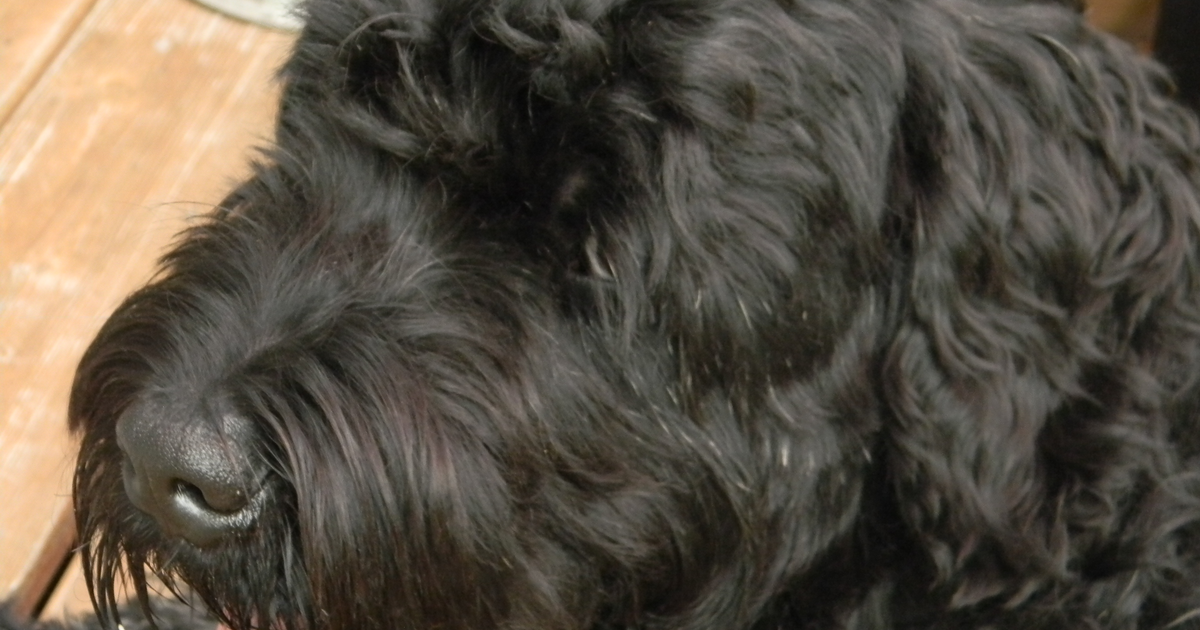
Photo: Laslovarga, CC BY-SA 4.0, via Wikimedia Commons.
How to get your pet tested
Some pet DNA tests screen for hereditary-disease carrier status or genetic risk markers, but the results are information, not a diagnosis. If your pet has symptoms or you need a confirmed diagnosis, please consult your veterinarian.
Below is where Hyperuricosuria / HUU (SLC2A9) can be tested, grouped by where you live and marked by whether each service explicitly lists this variant (✅ = listed / ❓ = unverified / ❌ = not offered).
In the United States
In the United Kingdom
In India
Elsewhere
Note: even if the kit can be purchased/shipped internationally, the service itself (sample return, analysis, results) is not guaranteed in your country. Check each service’s stated service area and sample-return method before ordering.
Services offered in other regions (may not be available where you live)
Worried about your pet’s health? — Talk to a veterinarian
A confirmed diagnosis and any treatment plan are decisions for a veterinarian, not a test kit. The links below are professional resources.
AVMA — Find a veterinarian (American Veterinary Medical Association)
This section contains advertising (affiliate links); we may earn a commission if you buy through them. As an Amazon Associate, we earn from qualifying purchases. Genetic tests do not guarantee the prevention, diagnosis, or treatment of any disease — results indicate tendencies and provide information only.
This page is educational information, not veterinary diagnosis or advice. Always consult a veterinarian about your pet’s health.
About the author
Elena Marsh
Editor & writer (not a veterinarian)
A writer with a molecular-biology background and a lifelong dog and cat owner. Not a veterinarian — she translates peer-reviewed genetics research and primary data into plain language, always as information rather than diagnosis.