Bottom line: Greyhounds are the one breed with a genuine, evidence-backed reputation for anesthetic trouble — but most of that reputation is about a different problem than the one owners fear. The well-documented Greyhound issue is slow thiobarbiturate metabolism: Robinson et al. (1986, Am J Vet Res) measured recovery times 3 to 4 times longer than in mixed-breed dogs, with some Greyhounds taking more than 8 hours to stand. Malignant hyperthermia (MH), caused by variants in the RYR1 gene, is a separate condition — a pharmacogenetic reaction to volatile inhalant anesthetics and succinylcholine in which skeletal muscle keeps contracting and body temperature and CO₂ production run away. Greyhounds do appear in the MH case literature (1978, 1983, 1984), and Embark lists Greyhound against its RYR1 test. Yet when Cosgrove et al. (1992) deliberately challenged seven Greyhounds with halothane and succinylcholine and ran muscle contracture tests, none of them was MH susceptible. The practical reading for a US or UK adopter of a retired racer: ask about the induction protocol and about capnography, not just about “is my Greyhound sensitive to anesthesia” — and if you test, understand what a negative result does and does not rule out. This article is information, not a diagnosis; anesthesia planning belongs to your veterinarian.
- Two different problems that both get called “Greyhounds and anesthesia”
- What malignant hyperthermia actually is
- The Greyhound case reports — and the study that complicates them
- New variants keep being found — which is why “tested clear” needs a footnote
- What an MH crisis looks like in the operating room
- Testing in the US and UK: what is on offer
- Reading the result without over-reading it
- A practical checklist before your Greyhound is anesthetized
- Frequently asked questions
- References
- How to get your pet tested
Two different problems that both get called “Greyhounds and anesthesia”

If you adopt a retired racing Greyhound in the United States, the UK, Ireland, Australia or New Zealand, you will be handed some version of the warning “Greyhounds are different under anesthesia.” That warning is real, and it is unusually well documented for a breed claim. But it bundles together two things that behave completely differently in the operating room.
Problem one is pharmacokinetic. Robinson, Sams and Muir (1986) gave racing Greyhounds and weight-matched mixed-breed dogs intravenous thiopental, thiamylal, methohexital and pentobarbital. Anesthesia lasted longer in the Greyhounds with thiopental, thiamylal and methohexital. Mean times from recumbency to standing were three to four times longer with thiobarbiturates, and some Greyhounds took over eight hours to get up. Recovery was rough, too: the Greyhounds had long periods of respiratory depression, struggled, and relapsed into sleep, while the comparison dogs woke quietly. This is a drug-handling difference — the dog is fine, the drug simply hangs around.
Problem two is pharmacogenetic. Malignant hyperthermia is not slow metabolism. It is a runaway metabolic reaction, and the mechanism is a calcium channel in skeletal muscle that fails to close. The distinction matters because the two problems call for different countermeasures. Slow thiobarbiturate recovery is solved by choosing a different induction agent. MH is not solved by any single drug substitution alone — it needs the triggering agents avoided, the monitoring in place, and dantrolene available.
What malignant hyperthermia actually is
Skeletal muscle contracts when calcium is released from an internal store, and relaxes when that calcium is pumped back. The release gate is the type 1 ryanodine receptor (RyR1), encoded by RYR1. Certain variants in this gene leave the gate liable to jam open when it meets a volatile inhalant anesthetic or the depolarizing muscle relaxant succinylcholine.
The result, as the Merck Veterinary Manual describes it, is tachypnea, tachycardia, fever, rigidity of the limb muscles and myoglobinuria, with severe metabolic acidosis and the potential for respiratory or cardiac arrest. Halothane, isoflurane and sevoflurane are named as triggers along with succinylcholine, and stress, excitement or exercise can also precipitate an episode.
The genetic proof in dogs came from Roberts et al. (2001, Anesthesiology 95:716-725). Starting from a male mixed-breed dog that survived a halothane-succinylcholine challenge, the group bred a colony and phenotyped 47 dogs by in vitro contracture testing. A T1640C substitution producing the V547A change in RYR1 cosegregated perfectly with susceptibility (maximum LOD score 12.29): every susceptible dog was heterozygous, every normal dog was homozygous wild type. Inheritance is autosomal dominant — one copy is enough.
The Greyhound case reports — and the study that complicates them
SamSo has malignant hyperthermia actually been seen in Greyhounds? Elena MarshYes, in case reports from 1978 to 1984. But a 1992 challenge study of seven Greyhounds found no susceptibility at all.The Greyhound appears in the MH literature early and repeatedly. Bagshaw et al. (1978, JAVMA 172:61-62) described a young male Greyhound whose rectal temperature rose rapidly to 45 °C after halothane and succinylcholine, with circulatory failure and death inside roughly 90 minutes. Cohen (1978, JAVMA 172:1254) reported another Greyhound the same year. Leary et al. (1983, JAVMA 182:521-522) reported a recurrent episode in a Greyhound.
The fourth report is the strangest and the most instructive. Kirmayer, Klide and Purvance (1984, JAVMA 185:978-982) described malignant hyperthermia in an adult Greyhound that began 24 hours after narcotic anesthesia and surgery, with stress considered the most likely trigger. Treatment with dantrolene, cooling and supportive care was successful. An episode that starts a day after the anesthetic is over is a useful reminder that the danger window is not only the moment the vaporizer is switched on.
Then comes the complication. Cosgrove et al. (1992, Lab Anim Sci 42:482-485) set out to test the breed claim directly, precisely because of those prior reports and because Greyhounds are highly inbred and might therefore share susceptibility. Seven Greyhounds and six mongrels were given halothane and succinylcholine as a deliberate trigger challenge, with full cardiopulmonary measurements, and semitendinosus muscle biopsies were taken for halothane and caffeine contracture testing. Greyhounds and mongrels responded the same way, with no evidence of MH in either group. The authors’ conclusion is worth quoting in substance: if all Greyhounds are genetically homologous, then Greyhounds may not be specifically MH susceptible.
Seven dogs cannot prove a negative for a whole breed any more than four case reports prove a positive. What the pair of findings supports is a narrower, more useful statement: MH is not a general property of Greyhounds; it is a property of individual dogs carrying a susceptibility variant, and Greyhounds are among the breeds in which such individuals have been documented.
New variants keep being found — which is why “tested clear” needs a footnote
The most recent work in this area is Perez Jimenez et al. (2025, Vet Anaesth Analg 52(1):8-18), which applied next-generation sequencing to two pet dogs that died of MH under isoflurane: a 7-year-old male Pit Bull mix and a 12-month-old male Golden Retriever. Both carried previously unreported missense RYR1 variants — p.Gly2375Arg and p.Pro152Leu respectively. Notably, p.Gly2375Arg matches a variant already used diagnostically in human MH.
Two consequences follow for anyone reading a Greyhound’s DNA report. First, the commercially tested variant is the 2001 V547A change, so a “clear” result means that variant is absent — not that every MH-causing variant is absent. Second, the Golden Retriever case was sequenced alongside both parents, neither of whom carried the variant: it had arisen de novo. Pedigree history is therefore not a substitute for precaution.
Population data are thin as well. Haluskova et al. (2023, Vet Med (Praha) 68:428-434) screened 50 dogs across 27 breeds and found no mutant alleles at all — consistent with a rare variant, but far too small a sample to establish a frequency.
What an MH crisis looks like in the operating room
SamWould the vet notice quickly? I keep imagining a thermometer. Elena MarshTemperature is the late sign. Merck’s manual states the earliest indicator in an anesthetized patient is rising CO₂ production.The name misleads. Muscle that will not stop contracting burns oxygen and produces carbon dioxide; the heat is downstream of that. The Merck Veterinary Manual identifies increased CO₂ production as the earliest indicator in an anesthetized patient. In practice this means the capnograph moves before the thermometer does, and end-tidal CO₂ that climbs despite adequate ventilation is the signal that prompts an anesthetist to think about MH.
That gives owners a sharper question to ask than “is anesthesia safe for Greyhounds.” The better question is “will my dog be on capnography and continuous monitoring throughout, and who is watching those numbers while the surgeon operates?” A dedicated person monitoring anesthesia is the difference between catching a trend and finding a crisis.
One regulatory point is worth knowing, because it explains why your clinic may hesitate. Dantrolene is licensed as a human medicine (Dantrium, Revonto, Ryanodex), not as a veterinary one. In the United States its use in a dog is extra-label use, permitted under the Animal Medicinal Drug Use Clarification Act (AMDUCA) and its implementing rules at 21 CFR Part 530, and only within a valid veterinarian-client-patient relationship. In the United Kingdom the equivalent framework is the prescribing cascade administered by the Veterinary Medicines Directorate: where no authorised veterinary product exists for the condition, a vet may work down the cascade to a human medicine — and under the RCVS Code of Professional Conduct must obtain the owner’s consent to do so. In practice this means a UK vet may ask you to agree to cascade prescribing before dantrolene is given: that request is routine, not a warning sign.
Treatment, when it is needed, is specific. Merck gives dantrolene at 2-3 mg/kg IV as a bolus, repeated until signs subside up to a cumulative 10 mg/kg, plus prophylactic use in previously affected patients (5-10 mg/kg PO before anesthesia). Everything else — stopping the trigger agent, hyperventilating with oxygen, active cooling, treating acidosis and hyperkalemia — is supportive. In human medicine the Malignant Hyperthermia Association of the United States (MHAUS) runs a 24-hour hotline (1-800-644-9737) that clinicians keep on speakerphone through a crisis; veterinary teams draw on the same body of protocol knowledge.
Testing in the US and UK: what is on offer
Unlike some conditions on this site, the RYR1 test is widely available to owners in the English-speaking market, and in several forms.
Direct-to-consumer panels. Embark includes malignant hyperthermia (RYR1) in its health condition screening and lists Greyhound as an affected breed. Its guidance to owners of dogs that test positive is worth repeating in full because it is exactly right: tell your vet so the result is in the medical record before any anesthesia or surgery, make sure every veterinarian who treats the dog knows, and understand that outside anesthesia these dogs live completely normal, active lives.
What does it cost? Embark’s Breed + Health kit lists at $199 (frequently discounted, US shipping included, results in roughly 2-4 weeks) and covers hundreds of conditions besides MH.
Single-condition laboratory tests are far cheaper. Animal Genetics prices the malignant hyperthermia test at $45.00 per sample, accepts buccal swab, blood or dewclaw samples, and quotes 2-3 business days for results — and, importantly for British owners, the company runs a laboratory in Tallahassee, Florida alongside an office in Cornwall, England, so UK samples do not have to cross the Atlantic on their own. Genomia (Czech Republic) lists the same RYR1 test at $56.00 excluding VAT with a usual turnaround of 12 business days; LABOKLIN (Bad Kissingen, Germany) quotes 3-5 working days from sample arrival. In Canada, LabGenVet lists malignant hyperthermia among its canine tests.
For UK owners the practical order of preference is usually: a lab with a domestic drop point first (post inside the UK, no customs paperwork), then EU labs, then US-only shipping — international veterinary sample shipments add days and occasionally require a commercial invoice, which matters when a surgery date is already booked.
Through your veterinarian. If your dog has already had a suspicious anesthetic event, this is the better route: the clinical record travels with the sample, and the result lands in the file where it will actually be read on the morning of surgery.
For adopters specifically, timing matters. Retired racing Greyhounds are frequently adopted after their dental work or spay/neuter has already been performed by the adoption program’s veterinarians, which means an anesthetic history already exists. Ask the adoption group for those records rather than starting from a blank page — an uneventful anesthetic recovery documented by the group is more informative than anything you can infer from breed alone.
Reading the result without over-reading it
Three points cover almost every misreading we see.
A positive result is not a ban on anesthesia. It is an instruction to change the plan. Volatile agents and succinylcholine are avoided; total intravenous anesthesia is used instead; monitoring is intensified; dantrolene is on hand. Shin and Ambros (2025, Can Vet J 66(8):868-873) documented exactly this arc in a 9-month-old dog that developed a suspected MH crisis at 42.8 °C under isoflurane, was rescued with propofol TIVA, increased ventilation, active cooling and IV dantrolene, and then underwent a second, uneventful anesthetic six weeks later planned as TIVA from the start.
A negative result is narrower than it sounds. It means the tested variant — in practice V547A — was not found. The 2025 case series exists precisely because dogs die of MH carrying variants nobody had catalogued yet. Testing supplements monitoring; it does not replace it.
Autosomal dominant changes the arithmetic. Owners who have read about carriers of recessive diseases often assume one copy is harmless. Here it is not: in the Roberts colony every susceptible dog carried a single copy. There is no benign carrier state to fall back on.
A practical checklist before your Greyhound is anesthetized
1. Hand over the anesthetic history in writing. Adoption group records, prior dental notes, any account of a rough or unusually long recovery. “He was slow to wake up last time” is a clinically meaningful sentence.
2. Ask which induction agent will be used. The Greyhound thiobarbiturate problem has a straightforward answer in modern practice, and asking the question signals that you know the breed has documented differences.
3. Ask about capnography and a dedicated monitor. This is the question that maps onto MH specifically, because CO₂ moves first.
4. If you test, do it well before the surgery date. Turnaround varies more than owners expect: Animal Genetics quotes 2-3 business days, Genomia 12 business days, LABOKLIN 3-5 working days from sample arrival — all before transit. Budget roughly $45-$56 for a single-condition test or $199 for a full panel, and start weeks ahead rather than days.
5. Carry a copy of a positive result. Emergency and out-of-hours clinics cannot see your regular practice’s records. A single printed page in the car does more good on a bad night than a file at home.
Greyhounds are, as the anesthesia literature puts it, the breed whose anesthetic differences are best supported by evidence. That is a reason for informed preparation, not for fear. Most Greyhounds are anesthetized uneventfully every day — by teams who know which drugs to avoid and which numbers to watch.
Frequently asked questions
Q. Is malignant hyperthermia the same thing as the Greyhound anesthesia sensitivity my adoption group warned me about?
Almost certainly not. The classic Greyhound warning refers to prolonged recovery from thiobarbiturates such as thiopental, documented by Robinson et al. (1986) with recovery times three to four times longer than in mixed-breed dogs. Malignant hyperthermia is a separate, rarer, genetically driven reaction to volatile inhalant anesthetics and succinylcholine. Both are worth mentioning to your veterinarian, but they call for different precautions.
Q. Should every Greyhound be tested for RYR1 before routine surgery?
There is no professional guideline requiring it, and the evidence does not support treating the whole breed as susceptible — Cosgrove et al. (1992) challenged seven Greyhounds and found none susceptible. Testing is most informative when there is a specific reason: a previous suspicious anesthetic event in your dog or a close relative, or a breeding program where the information will be used. Discuss the decision with your veterinarian rather than treating the test as mandatory.
Q. My Greyhound has had surgery before with no problems. Is that reassuring?
It is meaningful, but not conclusive. The Kirmayer et al. (1984) Greyhound developed malignant hyperthermia 24 hours after narcotic anesthesia and surgery, with stress as the suspected trigger — which shows episodes are not confined to the moment of exposure and can appear in a dog with an otherwise unremarkable history. Report the previous uneventful anesthetics as part of the history and let that inform the plan.
Q. Does a “clear” DNA result mean my dog cannot have an MH crisis?
No. It means the specific variant tested — usually the V547A change identified by Roberts et al. (2001) — was not detected. Perez Jimenez et al. (2025) identified two novel RYR1 variants in dogs that died of MH, neither of which any commercial panel was screening for at the time. Treat a clear result as one reassuring data point among several, not as an exemption from monitoring.
Q. Should I ask my clinic whether they stock dantrolene?
You can ask, and the answer is informative, but do not treat a “no” as disqualifying. Dantrolene is used rarely, has a limited shelf life and is expensive, so stocking practices vary widely between a referral hospital and a small first-opinion clinic. What matters more is whether the team recognises the early signs and has a plan — including how quickly they could obtain the drug. Ask your veterinarian how they would handle a suspected MH event, rather than auditing the drug cupboard.
Q. Can stress alone trigger an episode in a susceptible dog?
The Merck Veterinary Manual lists stress, excitement and exercise as possible precipitants alongside anesthetic agents, and the 1984 Greyhound case was attributed to stress rather than to the anesthetic itself. This is one reason low-stress handling matters for Greyhounds in the clinic. If your dog becomes rigid, hyperthermic or distressed after a procedure, treat it as an emergency and contact your veterinary team immediately.
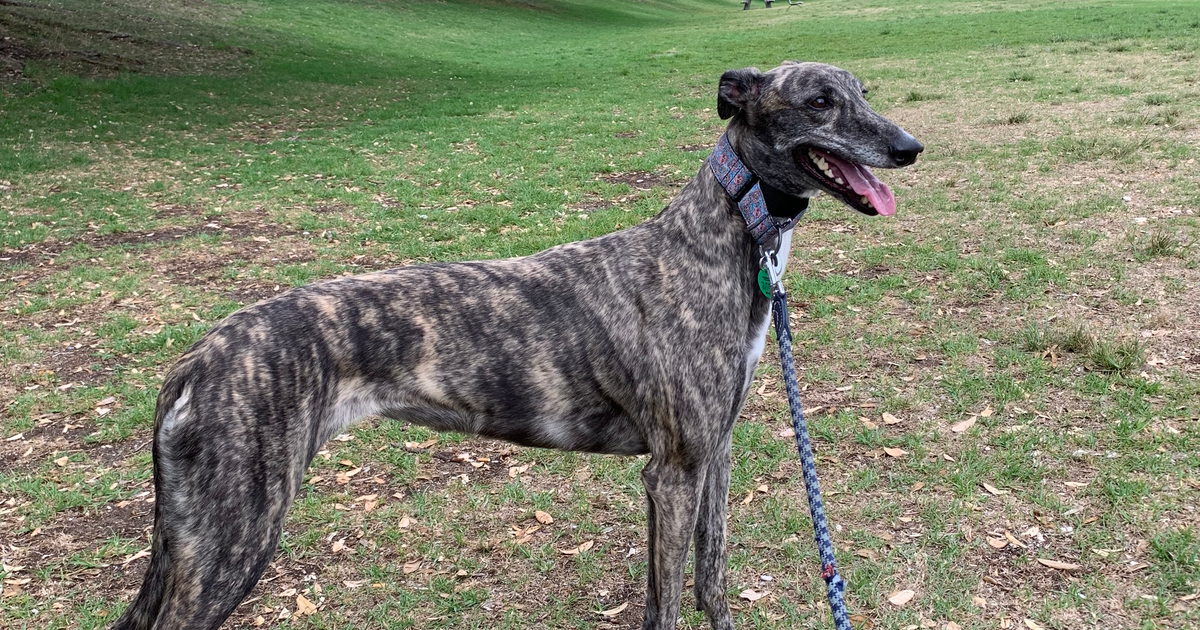
Image credit: Brindle greyhound, New Zealand by Blueskinbay, CC BY-SA 4.0 (centre-cropped to 1200×630).
References
- Robinson EP, Sams RA, Muir WW. Barbiturate anesthesia in greyhound and mixed-breed dogs: comparative cardiopulmonary effects, anesthetic effects, and recovery rates. Am J Vet Res. 1986;47(10):2105-2112. https://doi.org/10.2460/ajvr.1986.47.10.2105
- Cosgrove SB, Eisele PH, Martucci RW, Gronert GA. Evaluation of greyhound susceptibility to malignant hyperthermia using halothane-succinylcholine anesthesia and caffeine-halothane muscle contractures. Lab Anim Sci. 1992;42(5):482-485. https://pubmed.ncbi.nlm.nih.gov/1460848/
- Bagshaw RJ, Cox RH, Knight DH, Detweiler DK. Malignant hyperthermia in a Greyhound. J Am Vet Med Assoc. 1978;172(1):61-62. https://pubmed.ncbi.nlm.nih.gov/624662/
- Cohen CA. Malignant hyperthermia in a greyhound. J Am Vet Med Assoc. 1978;172(11):1254,1256. https://pubmed.ncbi.nlm.nih.gov/659305/
- Leary SL, Anderson LC, Manning PJ, Bache RJ, Zweber BA. Recurrent malignant hyperthermia in a Greyhound. J Am Vet Med Assoc. 1983;182(5):521-522. https://pubmed.ncbi.nlm.nih.gov/6833093/
- Kirmayer AH, Klide AM, Purvance JE. Malignant hyperthermia in a dog: case report and review of the syndrome. J Am Vet Med Assoc. 1984;185(9):978-982. https://pubmed.ncbi.nlm.nih.gov/6511640/
- Roberts MC, Mickelson JR, Patterson EE, et al. Autosomal dominant canine malignant hyperthermia is caused by a mutation in the gene encoding the skeletal muscle calcium release channel (RYR1). Anesthesiology. 2001;95(3):716-725. https://pubmed.ncbi.nlm.nih.gov/11575546/
- Perez Jimenez TE, Issaka Salia O, Neibergs HL, et al. Novel ryanodine receptor 1 (RYR1) missense gene variants in two pet dogs with fatal malignant hyperthermia identified by next-generation sequencing. Vet Anaesth Analg. 2025;52(1):8-18. https://doi.org/10.1016/j.vaa.2024.10.131
- Haluskova J, Holeckova B, Kokulova L, et al. Detection of the T1640C RYR1 mutation indicating malignant hyperthermia in dogs. Vet Med (Praha). 2023;68(11):428-434. https://doi.org/10.17221/46/2023-VETMED
- Shin CW, Ambros B. A case of suspected malignant hyperthermia in a dog. Can Vet J. 2025;66(8):868-873. https://pmc.ncbi.nlm.nih.gov/articles/PMC12330792/
- Merck Veterinary Manual — Malignant Hyperthermia in Animals. https://www.merckvetmanual.com/metabolic-disorders/malignant-hyperthermia/malignant-hyperthermia-in-animals
- OMIA:000621-9615 — Malignant hyperthermia in Canis lupus familiaris. https://omia.org/OMIA000621/9615/
- Embark — Malignant Hyperthermia (RYR1). https://embarkvet.com/products/dog-health/health-conditions/malignant-hyperthermia/
- LABOKLIN — Malignant hyperthermia (MH), dog. https://laboklin.com/en/products/genetics/hereditary-diseases/dog/malignant-hyperthermia-mh/
- LabGenVet — Malignant Hyperthermia. https://labgenvet.ca/en/disease/malignant-hyperthermia/
- Animal Genetics — Malignant Hyperthermia (canine). https://avian2.animalgenetics.com/Canine/Genetic_Disease/MH.asp
- Genomia — Testing of dogs: MH. https://www.genomia.cz/en/test/mh/
- US FDA — Animal Medicinal Drug Use Clarification Act of 1994 (AMDUCA). https://www.fda.gov/animal-veterinary/guidance-regulations/animal-medicinal-drug-use-clarification-act-1994-amduca
- UK Veterinary Medicines Directorate — The cascade: prescribing unauthorised medicines. https://www.gov.uk/guidance/the-cascade-prescribing-unauthorised-medicines
- Royal College of Veterinary Surgeons — Code of Professional Conduct: Veterinary medicines. https://www.rcvs.org.uk/setting-standards/advice-and-guidance/code-of-professional-conduct-for-veterinary-surgeons/supporting-guidance/veterinary-medicines/
- Malignant Hyperthermia Association of the United States (MHAUS). https://www.mhaus.org/
How to get your pet tested
Some pet DNA tests screen for hereditary-disease carrier status or genetic risk markers, but the results are information, not a diagnosis. If your pet has symptoms or you need a confirmed diagnosis, please consult your veterinarian.
Below is where Malignant hyperthermia (RYR1) can be tested, grouped by where you live and marked by whether each service explicitly lists this variant (✅ = listed / ❓ = unverified / ❌ = not offered).
In the United States
In the United Kingdom
In India
Elsewhere
Note: even if the kit can be purchased/shipped internationally, the service itself (sample return, analysis, results) is not guaranteed in your country. Check each service’s stated service area and sample-return method before ordering.
Services offered in other regions (may not be available where you live)
Worried about your pet’s health? — Talk to a veterinarian
A confirmed diagnosis and any treatment plan are decisions for a veterinarian, not a test kit. The links below are professional resources.
AVMA — Find a veterinarian (American Veterinary Medical Association)
This section contains advertising (affiliate links); we may earn a commission if you buy through them. As an Amazon Associate, we earn from qualifying purchases. Genetic tests do not guarantee the prevention, diagnosis, or treatment of any disease — results indicate tendencies and provide information only.
This page is educational information, not veterinary diagnosis or advice. Always consult a veterinarian about your pet’s health.
About the author
Elena Marsh
Editor & writer (not a veterinarian)
A writer with a molecular-biology background and a lifelong dog and cat owner. Not a veterinarian — she translates peer-reviewed genetics research and primary data into plain language, always as information rather than diagnosis.