The short answer: Exercise-Induced Collapse (EIC) in the Chesapeake Bay Retriever is linked to a recessive mutation in the DNM1 gene. Affected dogs (two copies) are completely normal at rest but can lose rear-limb control and collapse a few minutes into strenuous, high-excitement exercise — usually recovering within 15–30 minutes. Carriers (one copy) are clinically normal. A DNA test reports genetic risk (clear / carrier / affected), not a diagnosis, and many other conditions can also cause collapse.
- What EIC and DNM1 actually are
- Why it only shows under hard, excited exercise
- How common it is in Chesapeakes and other breeds
- Clear, carrier, affected — breeding and activity management
- Not all collapse is DNM1 — what the test can and cannot tell you
- FAQ — Frequently Asked Questions
- References
- How to get your pet tested
What EIC and DNM1 actually are

EIC is a genetic condition in which a dog that is perfectly healthy at rest suddenly loses coordination and collapses during intense exercise. In the Chesapeake Bay Retriever and several related breeds, one well-characterized form is caused by a single change in the DNM1 gene (dynamin-1): the variant c.767G>T, which swaps arginine for leucine at position 256 of the protein (p.Arg256Leu, or R256L) in exon 6. It is inherited in an autosomal recessive pattern, meaning a dog must inherit two copies of the variant to be at risk. The mutation and species record are catalogued as OMIA:001466-9615, and the discovery was published by Patterson et al., 2008 (Nat Genet 40(10):1235).
Dynamin-1 is a molecular machine at the ends of nerve cells. When a nerve fires, it releases tiny packets called synaptic vesicles that carry neurotransmitter across the gap to the next cell. Dynamin-1 is the GTPase that “pinches off” the spent vesicle membrane so it can be recycled, refilled, and reused. When that recycling can’t keep pace, the nerve terminal runs low on ready-to-fire vesicles.
Why it only shows under hard, excited exercise
SamThat’s the strange part — the dog is totally fine walking around the house. Why only when running hard? Elena MarshBecause at rest, backup recycling pathways cover for the faulty dynamin-1; Taylor and colleagues (2008, PMID 18981194) found episodes typically hit 5–15 minutes into strenuous, high-excitement exercise.The reason affected dogs look completely normal at rest is redundancy. At rest or moderate activity, other systems — dynamin-3 and bulk endocytosis — handle vesicle recycling, so the mutant dynamin-1 is not the bottleneck. But under intense, sustained, high-frequency nerve firing, demand for rapid recycling spikes. The mutant dynamin-1 can’t keep up, synaptic transmission begins to fail, motor control is lost, and the dog collapses — reversibly.
The clinical picture, described by Taylor et al., 2008 (JAAHA 44(6):295), fits this mechanism. The mean age of onset is about 12 months. The two dominant triggers were excitement (reported in 83% of cases) and heat (31%). Episodes usually begin 5–15 minutes into strenuous, high-excitement exercise: rear-limb weakness and ataxia progress to collapse, the dog is normal at rest, and episodes usually resolve within 15–30 minutes. Importantly, fatalities during or after a collapse have been reported, so this is not a trivial quirk.
How common it is in Chesapeakes and other breeds
SamIs this common in the breed, or did my friend just get unlucky? Elena MarshMinor and colleagues (2011, PMID 21782486) found about 2.5% of sampled Chesapeakes were affected and 17.5% were carriers — real but not the highest among the breeds tested.The Chesapeake Bay Retriever is a US-developed breed — it has been Maryland’s official state dog since 1964 — and ranks around #56 in AKC popularity. In the frequency survey by Minor et al., 2011 (Vet J 189(2):214), 2.5% of sampled Chesapeakes carried two copies (affected) and 17.5% carried one copy (carrier). The same study found the Curly-Coated Retriever had by far the highest frequency outside the Labrador — 19.5% affected and 33.5% carriers — while the variant was not found at all in Golden, Flat-Coated, or Nova Scotia Duck Tolling Retrievers.
| Breed | Affected (EE) | Carrier (EN) |
|---|---|---|
| Chesapeake Bay Retriever | 2.5% | 17.5% |
| Curly-Coated Retriever | 19.5% | 33.5% |
| Golden Retriever | Not found | Not found |
| Flat-Coated Retriever | Not found | Not found |
| Nova Scotia Duck Tolling Retriever | Not found | Not found |
Frequencies from Minor et al., 2011 (Vet J 189(2):214).
Clear, carrier, affected — breeding and activity management
SamSo if my friend’s dog is a “carrier,” does that mean it’s going to collapse too? Elena MarshNo — because it’s autosomal recessive, only affected dogs with two copies are at risk; carriers are clinically normal, though carrier-to-carrier matings give a 25% chance of affected pups (Taylor et al., 2008).Because DNM1-associated EIC is autosomal recessive, the three genetic outcomes mean different things. A clear dog has no copies and is not at DNM1 risk. A carrier has one copy and is clinically normal — it will not collapse from this variant. An affected dog has two copies and is the only one at risk of DNM1 collapse. The catch is breeding: pairing two carriers gives, on average, 25% affected, 50% carrier, and 25% clear offspring, which is exactly how the variant stays in the population unnoticed.
This is why the practical value of testing is threefold: information (knowing your dog’s status), breeding decisions (avoid carrier × carrier pairings), and activity management for affected dogs. For a dog that tests affected, the University of Minnesota canine genetics lab advises avoiding the specific high-intensity, high-excitement trigger exercise, stopping at the earliest signs of trouble (a rear-limb wobble), and then cooling the dog down and letting it rest.
Not all collapse is DNM1 — what the test can and cannot tell you
SamIf the test comes back clear, does that mean my friend never has to worry about collapse again? Elena MarshUnfortunately no — the Merck Veterinary Manual lists many causes of collapse, and a DNM1-clear dog can still collapse from cardiac, respiratory, metabolic, heat, or orthopedic problems.“Collapse” in dogs is an umbrella symptom, not a single disease. It can stem from cardiac disease, respiratory or laryngeal problems, metabolic disorders, heat and hyperthermia, orthopedic issues, and other genetically distinct collapse syndromes — including Border Collie Collapse (which is DNM1-negative) and a separate DNM1-negative EIC-like phenotype. As the Merck Veterinary Manual makes clear, exercise intolerance and collapse have a broad differential.
That means a DNM1 test covers only the DNM1 form of EIC. A dog that tests clear can still collapse for any of the reasons above, so a clear result is not a guarantee of “never collapses.” A DNA result reports genetic risk (clear / carrier / affected) — it is not a clinical diagnosis. Any dog that actually collapses needs a full veterinary work-up to find the real cause, regardless of its DNM1 status.
FAQ — Frequently Asked Questions
Q. My Chesapeake tested DNM1-clear but still collapsed after exercise. How is that possible?
A DNM1-clear result only rules out the DNM1 form of EIC. Collapse has many other causes — cardiac, respiratory or laryngeal, metabolic, heat-related, orthopedic, and other collapse syndromes such as Border Collie Collapse or a DNM1-negative EIC-like phenotype. A collapsing dog always needs a veterinary work-up.
Q. My dog tested affected. What should I do to manage it?
Following University of Minnesota guidance, avoid the specific high-intensity, high-excitement exercise that triggers episodes, stop immediately at the first sign of rear-limb wobble, and cool the dog down and let it rest. Onset is typically around 12 months, and excitement and heat are the main triggers.
Q. Is a carrier dog at risk of collapsing?
No. Because the condition is autosomal recessive, only affected dogs with two copies are at risk. Carriers with one copy are clinically normal — but breeding two carriers together gives about a 25% chance of affected puppies, so carrier status matters for breeding.
Q. How common is DNM1 EIC in Chesapeake Bay Retrievers compared with other retrievers?
In Minor et al. (2011), about 2.5% of sampled Chesapeakes were affected and 17.5% were carriers. The Curly-Coated Retriever was much higher (19.5% affected, 33.5% carriers), while the variant was not found in Golden, Flat-Coated, or Nova Scotia Duck Tolling Retrievers.
References
- Patterson EE et al., 2008, Nat Genet 40(10):1235 (PMID 18806795): https://pubmed.ncbi.nlm.nih.gov/18806795/
- Minor KM et al., 2011, Vet J 189(2):214 (PMID 21782486): https://pubmed.ncbi.nlm.nih.gov/21782486/
- Taylor SM et al., 2008, JAAHA 44(6):295 (PMID 18981194): https://pubmed.ncbi.nlm.nih.gov/18981194/
- OMIA:001466-9615 (DNM1, dog): https://omia.org/OMIA001466/9615/
- University of Minnesota Canine Genetics Lab — Dynamin-1-associated exercise-induced collapse: https://vetmed.umn.edu/research/research-labs/canine-genetics-lab/canine-genetics-testing/dynamin-1-associated-exercise
- Merck Veterinary Manual — Exercise intolerance and exercise-induced collapse in dogs: https://www.merckvetmanual.com/musculoskeletal-system/myopathies-in-dogs-and-cats/exercise-intolerance-and-exercise-induced-collapse-in-dogs
- Maryland state symbols — official state dog (Chesapeake Bay Retriever): https://msa.maryland.gov/msa/mdmanual/01glance/html/symbols/dog.html
- AKC most popular dog breeds 2025: https://www.akc.org/expert-advice/dog-breeds/most-popular-dog-breeds-2025/
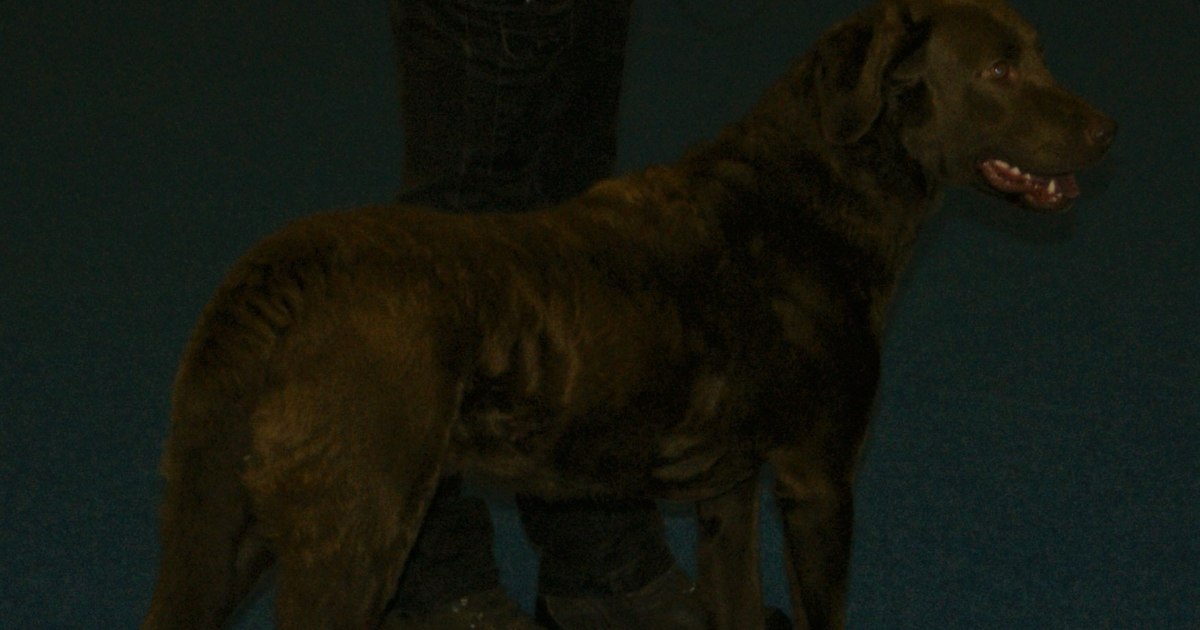
Eyecatch photo: Chesapeake Bay Retriever by Canarian, CC BY-SA 4.0, via Wikimedia Commons.
How to get your pet tested
Some pet DNA tests screen for hereditary-disease carrier status or genetic risk markers, but the results are information, not a diagnosis. If your pet has symptoms or you need a confirmed diagnosis, please consult your veterinarian.
Below is where Exercise-Induced Collapse (DNM1) can be tested, grouped by where you live and marked by whether each service explicitly lists this variant (✅ = listed / ❓ = unverified / ❌ = not offered).
In the United States
In the United Kingdom
In India
Elsewhere
Note: even if the kit can be purchased/shipped internationally, the service itself (sample return, analysis, results) is not guaranteed in your country. Check each service’s stated service area and sample-return method before ordering.
Services offered in other regions (may not be available where you live)
Worried about your pet’s health? — Talk to a veterinarian
A confirmed diagnosis and any treatment plan are decisions for a veterinarian, not a test kit. The links below are professional resources.
AVMA — Find a veterinarian (American Veterinary Medical Association)
This section contains advertising (affiliate links); we may earn a commission if you buy through them. As an Amazon Associate, we earn from qualifying purchases. Genetic tests do not guarantee the prevention, diagnosis, or treatment of any disease — results indicate tendencies and provide information only.
This page is educational information, not veterinary diagnosis or advice. Always consult a veterinarian about your pet’s health.
About the author
Elena Marsh
Editor & writer (not a veterinarian)
A writer with a molecular-biology background and a lifelong dog and cat owner. Not a veterinarian — she translates peer-reviewed genetics research and primary data into plain language, always as information rather than diagnosis.