Bottom line: The Parson Russell Terrier carries two genetically separate inherited ataxias, and clearing your dog for one tells you nothing about the other. Spinocerebellar ataxia (SCA) comes from KCNJ10:c.627C>G (p.Ile209Met), identified by Gilliam et al. (2014, J Vet Intern Med), and shows up at 2 to 6 months of age, often with myokymia (rippling muscle contractions) and seizures alongside the wobble. Late onset ataxia (LOA) comes from a different gene entirely — CAPN1:c.344G>A (p.Cys115Tyr), reported by Forman et al. (2013, PLOS ONE) — and typically begins at 6 to 12 months. Both are autosomal recessive, so a healthy-looking carrier can pass either one on. This is exactly why the Parson Russell Terrier Association of America lists both LOA and SCA among its recommended tests rather than one “ataxia panel.” And there is a further caution that breeders in the US and UK should hear plainly: Gast et al. (2016, BMC Vet Res) genotyped 77 Parson Russell Terriers and concluded that DNA testing for hereditary ataxia in this breed “does not capture all cases” — at least one additional genetic form is still unidentified. A clear result is good news, not a guarantee. This article is informational and is not a substitute for veterinary diagnosis or treatment. If your dog is unsteady or twitching, see your veterinarian.
- Two ataxias, one breed — and why the distinction is not academic
- What KCNJ10 actually does — a housekeeping failure, not a nerve failure
- The 2014 discovery, and the carrier numbers behind it
- The finding breeders most need to hear: a clear test is not a guarantee
- Where to test in the US and UK, and what the labs actually offer
- In the UK: an official Kennel Club scheme, and where to send the swab
- Insurance: what a hereditary diagnosis does to your cover
- Getting to the right clinician — and what it costs
- What owners actually see, and how to make the exam useful
- Frequently asked questions
- References
- How to get your pet tested
Two ataxias, one breed — and why the distinction is not academic

Most inherited diseases in dogs map to one gene and one test. Hereditary ataxia in the Russell group of terriers does not. Two distinct autosomal recessive variants, on two different genes, produce overlapping but non-identical pictures of the same clinical word: “ataxia.”
The first is spinocerebellar ataxia (SCA), caused by the KCNJ10 potassium channel variant. The second is late onset ataxia (LOA), caused by a variant in CAPN1, the gene for the enzyme calpain-1. Gast et al. (2016) state the split explicitly: KCNJ10:c.627C>G is associated with SCA in Russell group terriers, whereas CAPN1:c.344G>A is associated with LOA in Parson Russell Terriers.
The practical consequence is uncomfortable. A puppy buyer who is handed a certificate reading “ataxia clear” has been given an ambiguous document. Unless the paperwork names the gene — KCNJ10 or CAPN1 — it does not say which risk was excluded. When you are evaluating a litter, the correct question is not “was the dog ataxia tested?” but “which variants were tested, and what were the genotypes for each?”
What KCNJ10 actually does — a housekeeping failure, not a nerve failure
KCNJ10 encodes Kir4.1, an inward-rectifying potassium channel. It sits mostly not on neurons but on the glial cells packed around them — in the brain, the astrocytes.
Every time a neuron fires, it pushes potassium ions out into the surrounding space. If that potassium accumulated, the neighbourhood would become progressively easier to excite. Glial cells prevent this by pulling the excess back in through Kir4.1, a process called potassium buffering. It is maintenance work: unglamorous, continuous, and invisible until it stops.
When the channel is impaired, excitability rises wherever the failure occurs. In the cerebellum that reads out as incoordination. In peripheral nerve it reads out as myokymia and neuromyotonia — muscles that contract and ripple on their own, even at rest. In the forebrain it reads out as seizures. One broken gene, three symptom families that a general practitioner might otherwise attribute to three different problems.
The same logic holds in humans. Bockenhauer et al. (2009, New England Journal of Medicine) described children with epilepsy, ataxia, sensorineural deafness and a renal tubulopathy, and traced it to KCNJ10 — EAST syndrome. Working independently, Scholl et al. (2009, PNAS) named essentially the same disorder SeSAME syndrome. The dog and the human versions are the same machine failing in the same way.
The 2014 discovery, and the carrier numbers behind it
Gilliam et al. (2014, Journal of Veterinary Internal Medicine 28(3):871-877), working out of the University of Missouri, mapped the causal variant for SCA in Jack Russell Terriers and related breeds to KCNJ10:c.627C>G, p.Ile209Met. Affected dogs were homozygous; the inheritance is autosomal recessive.
They also screened the wider population. Among 204 Jack Russell Terriers, 17% were carriers and 1% were homozygous affected. Roughly one dog in six carrying a recessive variant is not a rare-disease frequency — it is a frequency at which mating two apparently healthy, well-regarded dogs produces affected puppies on a predictable schedule.
Two years later, Gast et al. (2016, BMC Veterinary Research 12:225) genotyped 77 Parson Russell Terriers and 9 Jack Russell Terriers in Germany, plus 179 control dogs from 20 other breeds. In the Parson sample, 38 dogs (49.4%) were homozygous wild-type, 22 (28.6%) heterozygous, and 17 (22.1%) homozygous for the mutant allele.
Those Parson percentages should be read carefully. This was not a random population survey — the cohort was assembled for an ataxia study, so it is enriched for the very genotype being counted. What the numbers legitimately establish is that the variant is present and common enough within the breeding population to matter, not that one Parson in five is affected.
The finding breeders most need to hear: a clear test is not a guarantee
SamIf both parents test clear, the puppies are safe from ataxia. Surely that’s the whole point? Elena MarshGast et al. found otherwise — some ataxic Parsons carried neither known variant. A further form exists.The most important result in the Gast study is a negative one. The authors screened their dogs for the CAPN1:c.344G>A variant and found that every animal tested was homozygous wild-type — the previously reported LOA variant “could not be validated and seems to be a rare variant in the samples screened.”
Their conclusion is stated without hedging: DNA testing for hereditary ataxia in Parson and Jack Russell Terriers does not capture all cases, and breeders cannot completely prevent affected offspring on the strength of normal parental genotypes alone. At least one additional genetic form of hereditary ataxia in this breed remains unidentified.
For a US or UK breeding programme, that reframes what DNA testing is for. Testing removes known risk from your decisions; it does not certify a dog. The corollary is that clinical observation still has a job to do. A breeder who tests and then stops watching litters for gait abnormalities has retired the wrong tool. Reporting an ataxic puppy — even one from clear-by-parentage lines — is how the remaining form eventually gets mapped.
Where to test in the US and UK, and what the labs actually offer
SCA testing is widely available in English-speaking markets, both as a standalone assay and inside consumer panels.
- Paw Print Genetics (Spokane, WA) lists it as Spinocerebellar Ataxia (Terrier Type) for the Jack Russell Terrier and related breeds, as a single-gene test.
- Embark includes it in its health screen and notes the condition was first identified in Russell group terriers before being found in Fox Terrier populations and Tenterfield Terriers.
- Wisdom Panel screens for it under the name SAMS — Spinocerebellar Ataxia with Myokymia and/or Seizures.
- LabGenVet (Canada) offers it and lists nine breeds across the three known KCNJ10 variants.
- Genomia ships internationally and publishes its price openly at USD 56.00 excluding VAT, with a typical turnaround of 12 business days.
Results from any OFA-participating laboratory can be submitted to the Canine Health Information Center (CHIC), the database jointly sponsored by the AKC Canine Health Foundation and the Orthopedic Foundation for Animals. The value of submitting is that a result stops being private paperwork and becomes searchable breed-level data — which is precisely what the unmapped third form of ataxia will eventually need.
The Parson Russell Terrier Association of America recommends LOA, SCA, PLL (primary lens luxation), BAER hearing testing and annual eye examination. Note that this is a list of separate tests, not a bundle — and that the club names LOA and SCA individually, for the reason set out at the top of this article.
In the UK: an official Kennel Club scheme, and where to send the swab
SamI’m in the UK. Do I have to ship a swab to America for this? Elena MarshNo. SCA sits in the Royal Kennel Club’s own DNA testing scheme, and Cambridge runs a lab for it.British owners and breeders are in a stronger position than the American-centric coverage of this condition suggests, because SCA is part of an official UK scheme rather than a matter of individual initiative.
- The Royal Kennel Club DNA Testing Services sell the SCA test directly for £60.00, on a cheek swab, for the Jack Russell Terrier and Parson Russell Terrier. The decisive detail is not the price but the plumbing: results are recorded on the dog’s official RKC record, so a buyer can verify the parents’ status through the registry rather than relying on a PDF from the breeder.
- Canine Genetic Testing, run by the Department of Veterinary Medicine at the University of Cambridge, offers “Spinocerebellar Ataxia (Russell Terrier type)” at £49.50 including VAT with a 1–2 week turnaround, across eight breeds including the Parson Russell Terrier, Jack Russell Terrier, Russell Terrier, Smooth Fox Terrier, Patterdale Terrier and Basenji.
- Laboklin UK lists SCA and — separately — Late Onset Ataxia (LOA) as two distinct catalogue entries. That is the two-ataxia problem made visible on a price list: you order them as two line items, because they are two tests.
On the regulatory side, the two markets are not symmetrical. In the US there is no federal requirement that breeders DNA-test for anything; USDA/APHIS licensing under the Animal Welfare Act covers housing, care and record-keeping rather than genetic screening, and the consumer-side remedies are state “puppy lemon laws”, which exist in some states and not others and generally give a refund or veterinary-cost remedy within a short window after purchase. Genetic screening in the US is therefore driven entirely by breed-club recommendation and buyer pressure. The UK, by contrast, gave puppy buyers a tool that did not exist before 2020. Lucy’s Law, in force in England since 6 April 2020, bans third-party commercial sales of puppies and kittens: a puppy must be sold by the breeder, from the premises where it was born, with the mother present. For a recessive disease this matters more than it first appears — if you are meeting the dam anyway, you are meeting a dog whose SCA genotype you can ask about and verify against the RKC record. The law that removed the middleman also removed the usual excuse for not producing parental test results.
Insurance: what a hereditary diagnosis does to your cover
Neither form of ataxia has a cure, so the financial question is not “how much does treatment cost” but “what will my policy still pay for once this is on the record.” The answer differs sharply between the two markets.
In the UK, the structural issue is policy type. Lifetime policies renew the vet-fee limit each year and are the only common type that keeps paying for a chronic, lifelong condition; time-limited policies typically stop paying for a condition 12 months after it is first claimed for, and maximum-benefit policies stop once a per-condition cap is exhausted. For a progressive neurological disease diagnosed in puppyhood, a time-limited policy will run out long before the dog does. Many policies also apply exclusions or waiting periods for hereditary and congenital conditions — check the wording rather than the marketing page.
In the US, treatment of hereditary and congenital conditions varies widely between insurers — some include it in standard cover, others exclude it or offer it only under a specific rider, and terms differ by state. Read the exclusions schedule rather than the summary page. The universal rule in both markets is the pre-existing condition exclusion: once a veterinarian has recorded ataxia, myokymia or seizures in the clinical notes, that condition — and often anything a claims assessor deems related — is excluded from any new policy, and frequently from the existing one at renewal.
Two practical consequences follow. First, the DNA test itself is not an insured expense in either market: it is a breeding and risk-management decision, not treatment, and no mainstream policy reimburses it. Second, and more importantly, the window for insuring a Russell-type puppy closes at roughly the age SCA appears. Onset at 2–6 months means the decision to insure has to be made in the first weeks after the puppy comes home. A carrier or clear DNA result does not itself create a pre-existing condition — a clinical note describing wobbliness does.
Getting to the right clinician — and what it costs
Ataxia in a young terrier is not a first-opinion diagnosis. In both markets the route runs through your regular veterinarian, but the second step differs.
UK: your primary-care practice refers to an RCVS Recognised Specialist in Veterinary Neurology, usually at a referral hospital or a university veterinary school. You generally cannot self-refer — the referral has to come from your own vet, and most insurers additionally want pre-authorisation before advanced imaging. Raise the insurance question at the referral appointment, not after the MRI.
US: the equivalent is a board-certified neurologist (ACVIM, Neurology) at a specialty or teaching hospital. Self-referral is more often possible, but records from the primary vet still determine how efficiently the appointment goes.
In both cases bring the two video clips described below, the age at onset, and the litter history. An MRI performed under general anaesthesia is the main cost driver in a neurological work-up, and it is an order of magnitude above a consultation fee in both markets — which is precisely why the £49.50–£60 DNA test, ordered before there is anything to investigate, is the cheapest information in this entire article.
What owners actually see, and how to make the exam useful
SamHe only wobbles at home. At the vet he trots in perfectly normally. Elena MarshThat is common — adrenaline masks mild ataxia. Bring video of him walking on a flat floor.Neurological signs are notoriously shy in the consulting room. A four-month-old Parson keyed up by a car journey and a waiting room full of strangers can look entirely normal for the eight minutes a veterinarian has to watch him.
Video solves this. Two clips are worth recording on a phone: a side-on view of the dog walking in a straight line across a flat, non-slip floor, and a close view of the flank, back and hind limbs while the dog is standing still or lying down. The first captures gait and hypermetria — the exaggerated, high-stepping placement of the feet. The second captures myokymia, which is defined by persisting at rest.
Three additional facts change the differential: the age at which signs first appeared (2–6 months points toward the KCNJ10 form; 6–12 months toward CAPN1-type LOA), whether it is getting worse over weeks, and whether any littermate shows the same thing. That last one carries real weight — in a recessive disease, affected littermates are a strong signal rather than a coincidence.
There is no cure for either form. Management is supportive, and anti-seizure medication may be used where seizures occur. Diagnosis still earns its keep, because it excludes treatable conditions — otitis interna, infectious and inflammatory disease, metabolic problems — and because it changes breeding decisions immediately. Diagnosis and treatment decisions belong with your veterinarian; please take these questions to them directly.
Frequently asked questions
Q. My dog tested carrier for SCA. Does he need any special care?
No. A carrier has one copy and will never develop the disease. No dietary change, no exercise restriction, no monitoring. Carrier status matters in exactly one context — breeding. A carrier bred to a homozygous-clear mate produces no affected puppies; a carrier bred to another carrier produces, on average, 25% affected.
Q. Should I remove carriers from my breeding programme entirely?
Most breed-health guidance advises against it. The KCNJ10 carrier rate reported by Gilliam et al. was 17% in Jack Russell Terriers, and excluding every carrier at once would shrink the gene pool sharply and risk concentrating other problems. The standard approach is to keep breeding good carriers but only to tested clear mates, and to test the resulting puppies.
Q. Is “clear by parentage” acceptable for SCA?
It is logically valid for a recessive variant when both parents are documented homozygous clear and the parentage itself is verified. Its weakness is that it inherits any error upstream — an unverified pedigree, or a lab result on a different dog. For a breed where Gast et al. showed the known tests miss cases anyway, direct testing of the individual dog is the more defensible position, particularly for a stud used widely.
Q. My dog is 14 months old and fine. Is he past the risk window?
For the KCNJ10 form, most likely yes — reported onset clusters at 2 to 6 months. But CAPN1-type LOA typically starts at 6 to 12 months, and the unidentified third form has no established onset window at all. Age alone is a weak reassurance. If you see a change in gait at any age, get it examined.
Q. Can a mixed-breed dog have this?
Yes. OMIA lists the c.627C>G variant across Russell Terrier, Parson Russell Terrier, Jack Russell Terrier, Smooth Fox Terrier, Tenterfield Terrier and Dachshund. Any dog with ancestry from those breeds can inherit it, which is one reason the variant appears on broad consumer panels rather than breed-restricted menus.
Q. What does testing cost?
In the UK, Canine Genetic Testing at Cambridge charges £49.50 including VAT and the Royal Kennel Club £60.00, both on a cheek swab. For comparison, Genomia publishes USD 56.00 excluding VAT. US single-gene pricing sits in the same band. Payment is by card online at all of these; there is no vet visit to pay for if you use a swab rather than blood. Consumer panels cost more per kit but less per condition. Check current pricing on each provider’s own page, as fees and shipping change.
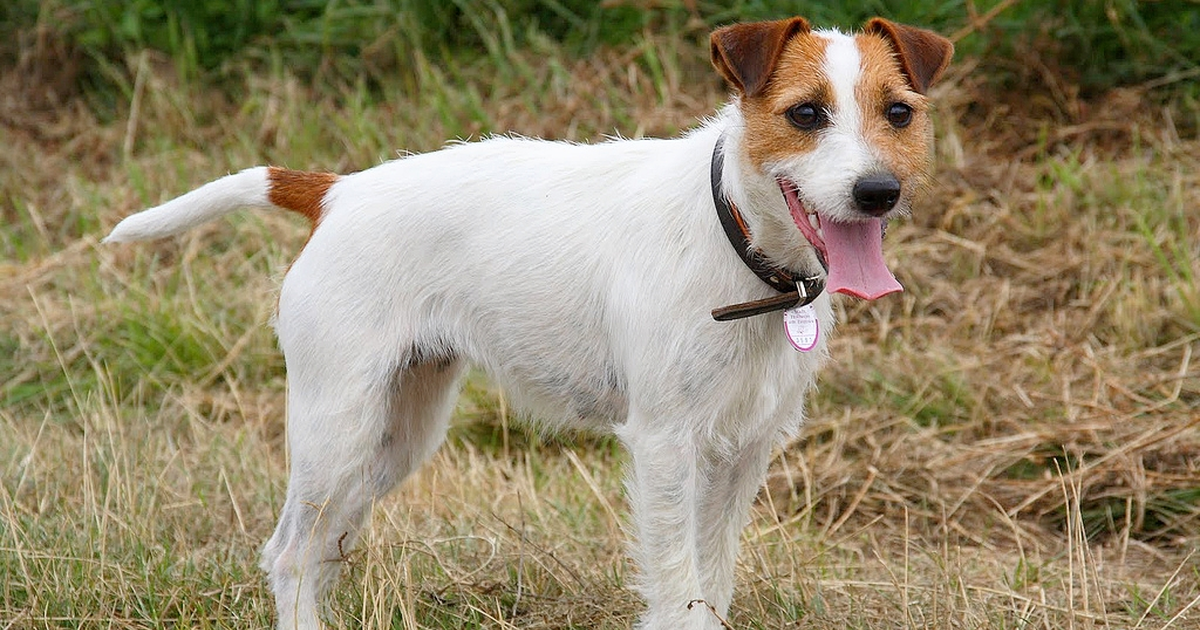
Image credit: Parson of Pirates Bela, public domain, centre-cropped to 1200×630.
References
- Gilliam D, O’Brien DP, Coates JR, et al. A homozygous KCNJ10 mutation in Jack Russell Terriers and related breeds with spinocerebellar ataxia with myokymia, seizures, or both. J Vet Intern Med. 2014;28(3):871-877. https://onlinelibrary.wiley.com/doi/pdf/10.1111/jvim.12355
- Gast AC, Metzger J, Tipold A, Distl O. Genome-wide association study for hereditary ataxia in the Parson Russell Terrier and DNA-testing for ataxia-associated mutations in the Parson and Jack Russell Terrier. BMC Vet Res. 2016;12:225. https://pmc.ncbi.nlm.nih.gov/articles/PMC5057501/
- Forman OP, De Risio L, Mellersh CS. Missense mutation in CAPN1 is associated with spinocerebellar ataxia in the Parson Russell Terrier dog breed. PLOS ONE. 2013;8(5):e64627. https://pmc.ncbi.nlm.nih.gov/articles/PMC3669408/
- Rohdin C, Ludwig CA, Drögemüller C, et al. A KCNJ10 mutation previously identified in the Russell group of terriers also occurs in Smooth-Haired Fox Terriers with hereditary ataxia and in related breeds. Acta Vet Scand. 2015;57:26. https://pubmed.ncbi.nlm.nih.gov/25998802/
- Bockenhauer D, Feather S, Stanescu HC, et al. Epilepsy, ataxia, sensorineural deafness, tubulopathy, and KCNJ10 mutations. N Engl J Med. 2009;360(19):1960-1970. https://www.nejm.org/doi/full/10.1056/NEJMoa0810276
- Scholl UI, Choi M, Liu T, et al. Seizures, sensorineural deafness, ataxia, mental retardation, and electrolyte imbalance (SeSAME syndrome) caused by mutations in KCNJ10. Proc Natl Acad Sci USA. 2009;106(14):5842-5847. https://www.pnas.org/doi/10.1073/pnas.0905765106
- Stee K, Van Poucke M, Peelman L, Bhatti SFM. Phenotypic and genetic aspects of hereditary ataxia in dogs. J Vet Intern Med. 2023;37(1):20-33. https://onlinelibrary.wiley.com/doi/10.1111/jvim.16742
- OMIA:002089-9615 — Ataxia, cerebellar, KCNJ10-related in Canis lupus familiaris. https://omia.org/OMIA002089/9615/
- Parson Russell Terrier Association of America — breed health statement. http://images.akc.org/pdf/Parson_Russell_Terrier_health_statement.pdf
- Orthopedic Foundation for Animals (OFA) / Canine Health Information Center. https://ofa.org/
- The Royal Kennel Club — Spinocerebellar Ataxia (SCA) DNA test. https://www.royalkennelclub.com/shop/dna-testing/the-royal-kennel-club-dna-testing-services-individual-dna-tests/spinocerebellar-ataxia-sca/
- Canine Genetic Testing, Department of Veterinary Medicine, University of Cambridge — Spinocerebellar Ataxia (Russell Terrier type). https://www.cagt.co.uk/product/spinocerebellar-ataxia/
- Laboklin UK — Spinocerebellar ataxia (SCA), dog. https://www.laboklin.co.uk/laboklin/showGeneticTest.jsp?testID=8537
- Laboklin UK — Late Onset Ataxia (LOA), dog. https://www.laboklin.co.uk/laboklin/showGeneticTest.jsp?testID=8493
- DEFRA / GOV.UK — Lucy’s Law: ban on third-party sales of puppies and kittens. https://www.gov.uk/government/news/lucys-law-spells-the-beginning-of-the-end-for-puppy-farming
- Royal College of Veterinary Surgeons (RCVS) — Recognised Specialists. https://www.rcvs.org.uk/
- Paw Print Genetics — Spinocerebellar Ataxia (Terrier Type). https://www.pawprintgenetics.com/products/tests/details/153/
- Embark — Spinocerebellar Ataxia with Myokymia and/or Seizures. https://embarkvet.com/products/dog-health/health-conditions/spinocerebellar-ataxia-with-myokymia-and-or-seizures/
- Wisdom Panel — Spinocerebellar Ataxia with Myokymia and/or Seizures (SAMS). https://www.wisdompanel.com/en-us/dog-health-conditions/sams
- Genomia — Testing of dogs: SCA. https://www.genomia.cz/en/test/sca/
- LabGenVet — Spinocerebellar Ataxia, early onset, with myokymia and seizures (SCA). https://labgenvet.ca/en/disease/spinocerebellar-ataxia-early-onset-with-myokymia-and-seizures-sca/
How to get your pet tested
Some pet DNA tests screen for hereditary-disease carrier status or genetic risk markers, but the results are information, not a diagnosis. If your pet has symptoms or you need a confirmed diagnosis, please consult your veterinarian.
Below is where Spinocerebellar ataxia / SAMS (KCNJ10) can be tested, grouped by where you live and marked by whether each service explicitly lists this variant (✅ = listed / ❓ = unverified / ❌ = not offered).
In the United States
In the United Kingdom
In India
Elsewhere
Note: even if the kit can be purchased/shipped internationally, the service itself (sample return, analysis, results) is not guaranteed in your country. Check each service’s stated service area and sample-return method before ordering.
Services offered in other regions (may not be available where you live)
Worried about your pet’s health? — Talk to a veterinarian
A confirmed diagnosis and any treatment plan are decisions for a veterinarian, not a test kit. The links below are professional resources.
AVMA — Find a veterinarian (American Veterinary Medical Association)
This section contains advertising (affiliate links); we may earn a commission if you buy through them. As an Amazon Associate, we earn from qualifying purchases. Genetic tests do not guarantee the prevention, diagnosis, or treatment of any disease — results indicate tendencies and provide information only.
This page is educational information, not veterinary diagnosis or advice. Always consult a veterinarian about your pet’s health.
About the author
Elena Marsh
Editor & writer (not a veterinarian)
A writer with a molecular-biology background and a lifelong dog and cat owner. Not a veterinarian — she translates peer-reviewed genetics research and primary data into plain language, always as information rather than diagnosis.