

Bottom line: Thrombopathia in the American Eskimo Dog is an autosomal recessive platelet disorder caused by a one-letter insertion (c.452dup, published as 452-453insA) in exon 5 of the CalDAG-GEFI gene, RASGRP2. Auburn University identified it in 2006 from one affected dog the researchers called an “Eskimo Spitz”. Affected dogs bleed from the nose, gums and gut although their platelet count and routine clotting tests look normal. A DNA result is risk information, not a diagnosis: unusual bleeding needs a veterinarian’s workup, and a clear result does not rule out other bleeding disorders.
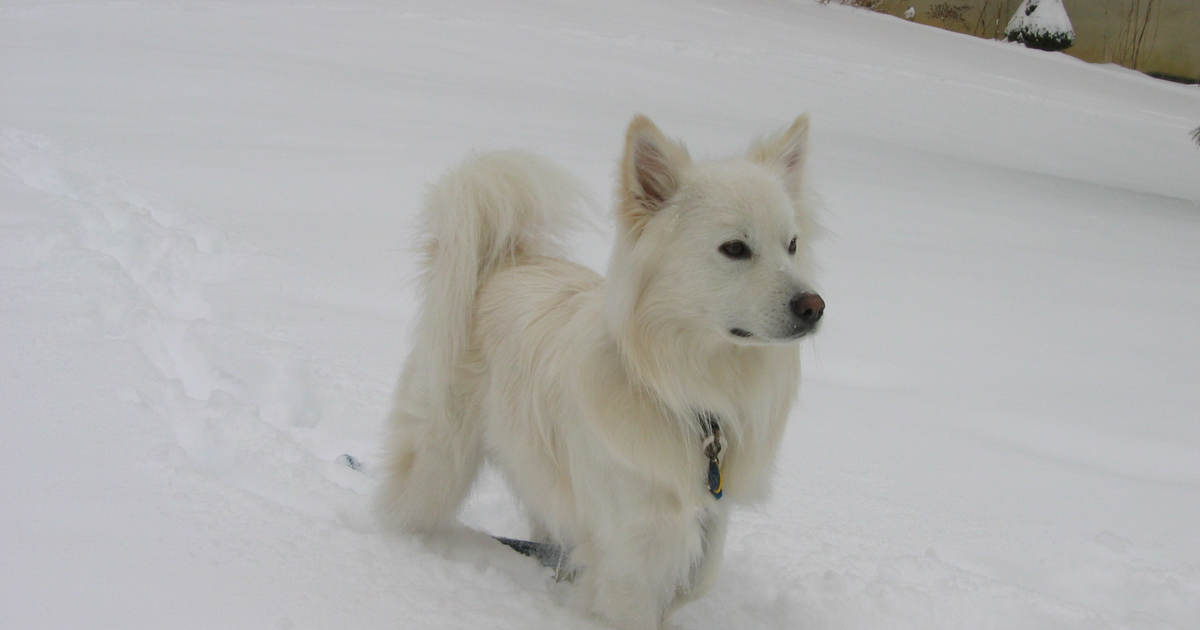
The American Eskimo Dog placed No. 124 of 202 breeds in the American Kennel Club’s 2025 registration ranking, and No. 79 on the same year’s rarest-breeds list. It comes in toy (9-12 in), miniature (12-15 in) and standard (15-19 in) sizes. For a breed this size, with a disorder that hides behind normal lab values, the useful questions are what was measured, in how many dogs, and what each test can read.
- One bleeding Spitz, one extra letter: the Auburn sequencing of 2006
- The lab form says “Spitz”: an old breed name that hides the right test
- Normal platelet count, normal clotting screen, still a bleeder
- RASGRP1 on the report, RASGRP2 in the database
- Fifty-four results, zero carriers, and 139 carriers that were mostly mixed breeds
- Four places to order the Eskie test, three listings built for another breed
- A patent that lapsed in 2022 and the labs that list the test now
- Why a bleeding Eskie has to travel to the test
- Ten days under Virginia law, and an insurance clock that resets
- Frequently asked questions
- References
- How to get your pet tested
One bleeding Spitz, one extra letter: the Auburn sequencing of 2006
In 1994 Mary K. Boudreaux and colleagues at Auburn University described an intrinsic platelet function defect in Spitz dogs in the Journal of Veterinary Internal Medicine. Two dogs had chronic, intermittent bleeding, mostly from the nose, mouth and gastrointestinal lining. Their platelets looked normal under light and electron microscopes and still carried GPIIIa, part of the fibrinogen receptor, which ruled out Glanzmann thrombasthenia. Yet they would not aggregate to ADP, collagen or platelet-activating factor. They changed shape, then stalled; only gamma-thrombin made them clump, late and slowly. Two related males had no bleeding tendency but weaker collagen responses. The authors judged the defect closest to one already known in Basset Hounds. Auburn’s submission form for the test adds that the 1994 dogs had nosebleeds, gut and gum bleeding, a shifting lameness and hematomas, and tells owners to watch the gums as permanent teeth come in.
The molecular answer followed. Boudreaux, Catalfamo and Klok (2007) in Translational Research reported loss-of-function mutations in the CalDAG-GEFI gene in three breeds. The paper’s full text is paywalled, so dog counts come from the matching US patent 7,838,232, whose worked example repeats the abstract word for word. According to the patent, only one affected Eskimo Spitz was sequenced. It carried an extra adenine between nucleotides 452 and 453 in exon 5, shifting the reading frame; the protein is predicted to stop early, near the end of exon 7. No cDNA from the dog was available to check that prediction. The patent calls this dog’s defect “essentially identical” to the Basset disease, for which it lists 79 sequenced hounds, 8 of them affected.
The OMIA entry 002433-9615 (University of Sydney) now records the change as XM_849829.5:c.452dup, p.(D151Efs), in the American Eskimo Dog, and marks its formal pathogenicity classification “not currently evaluated”. Two gaps remain: the 1994 abstract does not say whether its dogs were registered American Eskimo Dogs, and no source says whether the 2006 dog was one of them.
The lab form says “Spitz”: an old breed name that hides the right test
Search Auburn’s site for “American Eskimo” and you will not find this test. The Hemostasis Laboratory’s platelet testing page lists it as Spitz Thrombopathia, beside separate Basset Hound and Landseer forms. That is breed history, not a typo.
The American Eskimo Dog Club of America (AEDCA) breed history says the United Kennel Club registered the breed in 1913, white dogs only, and that the first recorded registrations were seven dogs under the name “Spitz”. It describes renamings to “American Spitz” (1924) and “American Eskimo Spitz” (1925), with “Spitz” dropped in 1926, yet the breed “was still referred to for many years as ‘Spitz’ or ‘Eskimo Spitz’.” The UKC standard (revised May 1, 2023) instead says the breed, known as the German Spitz in its homeland, was renamed the American Eskimo in 1917. The sources disagree on the year; we leave it there.
AEDCA records AKC approval for registration on April 13, 1993, Miscellaneous class from January 1, 1994, and full acceptance in 1995; Eskies now show in the AKC Non-Sporting group and the UKC Nordic group. That long “Spitz” era explains why the 1994 and 2007 papers use the old names, while OMIA, Genomia and Wisdom Panel file the variant under American Eskimo Dog or “Eskimo Spitz”. Practical point: when looking for the discovery lab’s test, search for Spitz, and on any commercial report check that the line names the Eskimo or Spitz variant, not just “thrombopathia”.
Normal platelet count, normal clotting screen, still a bleeder
CalDAG-GEFI was cloned at MIT by Kawasaki and colleagues (1998), who found it concentrated in the brain’s basal ganglia, responsive to calcium and diacylglycerol, and able to switch on the small signalling protein Rap1A. In platelets that relay has one main job: activated Rap1 flips the integrin αIIbβ3 into a fibrinogen-grabbing shape, and fibrinogen bridges platelets into a plug. Crittenden and colleagues (2004) showed that mouse platelets lacking CalDAG-GEFI had severely impaired integrin-dependent aggregation because the signal never reached Rap1.
The receptor itself is intact. The 2007 Auburn paper found normal αIIbβ3 on affected dog platelets but markedly impaired fibrinogen binding after ADP stimulation, unlike Glanzmann thrombasthenia, where the integrin is missing or faulty. It also found platelet number, von Willebrand factor, clot retraction and coagulation screening assays normal; only bleeding time tests were prolonged. A 2020 review in Animals by Cortese, Christopherson and Pelagalli explains why: these platelets still respond to thrombin, after a lag, reaching full aggregation in 4-6 minutes rather than the usual 3 minutes or less. Clot retraction, which relies on thrombin, therefore looks normal too. A coagulation panel before a spay can be clean in a dog that will still bleed.
SamSo what test would actually show something before surgery? Elena MarshBleeding time. In a 1993 study of 35 dogs with defined bleeding disorders, every dog with a primary hemostasis defect had a prolonged buccal mucosal bleeding time.That study by Brooks and Catalfamo also found bleeding time normal in every dog lacking a clotting factor (hemophilia A and B, factor VII deficiency), though its abstract does not say how many dogs had thrombopathia or of which genetic type. At the University of Pennsylvania, Callan and Giger (2001) found a point-of-care closure-time analyzer’s ADP cartridge prolonged in 5 of 6 dogs with thrombopathia, but the cause in those six was never identified, so they are not confirmed CalDAG-GEFI cases.
RASGRP1 on the report, RASGRP2 in the database
Wisdom Panel’s condition page “Thrombopathia (Discovered in the Eskimo Spitz)” names the gene RASGRP1, and Embark’s page does too. Your report may say RASGRP1; it is the same variant this article calls RASGRP2. Wisdom’s coordinate, chromosome 18 position 52,417,256 (CanFam3.1), is exactly where OMIA places the American Eskimo Dog variant.
OMIA first listed the disease under RASGRP1 from NCBI information, then, after a BLAST check, moved the entry on January 22, 2022 and stated the correct gene is RASGRP2; the old entry 001003-9615 now reads “key variant known: no”. NCBI’s dog records hint at the source of the mix-up: RASGRP2 sits on chromosome 18, while the RASGRP1 record (chromosome 30) still lists “CalDAG-GEFI” as an alias. The 1998 MIT paper had already identified CalDAG-GEFII as the protein known as RasGRP, today’s RASGRP1.
In people, Canault and colleagues (2014) found a RASGRP2 mutation in three siblings with severe bleeding. Rap1 activation and αIIbβ3 signalling were reduced, the defect was confined to platelets and megakaryocytes, and relatives with one normal copy did not bleed. The paper contrasts this with leukocyte adhesion deficiency type III, which is caused by kindlin-3. A 2007 report had tied LAD-III to CalDAG-GEFI, but later work assigned it to KINDLIN3, and no immune defect has been reported in affected dogs.
Fifty-four results, zero carriers, and 139 carriers that were mostly mixed breeds
Nobody can give an Eskie carrier rate. Here is what each source actually counted.
OFA. The Orthopedic Foundation for Animals breed statistics show 54 American Eskimo Dogs with a thrombopathia DNA result, all 54 normal, against 1,472 hip evaluations, 669 eye exams and 228 PRA results. The Basset Hound line shows 96 tested and 3 carriers. OFA does not say which variant the 54 Eskie samples were tested for, and owner-submitted results are not a survey.
The million-dog study. Donner and colleagues (2023) in PLoS Genetics genotyped about 1.05 million Wisdom Panel customer dogs, roughly 810,000 of them mixed breeds; it is not a random sample. Overall, 139 dogs carried one copy of the Eskimo variant and none carried two; 132 of the 139 were mixed breeds, 7 purebred. In 302 American Eskimo Dogs the allele frequency was 0.83%, about five copies across the breed sample. That is a share of chromosomes, not of carrier dogs, from a small customer base. Single copies also appeared once each among 5,294 Pomeranians and 4,718 Rottweilers; no disease is reported in those breeds.
The 2018 study. Donner and colleagues (2018) found, among about 83,000 mixed-breed dogs, 14 with one copy of the Eskimo variant and 4 with two; among roughly 13,000 purebreds, none. Whether the four two-copy dogs ever bled was not recorded.
SamIf most carriers are mixes, is my purebred Eskie basically safe? Elena MarshThat doesn’t follow. The 2023 data still found the variant among 302 Eskies, and mixes dominate the counts partly because they were about three in four dogs tested.Company figures and surveys. Wisdom Panel says the variant was “Found in 1 in 5,100 dogs in our testing”, a figure for its whole, mostly mixed-breed customer base that does not match the published counts; treat it as the company’s number. The breed’s closed owner health survey on OFA logged 2 “Platelet abnormality” answers, and AEDCA’s 2019 analysis found 19 of 862 dogs with any blood or lymphatic diagnosis, none confirmed as thrombopathia. The CHIC protocol and AKC parent-club recommendation cover hips, eyes and prcd-PRA only, so this test depends on breeders choosing it.
Four places to order the Eskie test, three listings built for another breed
Three breed-specific variants sit on the same gene: Basset Hound (c.509_511del, a three-letter deletion in exon 5), American Eskimo Dog (c.452dup, exon 5) and Landseer of European Continental Type (c.982C>T, a stop codon in exon 8). A test for one says nothing about the others. Prices were read from provider pages on October 17, 2026; US prices exclude sales tax.
| Provider | What the listing names | Price shown | Fit for an Eskie |
|---|---|---|---|
| Auburn University Hemostasis Laboratory (Alabama) | “Spitz Thrombopathia” DNA test; 1 ml EDTA whole blood, no ice, typically 8-10 working days after arrival | $130.00 | Yes: the discovery lab’s own test |
| Wisdom Panel Premium | “Thrombopathia (Discovered in the Eskimo Spitz)” among 270+ conditions; results within 3 weeks | $127.99 sale (regular $159.99) | Yes in Premium; not confirmed for the 25+ condition Essential kit |
| Orivet American Eskimo Dog Full Breed Profile | “Thrombopathia (Platelet Dysfunction)” with DM, PLL and prcd-PRA | $139.00, free shipping | Likely: the page names no variant, but the IPFD harmonization database lists Orivet’s test as the American Eskimo Dog type |
| Genomia (Czech Republic) | “Thrombopathia in American Eskimo Dog”, c.452dup in RASGRP2; 12 business days | $56.00 excluding VAT | Yes; useful outside the US |
| Embark | “RASGRP1 Exon 5, Basset Hound Variant”; breeds affected: Basset Hound | $139 sale (regular $159) | Not confirmed: the page names only the Basset variant |
| Animal Genetics | “Thrombopathia (Newfoundland type)” | $40.00 (US) / £40.00 (UK) | No: different variant |
| LABOKLIN UK, test 8486 | Thrombopathia for Basset Hound and Landseer | £48.00 including VAT | No: American Eskimo Dog not listed |
Auburn bills through Pathobiology Diagnostic Services, whose online portal handles requests, reports and payment; the form also allows check or wire, with invoices due within 30 days. Embark’s full condition list could not be searched, so a missing Eskimo line there means “not found”, not “not offered”. Paw Print Genetics, which listed a “Thrombopathia (American Eskimo Dog Type)” test, is merging with Orivet and its product pages show only the merger notice. In the UK no lab was found listing the Eskie variant, so Genomia or a US provider is the realistic route. Wisdom labels the condition “Low likelihood” and, as company information, says it is present from birth, has no cure and usually leaves lifespan normal; no long-term studies of affected dogs exist to check that, and the 1994 dogs bled chronically.
A patent that lapsed in 2022 and the labs that list the test now
US 7,838,232 B2 names Mary K. Boudreaux as inventor and Auburn University as assignee, with priority from October 19, 2006 and grant on November 23, 2010. The fourth- and eighth-year maintenance fees were paid; Google Patents lists it as expired for non-payment of the twelfth-year fee, effective November 23, 2022, while noting that its legal status is an assumption, not a legal conclusion.
The patent is also the fullest public record of the original dogs, and not a tidy one. Its worked example sequences 79 Basset Hounds, 1 Eskimo Spitz, 8 Landseers, a mixed breed and a Cavalier King Charles Spaniel; elsewhere the text says “41 basset hounds”, and another passage 57. The Eskimo count never changes: one affected dog. Today the International Partnership for Dogs’ testing-harmonization database lists 14 providers for the American Eskimo Dog, under the old RASGRP1 label. More labs since 2022 is consistent with the patent ending, but nothing shows the lapse caused it.
Why a bleeding Eskie has to travel to the test
A DNA sample can be mailed; a platelet function sample cannot. The veterinary clinical pathology textbook eClinPath says that, apart from the buccal mucosal bleeding time, these assays “are only available at specialized veterinary laboratories”, need fresh platelets so “samples cannot be sent through the mail”, and a suspected case “should be referred to the laboratory or veterinary school performing the testing.” A 2012 review by Christopherson, Spangler and Boudreaux agrees that advanced platelet testing sits at a limited number of academic institutions. Auburn’s page advertises DNA forms only, and we could not confirm which US schools currently run aggregation tests for client dogs, so have your vet call a university hemostasis service before you travel.
A typical route: the family vet sees bleeding that doesn’t fit, such as gums oozing after a lost tooth or an incision that keeps seeping, and finds a normal platelet count and coagulation panel. A bleeding time can be done in the clinic. If it is long, the DNA test for the Eskimo variant needs no travel, and referral for platelet function work follows if needed. Two copies of the variant in a dog with this history support the diagnosis your vet is weighing; a clear result sends the search elsewhere.
SamIf she’s diagnosed, is there anything that fixes it? Elena MarshThere is no cure. A 2009 review of canine platelet transfusion describes blood products as the way veterinary teams manage serious bleeding, case by case.That review, Callan, Appleman and Sachais (2009), concerns hospital practice; supportive care with blood products is decided by the treating team, often at a referral or emergency center. Owners can plan: tell the surgeon about the genotype before any elective procedure, dentals included, as Embark’s page also advises so blood products are on hand. Treat a nosebleed that won’t stop, vomiting blood, or black, tarry stools as an emergency. Auburn’s Basset form notes that hidden gut bleeding can cause iron-deficiency anemia, so pale gums or tiredness in a known affected dog also deserve a visit.
A clear CalDAG-GEFI result does not end a workup. Glanzmann thrombasthenia from ITGA2B defects is described in the Great Pyrenees and the Otterhound, a P2Y12 receptor variant caused postoperative bleeding in a Greater Swiss Mountain Dog, von Willebrand disease belongs in the same differential, and Callan and colleagues (2001) reported platelet defects in a Boxer and a mixed-breed dog whose genetic basis was never found.
Ten days under Virginia law, and an insurance clock that resets
Virginia Code § 3.2-6514 shows how buyer law misses this disease. If, within 10 days of receipt, a licensed veterinarian certifies an animal unfit because of illness or “a congenital defect deleterious to the health of the animal”, the buyer has three business days to claim a refund including sales tax or an exchange; buyers from pet shops and USDA-licensed dealers may instead keep the animal and recover vet fees up to the purchase price. Violations are a prohibited practice under the Virginia Consumer Protection Act. But a puppy with normal counts and a clean clotting panel is unlikely to be certified defective within ten days, and whether a hobby breeder counts as a “pet dealer” was not confirmed. This is not legal advice.
MetLife Pet Insurance says hereditary conditions can be covered if no symptoms appear before enrolment or during the 14-day waiting period, and its Preventive Care add-on “covers DNA testing when purchased through licensed veterinarians”, relevant if your vet orders Auburn’s form. Lemonade’s puppy preventative package pays for spaying or neutering from the day after purchase, but that is the operation, not an illness found during it; cancel, and waiting periods reset while anything diagnosed under the first policy becomes pre-existing. The Hawaii Insurance Division’s consumer FAQ on pet insurance adds that wellness plans “may not cover illnesses or accidents”, that some breeds and pre-existing conditions may be excluded, and recommends buying “when your pet is young and healthy.”
For breeders the recessive arithmetic is standard: carrier to clear gives no affected puppies but about half carriers; carrier to carrier gives each puppy a one-in-four chance of being affected. The IPFD entry advises testing offspring before breeding and never pairing two carriers. The AEDCA Code of Ethics asks members to plan litters with “freedom from hereditary defects” in mind; with 54 thrombopathia results at OFA against 1,472 hip evaluations, adding the Spitz test remains a choice, not a requirement.
Frequently asked questions
Q. My Eskie’s report says “Thrombopathia (RASGRP1)”. Is that this disease?
If the line names the Eskimo Spitz variant (an insertion at chromosome 18, position 52,417,256), yes. OMIA corrected the gene symbol to RASGRP2 in 2022, but several companies still print the old one.
Q. Does one copy of the variant make my dog bleed?
No bleeding has been linked to a single copy. The disease is autosomal recessive, and in the one human family studied, relatives with one normal copy did not bleed. A carrier result matters for breeding, not surgery planning.
Q. My Eskie tested clear. Can she still have a platelet problem?
Yes. The test reads one variant. Other platelet disorders, von Willebrand disease and low platelet counts are not excluded, so unexplained bleeding still needs a veterinary workup.
Q. Can a routine pre-anesthetic blood panel pick it up?
Usually not. Platelet counts and coagulation screens are normal in affected dogs. Bleeding time is the in-clinic test that tends to be abnormal; confirmation needs a specialist platelet function lab or the DNA test.
Q. What percentage of American Eskimo Dogs carry it?
Unknown. The 0.83% allele frequency in 302 customer-tested Eskies, OFA’s 54 clear results and Wisdom Panel’s “1 in 5,100” are none of them a breed carrier rate.
Q. Should I test my Eskie before a spay or dental work?
Ask your vet. For a dog of unknown status, a DNA test for the Eskimo variant, such as Auburn’s $130 Spitz Thrombopathia test, gives the surgeon useful information, and a bleeding time can be added. Diagnosis and treatment decisions stay with your veterinarian.
References
- Boudreaux MK, Catalfamo JL, Klok M (2007). Calcium-diacylglycerol guanine nucleotide exchange factor I gene mutations associated with loss of function in canine platelets. Transl Res 150(2):81-92.
- Boudreaux MK, Crager C, Dillon AR, Stanz K, Toivio-Kinnucan M (1994). Identification of an intrinsic platelet function defect in Spitz dogs. J Vet Intern Med 8(2):93-98.
- Boudreaux MK (inventor), Auburn University (assignee). CalDAG-GEF1 gene mutations associated with thrombopathy in canines. US Patent 7,838,232 B2, granted 2010-11-23 (priority 2006-10-19).
- OMIA 002433-9615: Thrombopathia, RASGRP2-related in Canis lupus familiaris (dog). Online Mendelian Inheritance in Animals, University of Sydney. Accessed 2026-10-17.
- Donner J, Freyer J, Davison S, Anderson H, Blades M, Honkanen L, Inman L, Brookhart-Knox CA, Louviere A, Forman OP, Chodroff Foran R (2023). Genetic prevalence and clinical relevance of canine Mendelian disease variants in over one million dogs. PLoS Genet 19(2):e1010651.
- Donner J, Anderson H, Davison S, Hughes AM, Bouirmane J, Lindqvist J, Lytle KM, Ganesan B, Ottka C, Ruotanen P, Kaukonen M, Forman OP, Fretwell N, Cole CA, Lohi H (2018). Frequency and distribution of 152 genetic disease variants in over 100,000 mixed breed and purebred dogs. PLoS Genet 14(4):e1007361.
- Cortese L, Christopherson PW, Pelagalli A (2020). Platelet function and therapeutic applications in dogs: current status and future prospects. Animals (Basel) 10(2):201.
- Crittenden JR, Bergmeier W, Zhang Y, Piffath CL, Liang Y, Wagner DD, Housman DE, Graybiel AM (2004). CalDAG-GEFI integrates signaling for platelet aggregation and thrombus formation. Nat Med 10(9):982-986.
- Canault M, Ghalloussi D, Grosdidier C, et al. (2014). Human CalDAG-GEFI gene (RASGRP2) mutation affects platelet function and causes severe bleeding. J Exp Med 211(7):1349-1362.
- Brooks M, Catalfamo J (1993). Buccal mucosa bleeding time is prolonged in canine models of primary hemostatic disorders. Thromb Haemost 70(5):777-780.
- Christopherson PW, Spangler EA, Boudreaux MK (2012). Evaluation and clinical application of platelet function testing in small animal practice. Vet Clin North Am Small Anim Pract 42(1):173-188.
- Callan MB, Appleman EH, Sachais BS (2009). Canine platelet transfusions. J Vet Emerg Crit Care 19(5):401-415.
- Wisdom Panel. Thrombopathia (Discovered in the Basset Hound) and Thrombopathia (Discovered in the Eskimo Spitz), dog health condition pages. Accessed 2026-10-17.
- Auburn University College of Veterinary Medicine, Hemostasis Laboratory. Platelet testing page and DNA test submission forms: Basset Hound Thrombopathia, Spitz Thrombopathia, Landseer Thrombopathia (forms dated 2024). Accessed 2026-10-17.
How to get your pet tested
Some pet DNA tests screen for hereditary-disease carrier status or genetic risk markers, but the results are information, not a diagnosis. If your pet has symptoms or you need a confirmed diagnosis, please consult your veterinarian.
Below is where Thrombopathia (RASGRP2/CalDAG-GEFI) can be tested, grouped by where you live and marked by whether each service explicitly lists this variant (✅ = listed / ❓ = unverified / ❌ = not offered).
In the United States
In the United Kingdom
In India
Elsewhere
Note: even if the kit can be purchased/shipped internationally, the service itself (sample return, analysis, results) is not guaranteed in your country. Check each service’s stated service area and sample-return method before ordering.
Services offered in other regions (may not be available where you live)
Worried about your pet’s health? — Talk to a veterinarian
A confirmed diagnosis and any treatment plan are decisions for a veterinarian, not a test kit. The links below are professional resources.
AVMA — Find a veterinarian (American Veterinary Medical Association)
This section contains advertising (affiliate links); we may earn a commission if you buy through them. As an Amazon Associate, we earn from qualifying purchases. Genetic tests do not guarantee the prevention, diagnosis, or treatment of any disease — results indicate tendencies and provide information only.
This page is educational information, not veterinary diagnosis or advice. Always consult a veterinarian about your pet’s health.
About the author
Elena Marsh
Editor & writer (not a veterinarian)
A writer with a molecular-biology background and a lifelong dog and cat owner. Not a veterinarian — she translates peer-reviewed genetics research and primary data into plain language, always as information rather than diagnosis.