SamEvery Dalmatian I’ve ever met seemed perfectly healthy. Why does this breed get singled out for a uric acid gene test?
Elena MarshBecause it isn’t a risk that varies dog to dog here. Every single Dalmatian tested — 247 out of 247 — carries two copies of the mutation.
SamThat sounds almost like it’s just… normal for the breed, then. Is it actually a problem?
Elena MarshIt’s normal in the genetic sense, but it does raise real bladder-stone risk. The breed’s own history shows breeders have been managing this for over a century.
SamIf literally every Dalmatian has it, what’s even the point of a DNA test or an article like this?
Elena MarshBecause the gene pool isn’t static — there’s a 50-year backcross program that changed the picture, and it directly affects how you should read a modern pedigree.
SamOkay, I want to understand the actual science and what I should do about it.
Elena MarshGood — we’ll walk through the UC Davis discovery paper, the LUA backcross story, and exactly how to test and manage risk, in that order.


Bottom line: Hyperuricosuria (HUU) is an autosomal recessive disorder caused by mutations in SLC2A9, the gene for a kidney transporter that normally reclaims uric acid back into the blood. Bannasch et al. (2008, PLoS Genetics) found that all 247 Dalmatians tested were homozygous for the mutation (amino acid change Cys188Phe) — meaning the entire breed, as traditionally registered, carries two copies. That trait predisposes dogs to urate bladder and kidney stones. Since 1973, a small backcross program (Dalmatian × Pointer, bred back to Dalmatians for generations) has produced dogs with normal uric acid levels while keeping the breed’s spotted phenotype — those are the “LUA” (Low Uric Acid) Dalmatians you’ll see referenced by breeders and in AKC records. A DNA test tells you a dog’s genotype, not whether it currently has stones; diagnosis and treatment are a vet’s job.
- What SLC2A9 actually does, and why Dalmatians are different from every other breed
- The LUA backcross: how breeders engineered a fix decades before the gene was found
- Clinical picture: urate stones, and why they’re easy to miss on an X-ray
- Testing, cost, and reading the result
- Diet, monitoring, and what owners can actually do
- Insurance and the club/registry landscape
- What Dalmatian owners can do today
- Frequently asked questions
- References
- How to get your pet tested
What SLC2A9 actually does, and why Dalmatians are different from every other breed
Most mammals break purines down into uric acid and then, via an enzyme called uricase, convert that further into allantoin — a compound that dissolves in urine far more easily. The Dalmatian is the one dog breed that ends up excreting uric acid directly instead, a trait documented for close to a century — but contrary to a common assumption, the defect isn’t in the uricase enzyme itself. Bannasch and colleagues confirmed that Dalmatian liver homogenates are capable of oxidising uric acid to allantoin, and genetically excluded the uricase gene as a candidate. The actual defect sits one step earlier: in the transport of uric acid into liver and kidney cells in the first place.
Bannasch, Safra, Young, Karmi, Schaible and Ling (2008, PLoS Genetics 4(11):e1000246) identified the actual mechanism using positional cloning: a missense mutation in SLC2A9 (amino acid substitution Cys188Phe, abbreviated C188F; commonly cited alongside the nucleotide notation G616T, though exact numbering varies by reference transcript) located in exon 5, within the gene’s fifth transmembrane domain, plus two promoter SNPs. SLC2A9 encodes a urate transporter that normally reabsorbs uric acid from urine back into the bloodstream in the kidney. When it fails, uric acid that should have been reclaimed stays in the urine at abnormally high concentration — hyperuricosuria.
The study’s genotyping is what makes Dalmatians unusual: all 247 Dalmatians tested were homozygous for the mutation, while 378 dogs across 58 other breeds carried only the normal (wild-type) allele at the time of that study. The same paper also detected the mutation in affected Bulldogs and Black Russian Terriers — breeds where, unlike the Dalmatian, it segregates rather than being fixed.
The LUA backcross: how breeders engineered a fix decades before the gene was found
Long before anyone knew which gene was responsible, Dalmatian breeder and medical geneticist Dr. Robert Schaible set out to solve the practical problem directly. In 1973, he crossed a male Pointer — the only non-Dalmatian ever used in the project — to a female Dalmatian, then bred the offspring back to purebred Dalmatians across successive generations. The goal: dogs that looked and behaved like Dalmatians but had normal, low uric acid levels and therefore lower stone risk.
The registration history is its own case study in breed-club politics. AKC agreed to register two fifth-generation backcross puppies in 1981, but a 1984 Dalmatian Club of America membership vote opposed continued registration, and the project stalled for decades. It wasn’t until July 2011 that the AKC formally announced it would register descendants of that original 1973 litter as Dalmatians. By that point, the backcross lines’ pedigrees were roughly 99.98% AKC-registered Dalmatian, and parentage analysis put their DNA at about 99.8% identical to standard Dalmatians. These are the dogs marketed today as “LUA Dalmatians” — genetically low-uric-acid, phenotypically standard.
The UK followed a similar but separate path. The Kennel Club accepted registration of an imported LUA Dalmatian bred from the same US backcross programme, and — despite opposition from sections of the breed club — formally agreed to recognise LUA Dalmatians for registration. If you’re buying in Britain, ask specifically whether a “Kennel Club registered” Dalmatian is from a standard or LUA line, since registration status alone doesn’t tell you which — a reputable breeder should be able to state a puppy’s HUU genotype on request. Note that the Kennel Club’s long-running Assured Breeder Scheme closed at the end of 2024, so don’t rely on outdated “Assured Breeder” listings; check the Kennel Club’s current breeder-standards guidance instead.
SamSo an “LUA Dalmatian” is basically a normal Dalmatian that just happens to have one Pointer ancestor from the 1970s? Elena MarshEssentially, yes. By the time the AKC recognised them in 2011 — many generations later — their pedigree was about 99.98% Dalmatian.Clinical picture: urate stones, and why they’re easy to miss on an X-ray
Elevated uric acid in the urine predisposes affected dogs to form urate crystals and stones (uroliths), most commonly in the bladder but sometimes in the kidney. Signs can include straining to urinate, frequent urination, blood in the urine, and urinating in unusual places — though some affected dogs show no signs at all. Urate stones are often poorly visible on plain radiographs compared with the more common struvite or calcium oxalate stones, so ultrasound or urine sediment analysis is typically more useful for detection.
Male dogs are at particular risk of a genuine emergency: a stone can lodge in the narrower male urethra and cause a complete obstruction. A dog straining repeatedly with little or no urine output needs same-day veterinary attention, not a wait-and-see approach — a blocked urethra can become life-threatening within hours.
SamA stone not showing up on an X-ray sounds like a terrifying way to miss something serious. Elena MarshThat’s exactly why vets lean on ultrasound or urine sediment analysis for this breed instead of relying on plain radiographs alone.Testing, cost, and reading the result
The SLC2A9 DNA test uses a non-invasive cheek (buccal) swab. In the US, the SLC2A9 (HUU) test is not one of the DNA tests OFA runs itself through its exclusive arrangement with the University of Missouri — HUU doesn’t appear on that list, so “order through OFA” isn’t a working route for this specific test. Order directly from UC Davis Veterinary Genetics Laboratory instead, the fee-for-service lab affiliated with the UC Davis School of Veterinary Medicine where Bannasch’s research group discovered the mutation: VGL’s own published fee is $58 for a single test (a small volume discount applies at three or more dogs, and it’s $27 if ordered as an add-on alongside another panel on the same dog). In Europe, Genomia lists both the Dalmatian and the Russian Black Terrier by name among its 45 tested breeds, at roughly $56 per test (excluding VAT) with about a 12-business-day turnaround.
In the UK, you don’t need to send a sample abroad. The Kennel Club’s own HUU DNA test costs £60.00, uses a cheek swab posted to your home with a prepaid return envelope, and has a 1-3 week turnaround, with results searchable in the Kennel Club’s own health test results database — the UK analogue of an OFA lookup. Laboklin UK offers the same test for £48.00 including VAT, accepting either a buccal swab or 0.5-1 ml EDTA blood, with a 2-3 week turnaround. In dollar terms those UK prices convert to roughly $80 and $64 at typical exchange rates — both higher than VGL’s $58 US fee — so the UK routes aren’t necessarily cheaper in absolute cost, but they save UK owners the hassle and delay of an international shipment, and keep the result in a UK-searchable database.
Results come back in three categories:
- Clear (N/N): no copies of the mutation. In non-Dalmatian breeds this means the dog will not develop SLC2A9-driven HUU and cannot pass the mutation on. (Not clinically meaningful for a purebred Dalmatian, since the mutation is fixed in the breed outside LUA lines.)
- Carrier (N/HUU): one copy. Not expected to be clinically affected, but can pass the mutation to roughly half its offspring.
- Affected/at-risk (HUU/HUU): two copies, as in nearly all traditional Dalmatians. Elevated urate excretion and increased stone risk; diet and monitoring reduce, but don’t eliminate, that risk.
One important caveat on “Clear”: a clear (N/N) result rules out SLC2A9-driven HUU specifically — it does not rule out urate stones altogether. Dogs of any breed and any HUU genotype can form urate stones for unrelated reasons, most notably an underlying liver problem such as a portosystemic shunt that impairs the liver’s own handling of urate precursors. A clear genetic result plus urate stones is a reason to investigate liver function, not a reason to doubt the DNA test.
For most Dalmatians, testing isn’t about discovering something unexpected — it’s about confirming LUA status if you’re buying, selling, or breeding a low-uric-acid line, since visually a LUA Dalmatian is indistinguishable from a standard one.
SamIf almost every Dalmatian is already “affected” by definition, does testing even change anything for a pet owner? Elena MarshFor a pet, not much — but for a buyer or breeder trying to source an LUA line, it’s the only way to tell a low-uric-acid dog from a standard one, since they look identical.Diet, monitoring, and what owners can actually do
Because nearly all traditional Dalmatians excrete elevated uric acid regardless of DNA test result, management is largely about lifestyle rather than genotype interpretation: a purine-restricted diet (several veterinary therapeutic diets are formulated specifically for this), generous water intake to keep urine dilute, and frequent opportunities to urinate all reduce crystal and stone formation. Dogs with a history of urate stones typically need periodic urinalysis and, in some cases, prescription urinary diets for life, under veterinary supervision — this is a management condition, not a one-time fix.
Insurance and the club/registry landscape
In the US, insurers such as Trupanion and Healthy Paws advertise coverage for hereditary and congenital conditions on their core plans, provided no signs or symptoms were present before the policy’s effective date and any waiting period has passed — but plan tiers vary between providers, so confirm the specific plan you’re quoted covers hereditary conditions rather than assuming it from the brand name alone. Because nearly every Dalmatian is genetically “affected” by definition, insurers are unlikely to treat the genotype itself as a disqualifying pre-existing condition — what matters is whether a dog has already had a documented stone episode before coverage starts. Insure early, and get the hereditary-condition wording in writing before you need it.
UK policies use a different structural split worth understanding before you buy: “Covered For Life” (lifetime) policies keep paying for an ongoing condition year after year as long as you renew without a break, while time-limited policies cap cover for each new condition at 12 months. Petplan and Agria both state that hereditary and congenital conditions are covered as standard on their lifetime plans, provided the dog hadn’t already shown clinical signs or been diagnosed before the policy started — which matters for a Dalmatian, since the underlying genetics are present from birth even though stones may never form. For a lifelong management condition like recurring urate stones, a time-limited policy that stops paying after a year is a materially weaker safety net than a lifetime one; get a lifetime policy in place while the dog is still a puppy and get the hereditary-condition wording in writing, rather than reading the small print only after a stone shows up.
Therapeutic purine-restricted diets are available on both sides of the Atlantic through much the same channel. In the US they’re typically dispensed by your own vet’s in-house pharmacy or a linked online pharmacy; in the UK the same Hill’s and Royal Canin urinary-care ranges are available through your vet’s dispensary or Registered Veterinary Practice-linked online pharmacies such as VioVet. Note that in the UK these therapeutic diets are regulated as specialist animal feed (a “PARNUTs” product) rather than as a veterinary medicine, so no prescription is legally required to buy them — but most retailers still ask your vet to confirm the diet is appropriate before shipping, and getting your vet’s input is worth doing regardless of the legal minimum.
On the club side, the Dalmatian Club of America is the AKC parent club and the body that debated the LUA backcross registration for decades; its affiliated charitable arm, the Dalmatian Club of America Foundation, is a useful starting point for health resources; its health resources and the AKC’s own registration history are worth reading directly if you’re evaluating breeding stock. There is no legal requirement in the US to genetically test a Dalmatian before breeding — testing and disclosure are voluntary, club-recommended practices, not statutory ones. In the UK, the Kennel Club’s 2016 health programme for Dalmatians, developed with the UK breed clubs, endorses the SLC2A9/HUU DNA test and flags it as particularly relevant when evaluating outcross (LUA-derived) dogs and their descendants — but this is a scheme recommendation, not a legal requirement enforced by any UK authority. (The Kennel Club’s separate Assured Breeder Scheme, which some older sources reference, closed at the end of 2024; it’s no longer the relevant standard to check.)
What Dalmatian owners can do today
- Assume your Dalmatian has elevated urate excretion unless you have documentation it’s from a confirmed LUA line — this is the normal state for the breed, not a red flag on its own.
- Watch for straining, frequent urination, or blood in the urine, and treat male dogs straining with little output as a same-day emergency.
- Ask your vet about a purine-restricted diet and adequate hydration as baseline preventive management, especially for dogs with any stone history.
- If you’re buying, selling, or breeding, confirm LUA status by DNA test rather than by appearance — the two lines look identical.
- Insure early, before any stone episode is on record, and confirm hereditary-condition coverage terms in writing.
- This article is general information, not a diagnosis. Talk to your veterinarian about testing, diet, and monitoring specific to your dog.
Frequently asked questions
Q. Does every Dalmatian really have this mutation?
Among traditionally registered Dalmatians, yes — Bannasch et al. (2008) found all 247 dogs tested were homozygous. LUA (Low Uric Acid) backcross-line Dalmatians are the documented exception, tracing to a single 1973 Dalmatian-Pointer cross.
Q. Is a Black Russian Terrier at the same risk as a Dalmatian?
No — the mechanism is the same gene, but the population genetics differ. In Black Russian Terriers the mutation segregates (allele frequency about 0.51, roughly 27% affected per Karmi et al. 2010), rather than being fixed across the whole breed as in the Dalmatian.
Q. My Dalmatian has never had a stone. Do I still need to worry?
Most Dalmatians never form a stone despite elevated uric acid excretion, but the underlying risk is present for the dog’s whole life. Basic prevention — hydration, diet, monitoring — is worth doing regardless of history.
Q. What’s the difference between a DNA test and a urine test for this?
The DNA test reports genotype (how many copies of the mutation) and doesn’t change over a dog’s lifetime. A urine uric-acid-to-creatinine ratio test measures current excretion and can help flag active risk, but per Karmi et al. (2010) it can’t reliably distinguish carriers from clear dogs — only the DNA test does that definitively.
Q. My dog is straining to urinate right now. Should I wait for test results?
No. A dog straining with little or no urine output — especially a male — needs same-day veterinary care. This is a potential emergency, not something to diagnose from an article.
References
- Bannasch D, Safra N, Young A, Karmi N, Schaible RS, Ling GV (2008). “Mutations in the SLC2A9 Gene Cause Hyperuricosuria and Hyperuricemia in the Dog.” PLoS Genetics 4(11):e1000246.
- Karmi N, Safra N, Young A, Bannasch DL (2010). “Validation of a urine test and characterization of the putative genetic mutation for hyperuricosuria in Bulldogs and Black Russian Terriers.” American Journal of Veterinary Research 71(8):909-914. PMID 20673090.
- Karmi N, Brown EA, Hughes SS, McLaughlin B, Mellersh CS, Biourge V, Bannasch DL (2010). “Estimated Frequency of the Canine Hyperuricosuria Mutation in Different Dog Breeds.” Journal of Veterinary Internal Medicine 24(6):1337-1342.
- UC Davis News — “Dalmatian Bladder Stones Caused By Gene That Regulates Uric Acid In Humans” (2008)
- UC Davis Veterinary Genetics Laboratory — Hyperuricosuria (HUU)
- OFA — Order DNA Tests
- Genomia — Hyperuricosuria test (breeds tested, pricing, turnaround)
- Dalmatian Club of America Foundation
- Trupanion — Hereditary and Congenital Conditions
- Healthy Paws — Hereditary and Congenital Conditions in Pets
- The Kennel Club (UK) — Hyperuricosuria (HUU) DNA test, £60.00
- Laboklin UK — Hyperuricosuria/Urate Stones (HUU, SLC), £48.00 inc. VAT
- Petplan UK — Lifetime and time-limited pet insurance
- Agria Pet Insurance (UK) — Does Pet Insurance Cover Pre-Existing Conditions?
- The Kennel Club — New Health Programme For Dalmatians (2016, SLC2A9/HUU DNA test)
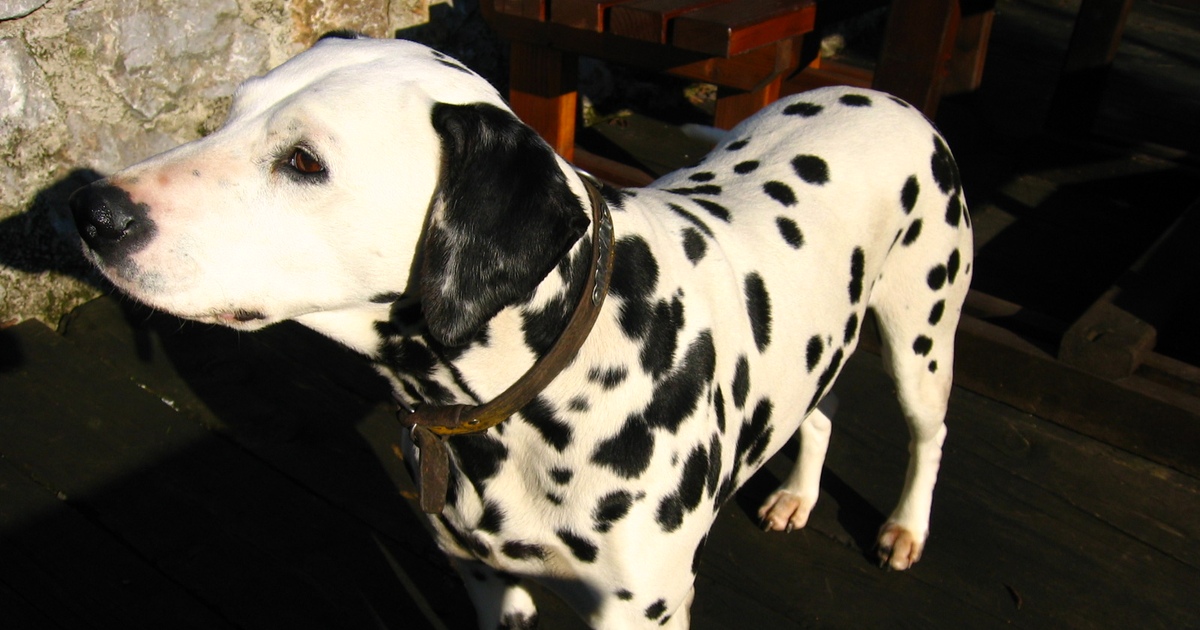
Image: “Dalmatian in Croatia”, public domain, via Wikimedia Commons (scaled proportionally and centre-cropped to 1200×630).
How to get your pet tested
Some pet DNA tests screen for hereditary-disease carrier status or genetic risk markers, but the results are information, not a diagnosis. If your pet has symptoms or you need a confirmed diagnosis, please consult your veterinarian.
Below is where Hyperuricosuria / HUU (SLC2A9) can be tested, grouped by where you live and marked by whether each service explicitly lists this variant (✅ = listed / ❓ = unverified / ❌ = not offered).
In the United States
In the United Kingdom
In India
Elsewhere
Note: even if the kit can be purchased/shipped internationally, the service itself (sample return, analysis, results) is not guaranteed in your country. Check each service’s stated service area and sample-return method before ordering.
Services offered in other regions (may not be available where you live)
Worried about your pet’s health? — Talk to a veterinarian
A confirmed diagnosis and any treatment plan are decisions for a veterinarian, not a test kit. The links below are professional resources.
AVMA — Find a veterinarian (American Veterinary Medical Association)
This section contains advertising (affiliate links); we may earn a commission if you buy through them. As an Amazon Associate, we earn from qualifying purchases. Genetic tests do not guarantee the prevention, diagnosis, or treatment of any disease — results indicate tendencies and provide information only.
This page is educational information, not veterinary diagnosis or advice. Always consult a veterinarian about your pet’s health.
About the author
Elena Marsh
Editor & writer (not a veterinarian)
A writer with a molecular-biology background and a lifelong dog and cat owner. Not a veterinarian — she translates peer-reviewed genetics research and primary data into plain language, always as information rather than diagnosis.