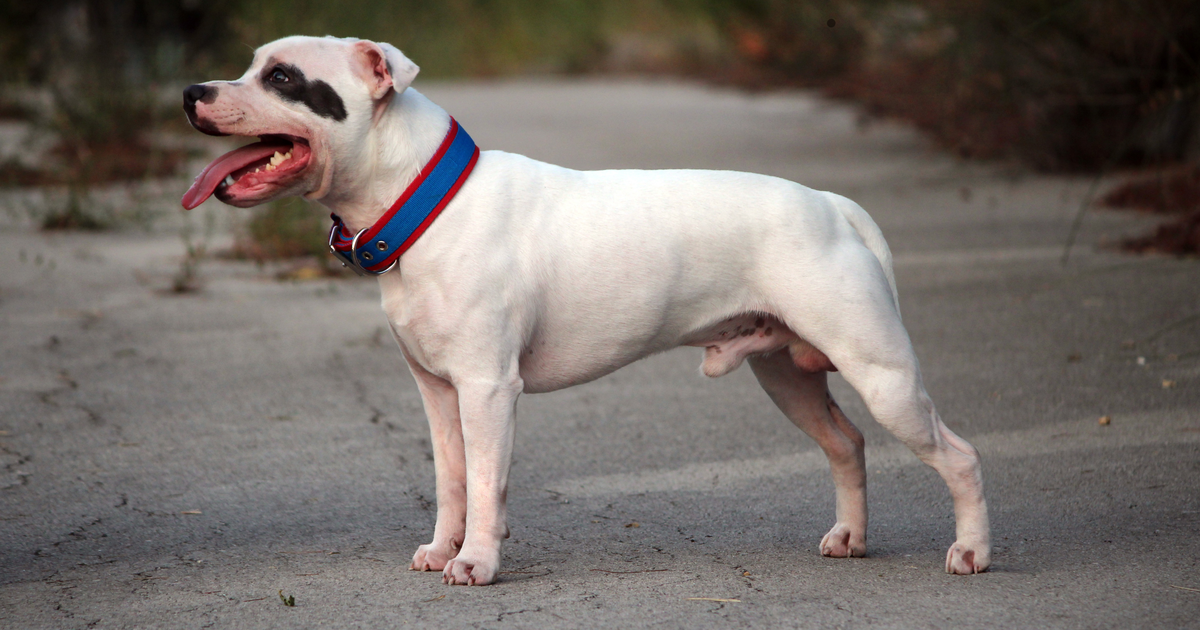
Bottom line: Early-onset hereditary cataract (HC) in the Staffordshire Bull Terrier is caused by an insertion in the HSF4 gene — the c.971_972insC, p.(L325Tfs*28) variant — which Mellersh et al. (2006) first identified in this very breed. It is inherited in an autosomal recessive pattern, so a dog needs two copies to be at risk, while a single-copy carrier stays clinically normal. Neither the US nor the UK makes the test a legal requirement; it runs through kennel club schemes, which is why the practical questions are which laboratory your registry will accept, and whether you arrange insurance before or after you test. A DNA test reports a genotype — clear, carrier or affected — not a clinical diagnosis. If your Stafford’s eyes look cloudy, or a test returns two copies, have the dog examined by a veterinarian, ideally a veterinary ophthalmologist.
- What hereditary cataract is, and how HSF4 fails
- How it presents in Staffords — and what else clouds an eye
- Inheritance and why carrier testing matters
- Where to test in the US and the UK, and what it costs
- Registries and the law: OFA, CHIC and the Kennel Club
- Pet insurance, and why the order matters
- Frequently asked questions
- References
- How to get your pet tested
What hereditary cataract is, and how HSF4 fails


A cataract is any opacity of the lens. The lens has no blood supply and almost no way to clear damaged material, so its transparency depends entirely on lens fibre cells keeping their crystallin proteins in orderly solution. Once those proteins misfold and clump, light scatters and the lens turns milky.
HSF4 (heat shock transcription factor 4) is one of the master regulators of that packing job, driving expression of chaperones and crystallins during lens fibre-cell differentiation. In the Staffordshire Bull Terrier the fault is a single-cytosine insertion in exon 9, c.971_972insC. Inserting one base shifts the reading frame, so the protein is translated as p.(L325Tfs*28) — running 28 residues into novel sequence before stopping early and truncating HSF4’s C-terminal end. The regulatory function is lost, chaperone support for the developing lens fails, and the fibres opacify from early life.
Mellersh et al. (2006) reported mutations in HSF4 in dogs of three different breeds with hereditary cataract, establishing HSF4 as the first cataract gene mapped in the dog. The exon 9 insertion described here is the variant associated with the Staffordshire Bull Terrier and the Boston Terrier; a separate single-base deletion in the same gene (c.971del) is the Australian Shepherd variant, and the two must never be confused when reading a laboratory menu. The variant is catalogued under OMIA:001758-9615, early-onset cataract in Canis lupus familiaris. One honest caveat: commercial panels often list the French Bulldog alongside the two terrier breeds. The same insertion does appear to have been identified in a small number of French Bulldogs, but the support is the peer-reviewed review by Mellersh (2014) and lab test offerings rather than a dedicated primary paper, and the breed is absent from the OMIA variant table.
How it presents in Staffords — and what else clouds an eye
SamWhen would cloudiness actually show up — is this a young dog’s problem or an old dog’s problem? Elena MarshIn Staffords it is a young dog’s problem: Mellersh et al. (2006) described opacities appearing within weeks to months of birth and maturing into full cataract by around two to three years.The Staffordshire Bull Terrier form is early-onset, and often genuinely juvenile. In the original description by Mellersh et al. (2006), affected Staffords developed lens opacities within weeks to a few months of birth, progressing to a mature, vision-destroying cataract by roughly two to three years of age. The disease is typically bilateral — both eyes involved, though not always at identical speed — which is one of the features separating an inherited cataract from an injury to a single eye.
Onset figures differ between sources, and that difference is real rather than sloppy. Genomia, which offers the terrier-type HC test, describes affected dogs developing cataract within the first year and losing sight around three years. The Australian Shepherd form is a different variant of the same gene (c.971del) with a later profile — UC Davis VGL describes onset from around two years. Consumer panels, describing hereditary cataract in general, quote windows as wide as two to seven years. Do not average these together: terrier-type insertion, early; Australian Shepherd deletion, later.
A further precision point comes from the Boston Terrier. Mellersh et al. (2007) showed that in that breed the HSF4 insertion is associated with early-onset hereditary cataract but not with the late-onset form — so a cataract appearing in a mature or elderly dog is likely a different disease process. A clear HSF4 result does not immunise an older dog against cataract, and a cloudy-eyed senior does not imply an HSF4 problem. That is the general shape of the test’s limits: it answers how many copies of this one variant this dog carries, permanently and reliably, but it cannot say whether opacities have already begun, predict the age of onset or rate of progression in an individual, or exclude cataract from any other cause.
So a Stafford that is clear or carrier and still has a hazy eye needs a differential:
- Nuclear sclerosis. The commonest false alarm: from middle age the lens nucleus compacts and takes on a bluish-grey haze. A normal ageing change, not a cataract, and barely affects vision.
- Diabetic cataract. Diabetes mellitus is an important acquired cause, and diabetic cataracts can develop fast. Sudden bilateral cloudiness with increased drinking and urination is an urgent veterinary matter, not a genetics question.
- Trauma and inflammation. A penetrating injury or uveitis can opacify a single lens. Unilateral change points away from an inherited recessive cause, which is characteristically bilateral.
- Other inherited eye disease. Hereditary cataract is one entry in the canine inherited eye disease catalogue reviewed by Mellersh (2014); retinal disease can coexist with or mimic a lens problem.
None of that can be settled from a photograph or a genotype, and what an owner notices first is rarely “cloudiness” — it is a young dog hesitating on unfamiliar ground or in dim light. Staffords are stoical and adapt fast to reduced vision, so a greyish sheen across the pupil in daylight is worth an appointment the same week. The referral route is country-specific: in the US, ask for a Diplomate of the American College of Veterinary Ophthalmologists (DACVO), whose public search tool lists board-certified specialists by location; in the UK, the RCVS publishes its list of Advanced Practitioners by subject area, including veterinary ophthalmology, on the public Find a Vet directory. This article is informational only and is not diagnostic or treatment advice.
Inheritance and why carrier testing matters
SamThe result says “carrier”. Is my dog going to go blind? Elena MarshFor this terrier insertion variant, no — it is autosomal recessive, so a single copy leaves the dog clinically normal; the copy matters for breeding, not for his eyes.The c.971_972insC variant behaves as an autosomal recessive trait: a dog must inherit one copy from each parent to have the affected genotype. That gives three possible results and three very different meanings.
- Clear (homozygous normal): no copies. Cannot pass the variant on.
- Carrier (heterozygous): one copy. Clinically normal, indistinguishable by eye or by ophthalmic examination as far as this variant is concerned, but passes the copy to about half of its offspring.
- Affected genotype (homozygous): two copies. At risk of the early-onset cataract described above.
Because carriers look completely healthy, only a DNA test can find them — that is the whole argument for pre-breeding screening. The rule is simple: never mate carrier × carrier, while carrier × clear produces no affected puppies at all. Excluding every carrier from the gene pool in one generation throws away good dogs and narrows diversity; breeding carriers only to tested-clear partners removes the disease risk while keeping the bloodlines.
Does that work in practice? There is UK evidence that it does. Lewis and Mellersh (2019) tracked eight Mendelian disorders across eight UK pedigree dog populations after a commercial DNA test became available and documented that mutation frequency fell once breeders could screen — which is only possible because results are recorded centrally and can be looked up before a mating is planned. For the other HSF4 variant the risk has also been quantified: Mellersh et al. (2009), studying around 400 Australian Shepherds and the c.971del deletion, reported roughly a 17-fold increased risk of bilateral cataract in carriers. That figure belongs to the Australian Shepherd deletion, whose inheritance is reported inconsistently between laboratories, and does not transfer to the recessive terrier insertion; it is quoted only to show why breed and variant must always be stated together.
Where to test in the US and the UK, and what it costs
SamI’m in the UK. Do I have to post the swab to Europe to get this done? Elena MarshNo — the Royal Kennel Club sells the HC-HSF4 test itself at £60 including VAT and delivery, and LABOKLIN’s Manchester laboratory lists the same test at £48 including VAT.Check the variant name first, not the price. HSF4 has two different disease variants in dogs, so a menu entry reading “hereditary cataract” tells you nothing on its own. For a Staffordshire Bull Terrier you want the insertion variant (c.971_972insC, exon 9), not the Australian Shepherd deletion.
United States. The UC Davis Veterinary Genetics Laboratory is the standard academic reference lab for canine DNA testing, but its Hereditary Cataracts listing is the Australian Shepherd type, so it does not match this breed — a live example of the trap above. The consumer panel Embark includes an HSF4 exon 9 test listed under the Boston Terrier variant name; since that exon 9 insertion is the variant shared with the Staffordshire Bull Terrier, ask Embark directly whether the result is reported for this breed. A breed-identity DTC kit often does not include this disease locus at all. Whichever route you take, remember that a result only becomes visible to anyone else if it is submitted to the OFA — the certificate in your drawer is not a public record.
United Kingdom, in pounds. UK Staffords are the breed’s home population, and the test is available domestically without any cross-border posting:
- The Royal Kennel Club’s own DNA testing service sells the HC-HSF4-2 test at £60.00, with free delivery inclusive of VAT, postage and packaging; a cheek swab, results in 1–3 weeks, listed for the Boston Terrier, French Bulldog and Staffordshire Bull Terrier. Assured Breeder members get 10% off.
- The breed package for the Staffordshire Bull Terrier bundles HC-HSF4, L-2-hydroxyglutaric aciduria (L-2-HGA) and a DNA Profile (SNP, ISAG 2020) for £150.00, described as a £235 value.
- LABOKLIN’s UK laboratory, in Trafford Park, Manchester, lists Hereditary Cataract (HSF4) at £48.00 including VAT, 2–3 weeks, from EDTA blood or a buccal swab. Its Staffordshire Bull Terrier KC bundle (HSF4 + L-2-HGA) is £96.00 including VAT, and states that both tests sit within the official UK Kennel Club DNA testing scheme, with results submittable to the Kennel Club provided the microchip number, registered name and owner declaration are on the order form.
This is why the widely quoted 56 USD figure needs repositioning for a UK or US reader. That price belongs to Genomia, a laboratory in Pilsen, Czech Republic; it is quoted excluding VAT, with a currency selector offering CZK, EUR, USD or PLN, and a 12-business-day turnaround. A UK buyer therefore pays in a foreign currency, absorbs the conversion, and posts the sample out of the country — for a variant that is available domestically in pounds. Worse, the Royal Kennel Club records results only from laboratories on its approved list and states plainly that “Results from laboratories not included on this list will not be recorded”, so a cheaper foreign order can cost you the registry entry that made the test worth doing. Check the current list before you order, not after.
Total cost differs by route too: kennel club and consumer-panel kits are card payments online with VAT and delivery included, while reference laboratories work from a submission form and may quote before tax — and if you choose blood over a home cheek swab, your practice’s sampling fee is separate. LABOKLIN / LABOGEN also runs the insertion-variant test on the continent for the Boston Terrier, French Bulldog and Staffordshire Bull Terrier in 7 to 14 business days and accepts international submissions — the usual route for Australian owners, where the breed is numerous (3,199 ANKC registrations in 2024). Results are valid for life, because a genotype does not change. All prices here are as published at the time of writing and should be confirmed with the laboratory when ordering.
Registries and the law: OFA, CHIC and the Kennel Club
SamHow does a puppy buyer check the parents were actually tested? Elena MarshIn the US you search the OFA database; in the UK you use the Royal Kennel Club’s Health Test Results Finder — both are free public lookups, which is exactly what Lewis and Mellersh measured.United States: OFA and CHIC. The Canine Health Information Center (CHIC) is a partnership between the Orthopedic Foundation for Animals (OFA) and breed parent clubs; each club sets its own breed’s required screens, and the OFA notes those requirements are dynamic and revised as new tests appear. For this breed the parent club is the Staffordshire Bull Terrier Club of America, whose published CHIC requirements are hip evaluation (OFA or PennHIP), elbow evaluation, an eye examination by a boarded ACVO ophthalmologist from one year of age, and DNA tests for L-2-HGA and hereditary cataract — with patellar luxation and cardiac evaluation optional. The AKC’s own listing of national-breed-club recommended tests for the Staffordshire Bull Terrier matches. Because these lists change, check the parent club’s current requirements rather than trusting any published summary, including this one.
Two US-specific mechanisms matter more than the list itself. First, a CHIC number requires that all results be released into the public domain, and the OFA is explicit that the number “does not imply normal test results, only that all the required breed specific tests were performed and the results made publicly available”. Second, the database is publicly searchable, so a buyer can verify a breeder’s claims about the sire and dam instead of taking them on trust — with one caveat the OFA states in its FAQs: normal results for dogs over 24 months post automatically, but abnormal results appear only if the owner initialled the abnormal-release box. An empty record is not the same as a clear result. On the eye side, the OFA Companion Animal Eye Registry (CAER) accepts only examinations by board-certified ACVO ophthalmologists, valid for one year with annual re-examination recommended — which is why the parent club’s eye requirement and the OFA record are the same piece of paper. For scale, the breed ranked 63rd in the AKC’s 2024 popularity table.
United Kingdom: the Kennel Club schemes. HC-HSF4 is an official Royal Kennel Club DNA testing scheme, covering the Australian Shepherd, Boston Terrier, French Bulldog and Staffordshire Bull Terrier. Results from approved laboratories are recorded on the dog’s record and published through the Health Test Results Finder, which lets anyone look up official-scheme DNA results for any dog on the Breed Register. The breed’s own page sets out the screening a breeder is expected to complete: DNA tests for HC-HSF4-2 and L-2-HGA, elbow dysplasia screening, and eye testing under the BVA/KC/ISDS Eye Scheme, which is run by a panel of expert veterinary ophthalmologists across the UK and feeds certified results back to the Royal Kennel Club for publication. That combination — DNA scheme plus clinical eye scheme, both publicly visible — is the UK counterpart to OFA/CHIC.
Is any of it required by law? No — in neither country. DNA testing for HSF4 or any other canine hereditary disease is not mandated by statute in the US or the UK; what carries it is the voluntary framework of kennel club schemes and breed club codes of ethics. The regulation that does exist is about licensing and welfare, not genotypes:
- UK. The Animal Welfare (Licensing of Activities Involving Animals) (England) Regulations 2018 make dog breeding a licensable activity, triggered by “breeding three or more litters of puppies in any 12-month period” or “breeding dogs and advertising a business of selling dogs”. Its breeding conditions include a genotype-aware welfare duty — Schedule 6 states that “No dog may be kept for breeding if it can reasonably be expected, on the basis of its genotype, phenotype or state of health that breeding from it could have a detrimental effect on its health or welfare or the health or welfare of its offspring” — but it names no test. Separately, Lucy’s Law, in force in England since 6 April 2020, banned commercial third-party sales, so a buyer must purchase direct from the breeder or adopt from a rescue centre, and licensed breeders must show puppies interacting with their mother. That is precisely why UK buyers are in the room with the breeder and can ask to see the Kennel Club record on the spot. Licensing is devolved, so rules differ in Scotland, Wales and Northern Ireland.
- United States. Federal oversight runs through the Animal Welfare Act and USDA licensing, but the implementing regulation exempts anyone who maintains “a total of four or fewer breeding female pet animals… and sells only the offspring of these animals, which were born and raised on his or her premises, for pets or exhibition” (9 CFR 2.1(a)(3)(vii)). Most show and hobby breeders therefore fall outside federal licensing entirely, and everything else — kennel limits, breeder permits, sale rules — is state and local law, which varies enormously. Check the rules where you live.
- GINA does not apply here. The Genetic Information Nondiscrimination Act of 2008 protects people: Title I stops health insurers using genetic information in eligibility, underwriting or premiums, and Title II stops employers using it in employment decisions. It does not even reach human life, disability or long-term care insurance, and it has nothing whatever to say about a dog’s genotype or about pet insurance. Owners who have met GINA through their own DTC testing should not assume any equivalent protection for their Stafford.
Pet insurance, and why the order matters
SamShould I insure him first, or test him first? Elena MarshIf you intend to insure at all, insure first — UK insurers treat a condition already known to you as pre-existing, and the US model definition turns on veterinary advice given before cover starts.In the US and the UK, treatment costs fall on the owner, so whether a progressive bilateral cataract is covered is not a footnote — it is the decision. And the single most consequential thing an owner controls is sequence.
United States. Pet insurance is regulated state by state. The National Association of Insurance Commissioners adopted a Pet Insurance Model Act (#633) at its Summer 2022 meeting to standardise the vocabulary, and its definitions are exactly the ones that decide an HSF4 claim. A “hereditary disorder” is “an abnormality that is genetically transmitted from parent to offspring and may cause illness or disease” — which describes this variant precisely. A “chronic condition” is “a condition that can be treated or managed, but not cured”. A “preexisting condition” is any condition for which, before the policy’s effective date or during a waiting period, a veterinarian provided medical advice, the pet received previous treatment, or the pet had signs or symptoms directly related to the claim. Section 4 requires the insurer to disclose whether the policy excludes coverage for a pre-existing condition, a hereditary disorder, a congenital anomaly or a chronic condition — but the Act is explicit that “Nothing in this Act shall in any way prohibit or limit the types of exclusions pet insurers may use”. NAIC’s own summary notes that most pet insurers exclude pre-existing and hereditary or congenital conditions. Read that disclosure document, not the marketing page; the Act also gives a 15-day right to examine and return the policy.
United Kingdom: lifetime versus 12 months. This is the UK-specific fork, and it is decided at purchase, not at claim. As the PDSA’s guide sets it out, a lifetime policy gives an annual financial limit for new accidents and illnesses that is reinstated at each renewal; a time-limited policy gives a fixed sum per illness or injury and covers it for only 12 months from the start of that illness or injury; a maximum benefit policy caps the total per condition with no time limit; accident-only excludes illness altogether. A hereditary cataract that progresses over years, is referred for surgery and then needs long-term ophthalmic follow-up is the textbook case where a time-limited policy stops paying mid-course while the condition is still active. If you are insuring a Stafford with this variant in the pedigree, lifetime cover is the only UK structure that keeps a chronic, progressive eye condition in scope on renewal.
The ordering rule. The PDSA states that most policies do not cover pre-existing illness or injury and defines it as “any condition that has already been diagnosed by a vet, or is known to you, before taking out the insurance”. That clause is the whole argument: a genotype result you already hold is knowledge you have, and the US model definition turns on veterinary advice, prior treatment or observed signs before cover began. So if you intend to insure, arrange the policy before the test and before any clinical work-up, then test. Doing it the other way round invites an exclusion for the exact condition you were insuring against. One more practical point: pet insurance is defined even in the model act as covering “accidents and illnesses of pets”, so an elective pre-breeding DNA screen on a healthy dog is not a claimable treatment — budget the test fee as an out-of-pocket breeding cost, not an insured one. Cataract surgery is specialist referral work; ask your practice for a written estimate and check it against your policy’s annual limit before you commit. Terms vary between insurers in both countries, so confirm the wording in the policy document before you buy.
Frequently asked questions
Q. My Staffordshire Bull Terrier is an HSF4 carrier — will he go blind?
No. The c.971_972insC variant is autosomal recessive, so a carrier has one copy and is clinically normal for this variant. The result matters for breeding: mate him only to a tested-clear partner and no puppy in the litter can have the affected genotype. Avoid carrier × carrier matings entirely.
Q. At what age would an affected Stafford show signs?
Early. Mellersh et al. (2006) described opacities within weeks to months of birth in affected Staffordshire Bull Terriers, maturing to full cataract by around two to three years. Genomia describes onset within the first year and sight loss around three years. Later figures quoted for the Australian Shepherd (from about two years) relate to a different variant of the same gene and should not be applied to this breed.
Q. What does the test cost in the US and the UK, and where should I order it?
In the UK the Royal Kennel Club sells the HC-HSF4-2 test itself at £60.00 including VAT and delivery, or £150.00 for the Staffordshire Bull Terrier package adding L-2-HGA and a DNA profile; LABOKLIN’s Manchester laboratory lists the single test at £48.00 including VAT. Order from a laboratory on the Royal Kennel Club’s approved list — results from other laboratories will not be recorded. The frequently quoted 56 USD is Genomia’s, a Czech laboratory, excluding VAT and in a choice of currencies, so a UK buyer adds conversion and international postage. In the US, UC Davis VGL’s Hereditary Cataracts listing is the Australian Shepherd type and does not match this breed, and Embark’s HSF4 exon 9 test is listed under the Boston Terrier variant name — confirm the exon 9 insertion is reported for a Staffordshire Bull Terrier before ordering, and note that a breed-identity DTC kit often does not include this locus. A result reaches the OFA database only if it is submitted there. Prices are as published; confirm with the laboratory.
Q. Will pet insurance cover it, and is testing required by law?
Testing is not a legal requirement in either country — it runs through kennel club schemes and breed club codes, not statute. UK breeding is licensed at three or more litters in any 12-month period under the 2018 Regulations, and Lucy’s Law has required direct-from-breeder purchase in England since 2020; US federal licensing exempts breeders with four or fewer breeding females selling their own offspring, leaving the rest to state law. On insurance: hereditary and congenital exclusions are common in both markets, and the NAIC model act expressly does not limit what insurers may exclude. In the UK, only a lifetime policy keeps a chronic, progressive condition covered past 12 months. Because pre-existing is defined to include what is already known to you, arrange cover before you test rather than after. GINA does not help — it protects people, in human health insurance and employment, and has no application to dogs.
References
- Mellersh CS, Pettitt L, Forman OP, Vaudin M, Barnett KC (2006) Identification of mutations in HSF4 in dogs of three different breeds with hereditary cataracts. Vet Ophthalmol 9(5):369-78. https://pubmed.ncbi.nlm.nih.gov/16939467/
- Mellersh CS, Graves KT, McLaughlin B, Ennis RB, Pettitt L, Vaudin M, Barnett KC (2007) Mutation in HSF4 associated with early but not late-onset hereditary cataract in the Boston Terrier. J Hered 98(5):531-3. https://pubmed.ncbi.nlm.nih.gov/17611257/
- Mellersh CS, McLaughlin B, Ahonen S, Pettitt L, Lohi H, Barnett KC (2009) Mutation in HSF4 is associated with hereditary cataract in the Australian Shepherd. Vet Ophthalmol 12(6):372-8. https://pubmed.ncbi.nlm.nih.gov/19883468/
- Mellersh CS (2014) The genetics of eye disorders in the dog. Canine Genet Epidemiol 1:3. https://pmc.ncbi.nlm.nih.gov/articles/PMC4574392/
- Lewis TW, Mellersh CS (2019) Changes in mutation frequency of eight Mendelian inherited disorders in eight pedigree dog populations following introduction of a commercial DNA test. PLoS One 14:e0209864. https://pubmed.ncbi.nlm.nih.gov/30650096/
- OMIA:001758-9615 Cataract, early-onset, in Canis lupus familiaris (HSF4). https://omia.org/OMIA001758/9615/
- Orthopedic Foundation for Animals — CHIC Program. https://ofa.org/chic-programs/
- Orthopedic Foundation for Animals — FAQs (database searchability, publication of normal and abnormal results). https://ofa.org/about/faqs/
- Orthopedic Foundation for Animals — Companion Animal Eye Registry (CAER). https://ofa.org/diseases/eye-certification/
- Staffordshire Bull Terrier Club of America — OFA / CHIC Program requirements. https://sbtca.com/health/ofa-chic-program/
- American Kennel Club — Terrier Group health testing requirements (national breed club recommendations). https://www.akc.org/breeder-programs/breed-health-testing-requirements/terrier-group-health-testing-requirements/
- American Kennel Club — Most Popular Dog Breeds of 2024. https://www.akc.org/expert-advice/news/most-popular-dog-breeds-2024/
- American College of Veterinary Ophthalmologists — Ophthalmologist Search. https://www.acvo.org/ophthalmologist-search
- Royal Kennel Club — DNA test: Hereditary Cataract (HC-HSF4), official DNA testing scheme. https://www.royalkennelclub.com/health-and-dog-care/health/getting-started-with-health-testing-and-screening/dna-testing/dna-test-hc-hsf4/
- Royal Kennel Club — DNA testing, approved laboratories and Health Test Results Finder. https://www.royalkennelclub.com/health-and-dog-care/health/getting-started-with-health-testing-and-screening/dna-testing/
- Royal Kennel Club — Hereditary cataract (HC-HSF4-2) DNA test, £60.00. https://www.royalkennelclub.com/shop/dna-testing/the-royal-kennel-club-dna-testing-services-individual-dna-tests/hereditary-cataract-hc-hsf4-2/
- Royal Kennel Club — Staffordshire Bull Terrier DNA testing package, £150.00. https://www.royalkennelclub.com/shop/dna-testing/the-royal-kennel-club-dna-testing-services-terrier-group/staffordshire-bull-terrier/
- Royal Kennel Club — Staffordshire Bull Terrier breed page (Good Practice / Best Practice health screening). https://www.royalkennelclub.com/search/breeds-a-to-z/breeds/terrier/staffordshire-bull-terrier/
- British Veterinary Association — BVA/KC/ISDS Eye Scheme. https://www.bva.co.uk/canine-health-schemes/eye-scheme/
- Royal College of Veterinary Surgeons — Advanced Practitioner status and the public list on Find a Vet. https://www.rcvs.org.uk/lifelong-learning/professional-accreditation/advanced-practitioner-status/
- LABOKLIN (UK) — Hereditary Cataract (HSF4), £48.00 incl. VAT. https://www.laboklin.co.uk/laboklin/showGeneticTest.jsp?testID=8576
- LABOKLIN (UK) — Staffordshire Bull Terrier KC DNA bundle (HSF4 + L2-HGA), £96.00 incl. VAT. https://www.laboklin.co.uk/laboklin/showGeneticTest.jsp?testID=8712
- LABOKLIN / LABOGEN — Hereditary Cataract (HSF4), Boston Terrier / French Bulldog / Staffordshire Bull Terrier. https://labogen.com/en/genetic-diseases-dog/hereditary-cataract-hsf4-boston-terrier-french-bulldog-staffordshire-bull-terrier/
- Genomia (Pilsen, Czech Republic) — HC, Hereditary Cataract (Terriers and others), 56 USD excl. VAT / 12 business days. https://www.genomia.cz/en/test/hc-hereditary-cataract-st/
- Embark — Hereditary Cataracts (early-onset / juvenile cataracts), HSF4 exon 9. https://embarkvet.com/products/dog-health/health-conditions/hereditary-cataracts-early-onset-cataracts-juvenile-cataracts/
- UC Davis Veterinary Genetics Laboratory — Hereditary Cataracts (Australian Shepherd type). https://vgl.ucdavis.edu/test/hc-australian-shepherd
- National Association of Insurance Commissioners — Pet Insurance Model Act (#633), adopted Summer 2022. https://content.naic.org/sites/default/files/model-law-633.pdf
- National Association of Insurance Commissioners — Insurance Topics: Pet Insurance. https://content.naic.org/insurance-topics/pet-insurance
- PDSA — Pet Insurance Guide (lifetime, maximum benefit, time-limited and accident-only cover; pre-existing conditions). https://www.pdsa.org.uk/pet-help-and-advice/pdsa-pet-insurance/pet-insurance-guide
- National Human Genome Research Institute — Genetic Discrimination and the Genetic Information Nondiscrimination Act (GINA) of 2008. https://www.genome.gov/about-genomics/policy-issues/Genetic-Discrimination
- The Animal Welfare (Licensing of Activities Involving Animals) (England) Regulations 2018. https://www.legislation.gov.uk/uksi/2018/486/contents/made
- The Animal Welfare (Licensing of Activities Involving Animals) (England) Regulations 2018, Schedule 6 (dog breeding conditions). https://www.legislation.gov.uk/uksi/2018/486/schedule/6/made
- GOV.UK — Lucy’s Law (ban on commercial third-party sales of puppies and kittens, in force 6 April 2020). https://www.gov.uk/government/news/lucys-law-spells-the-beginning-of-the-end-for-puppy-farming
- 9 CFR 2.1 — Animal Welfare Act licensing requirements and exemptions (four or fewer breeding females). https://www.law.cornell.edu/cfr/text/9/2.1
How to get your pet tested
Some pet DNA tests screen for hereditary-disease carrier status or genetic risk markers, but the results are information, not a diagnosis. If your pet has symptoms or you need a confirmed diagnosis, please consult your veterinarian.
In the United States
In the United Kingdom
In India
Elsewhere
Note: even if the kit can be purchased/shipped internationally, the service itself (sample return, analysis, results) is not guaranteed in your country. Check each service’s stated service area and sample-return method before ordering.
Services offered in other regions (may not be available where you live)
Worried about your pet’s health? — Talk to a veterinarian
A confirmed diagnosis and any treatment plan are decisions for a veterinarian, not a test kit. The links below are professional resources.
AVMA — Find a veterinarian (American Veterinary Medical Association)
This section contains advertising (affiliate links); we may earn a commission if you buy through them. As an Amazon Associate, we earn from qualifying purchases. Genetic tests do not guarantee the prevention, diagnosis, or treatment of any disease — results indicate tendencies and provide information only.
This page is educational information, not veterinary diagnosis or advice. Always consult a veterinarian about your pet’s health.
About the author
Elena Marsh
Editor & writer (not a veterinarian)
A writer with a molecular-biology background and a lifelong dog and cat owner. Not a veterinarian — she translates peer-reviewed genetics research and primary data into plain language, always as information rather than diagnosis.