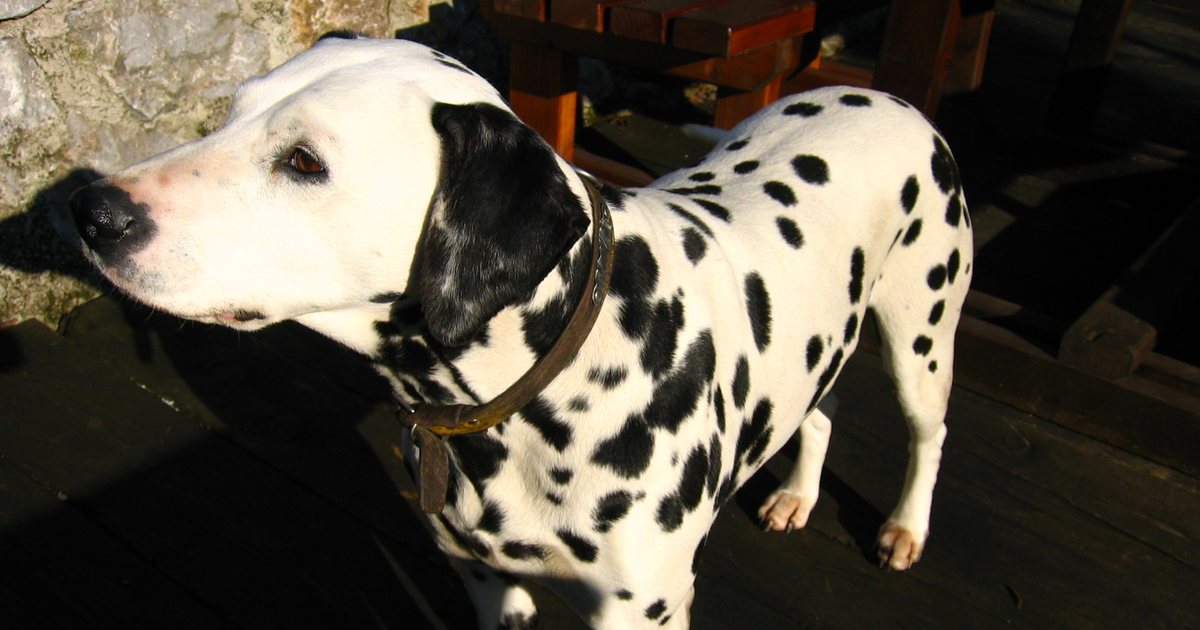
The short answer: Every Dalmatian carries two copies of the same SLC2A9 variant (p.Cys188Phe), so high urinary uric acid — hyperuricosuria — is a fixed breed trait, not a variable risk. That does not mean every Dalmatian forms urate stones, but every Dalmatian is predisposed. Management is the same for the whole breed: a low-purine diet, generous water intake, and monitoring — not genotype selection. A DNA test is meaningful risk information in other breeds where the variant is polymorphic; in Dalmatians the result is a foregone conclusion, and only a veterinarian can diagnose or manage actual stones.
- Why every Dalmatian has high uric acid (SLC2A9, GLUT9, and breed history)
- From high uric acid to urate stones (the mechanism)
- Not every Dalmatian forms stones — diet and hydration prevention
- Diagnosis and monitoring (urinalysis, ultrasound, and the radiolucent caveat)
- What DNA testing means here versus in other breeds (whole-breed vs clear/carrier/affected)
- FAQ — Frequently Asked Questions
- References
- How to get your pet tested
Why every Dalmatian has high uric acid (SLC2A9, GLUT9, and breed history)


In most dog breeds, hyperuricosuria and hyperuricemia (together abbreviated HUU) are a variable trait — some dogs carry the risk variant and some don’t. In the Dalmatian, that variation disappeared long ago. The breed is fixed for a single missense change in the SLC2A9 gene: p.Cys188Phe (written at the DNA level as c.563G>T, a G→T substitution). Because the entire breed carries two copies, the trait it produces — elevated uric acid — is a breed characteristic rather than an individual risk.
This fixation is a byproduct of breeding history. The landmark study that identified the gene, Bannasch et al., 2008, PLoS Genetics 4(11):e1000246, was able to clone the “huu” locus precisely because there was no genetic variation to break up within the Dalmatian breed — every dog was homozygous. That uniformity is tied to the same closed breeding history that produced the breed’s distinctive spotted coat. The variant is catalogued as OMIA:001033-9615. (You may also see the change written as Cys181Phe in the Bulldog literature — that is simply a second numbering scheme for the same substitution; p.Cys188Phe is the preferred name.)
From high uric acid to urate stones (the mechanism)
SamSo what does that one gene actually break? Elena MarshIt disables a urate transporter called GLUT9. The SLC2A9 variant catalogued in OMIA:001033-9615 stops the liver and kidney from clearing uric acid the normal way.SLC2A9 encodes GLUT9, a urate transporter that works in the liver and kidney. Normally it helps the liver convert uric acid into allantoin, a far more soluble waste product, and helps the kidney reabsorb urate rather than dumping it into the urine. The p.Cys188Phe change disrupts GLUT9, so uric acid is not converted and is not reabsorbed. The result is high uric acid in both the urine (hyperuricosuria) and the blood (hyperuricemia).
Uric acid is only sparingly soluble. When its concentration in urine stays high, it can crystallize and aggregate into urate stones (uroliths) — most often in the bladder, sometimes in the kidney. These stones can obstruct the urinary tract and, in serious cases, require surgical removal. Because the whole problem traces back to purine metabolism (uric acid is the end-product of purine breakdown), the two levers that actually help are dietary: reducing purine intake and diluting the urine with water. That is why a low-purine, low-organ-meat diet plus high water intake is the central preventive strategy for the breed.
Not every Dalmatian forms stones — diet and hydration prevention
SamIf every Dalmatian has high uric acid, does every Dalmatian get stones? Elena MarshNo — and that distinction matters. Cornell notes that high urinary uric acid is universal in the breed, but stone formation is not; diet and hydration change the odds.This is the most important nuance for a Dalmatian owner: high urinary uric acid is universal, but stone formation is not. As the Cornell Riney Canine Health Center explains, the predisposition is fixed but the outcome is manageable. Prevention works by keeping the uric acid concentration in the urine below the point where crystals form.
A controlled feeding trial, Westropp et al., 2017, BMC Veterinary Research 13:45, showed that a purine-restricted diet lowered urinary uric acid in dogs — direct evidence that the dietary lever moves the number that matters. Combine that with generous water intake (which dilutes the urine) and you address both sides of the crystallization equation: less uric acid produced, and more water to keep it dissolved. The table below summarizes the practical do-and-avoid.
| Category | Favor (lower purine) | Limit or avoid (high purine) |
|---|---|---|
| Protein sources | Eggs, dairy, many vegetable proteins | Organ meats (liver, kidney), game meat |
| Diet type | Veterinary purine-restricted / therapeutic diet | High-organ-meat or unbalanced homemade diets |
| Hydration | Constant fresh water; wet/moistened food to raise water intake | Dry-only feeding with limited water access |
| Oversight | Periodic urinalysis and vet-guided diet choices | Switching diets without checking urine effects |
Note: purine content is a general guide, not an exact prescription — your veterinarian should confirm the specific diet, because urate stones can also arise from liver disease or a portosystemic shunt, not diet alone.
Diagnosis and monitoring (urinalysis, ultrasound, and the radiolucent caveat)
SamHow would a vet even find these stones — an X-ray? Elena MarshCareful there: urate stones are often radiolucent. Westropp et al. (2017) found plain X-ray detected only about 32% of urate-urolith cases, so ultrasound is preferred.Diagnosis is a job for a veterinarian, not a DNA test. It starts with urinalysis, which can reveal urate crystals and concentrated urine, and proceeds to imaging to look for actual stones. Here is the crucial technical point: urate stones are frequently radiolucent — they don’t reliably show up on standard X-rays. In the Westropp et al. (2017) data, plain radiography detected only about 32% of urate-urolith cases. For that reason, ultrasound is the preferred imaging method for these stones.
For a Dalmatian, “monitoring” means periodic urinalysis and vet-guided imaging when clinically indicated, plus watching for warning signs such as straining to urinate, blood in the urine, or frequent small urinations. Because the breed’s predisposition is fixed, monitoring is a lifelong, whole-breed practice — not something reserved for a subset of “affected” dogs.
What DNA testing means here versus in other breeds (whole-breed vs clear/carrier/affected)
SamThen is a Dalmatian HUU DNA test even worth running? Elena MarshIn a purebred Dalmatian the answer is essentially predetermined — Karmi et al. (2010) reported an allele frequency of 1.00 in Dalmatians, versus polymorphic frequencies in other breeds.In breeds where the SLC2A9 variant is polymorphic — such as the Bulldog, Weimaraner, and Pomeranian — a DNA test returns a genuinely informative clear / carrier / affected result that breeders and owners can act on. In the Dalmatian, that framework collapses: the breed is fixed, so effectively every purebred Dalmatian is “affected” (homozygous). The genetic questions “is my dog a carrier?” and “should I select against this?” don’t apply within the breed.
The allele-frequency data below, from Karmi et al., 2010, makes the contrast concrete: fixation in Dalmatians versus low, variable frequencies elsewhere.
| Breed | SLC2A9 HUU allele frequency | What a DNA test tells you |
|---|---|---|
| Dalmatian | 1.00 (fixed) | Predetermined — whole-breed trait |
| Weimaraner | 0.150 | Informative: clear / carrier / affected |
| Giant Schnauzer | 0.056 | Informative: clear / carrier / affected |
| Pomeranian | 0.005 | Informative: clear / carrier / affected |
One more boundary to keep straight: a DNA test is genetic-risk information, not a diagnosis. It tells you about the SLC2A9 genotype; it does not tell you whether a dog currently has stones. And SLC2A9 is not the only cause of urate stones — liver disease, a portosystemic (liver) shunt, and diet can all contribute. Only a veterinarian can diagnose and manage actual uroliths, using urinalysis, ultrasound, and diet.
FAQ — Frequently Asked Questions
Q. Is my Dalmatian’s high uric acid a disease I did something to cause?
No. It is a fixed breed trait. Every Dalmatian is homozygous for the SLC2A9 p.Cys188Phe variant, which was already present when the breed was established (Bannasch et al., 2008). It reflects breeding history, not diet or care mistakes.
Q. What diet actually helps prevent urate stones?
A low-purine diet — limiting organ meats and game — combined with high water intake. A controlled trial (Westropp et al., 2017) showed a purine-restricted diet lowered urinary uric acid. Ask your veterinarian to confirm a specific therapeutic diet, since liver conditions can also affect the plan.
Q. Will a normal X-ray rule out stones?
Not reliably. Urate stones are often radiolucent; plain radiography detected only about 32% of urate-urolith cases in the Westropp et al. (2017) data, which is why ultrasound is the preferred imaging method.
Q. Should I DNA-test my Dalmatian for HUU?
Within the purebred Dalmatian the result is essentially predetermined (allele frequency 1.00; Karmi et al., 2010), so it adds little. HUU DNA testing is far more useful in polymorphic breeds — Bulldog, Weimaraner, Pomeranian — where it returns an actionable clear/carrier/affected result. Either way, a DNA test is risk information, not a diagnosis of stones.
References
- Bannasch D, et al. Mutations in the SLC2A9 gene cause hyperuricosuria and hyperuricemia in the dog. PLoS Genet. 2008;4(11):e1000246. https://pmc.ncbi.nlm.nih.gov/articles/PMC2573870/
- OMIA:001033-9615 — Hyperuricosuria and hyperuricemia (SLC2A9), Canis lupus familiaris. https://omia.org/OMIA001033/9615/
- Westropp JL, et al. Evaluation of a purine-restricted diet in dogs. BMC Vet Res. 2017;13:45. https://pmc.ncbi.nlm.nih.gov/articles/PMC5299647/
- Karmi N, et al. Estimated frequency of the canine hyperuricosuria mutation in different dog breeds. 2010. https://pmc.ncbi.nlm.nih.gov/articles/PMC5535792/
- Cornell Riney Canine Health Center — Hyperuricosuria and hyperuricemia or urolithiasis (HUU). https://www.vet.cornell.edu/departments-centers-and-institutes/riney-canine-health-center/canine-health-information/hyperuricosuria-and-hyperuricemia-or-urolithiasis-huu
- American Kennel Club — Dalmatian breed. https://www.akc.org/dog-breeds/dalmatian/
How to get your pet tested
Some pet DNA tests screen for hereditary-disease carrier status or genetic risk markers, but the results are information, not a diagnosis. If your pet has symptoms or you need a confirmed diagnosis, please consult your veterinarian.
Below is where Hyperuricosuria / HUU (SLC2A9) can be tested, grouped by where you live and marked by whether each service explicitly lists this variant (✅ = listed / ❓ = unverified / ❌ = not offered).
In the United States
In the United Kingdom
In India
Elsewhere
Note: even if the kit can be purchased/shipped internationally, the service itself (sample return, analysis, results) is not guaranteed in your country. Check each service’s stated service area and sample-return method before ordering.
Services offered in other regions (may not be available where you live)
Worried about your pet’s health? — Talk to a veterinarian
A confirmed diagnosis and any treatment plan are decisions for a veterinarian, not a test kit. The links below are professional resources.
AVMA — Find a veterinarian (American Veterinary Medical Association)
This section contains advertising (affiliate links); we may earn a commission if you buy through them. As an Amazon Associate, we earn from qualifying purchases. Genetic tests do not guarantee the prevention, diagnosis, or treatment of any disease — results indicate tendencies and provide information only.
This page is educational information, not veterinary diagnosis or advice. Always consult a veterinarian about your pet’s health.
About the author
Elena Marsh
Editor & writer (not a veterinarian)
A writer with a molecular-biology background and a lifelong dog and cat owner. Not a veterinarian — she translates peer-reviewed genetics research and primary data into plain language, always as information rather than diagnosis.