Bottom line: Juvenile Laryngeal Paralysis and Polyneuropathy (JLPP) is an autosomal recessive disease of the Black Russian Terrier caused by a single-base deletion — RAB3GAP1:c.743delC — identified by researchers at the University of Missouri and published by Mhlanga-Mutangadura et al. (2016, Neurobiology of Disease 86:75-85). Affected puppies begin showing signs at about 3 months of age and are typically euthanized by 6 months; there is no effective treatment. The practical news is good, though: this is one of the easiest hereditary diseases in the breed to design out. A cheek-swab DNA test is available through the OFA, run by the University of Missouri Small Animal Molecular Genetics Lab, and results are automatically registered in the OFA database. Because the mode of inheritance is recessive, you do not have to remove carriers from your breeding program — you only have to make sure a carrier is never bred to another carrier. That single rule reduces the number of affected puppies to zero while preserving the genetic diversity of a numerically small breed.
- Why this disease is a breeder problem, not an owner problem
- What JLPP does — the clinical picture
- One mutation, two breeds — and what that tells us
- The human parallel: Warburg Micro syndrome
- How to test in the United States, and what it costs
- In the UK: the Royal Kennel Club route and what it costs in pounds
- The breeding rule, stated plainly
- Frequently asked questions
- References
- How to get your pet tested
Why this disease is a breeder problem, not an owner problem


Most hereditary disease articles ask you to watch for symptoms. This one does not, and the reason matters. JLPP has an early and narrow onset window. The OFA describes it as beginning “typically around 3 months of age,” and affected dogs do not reach adulthood. If your Black Russian Terrier is a healthy adult, it is not going to develop JLPP later.
What that means is that the entire value of DNA testing in this breed sits upstream — in the decisions breeders make before a litter exists, and in the questions buyers ask before they put down a deposit. There is no screening protocol, no early-intervention window, no diet or supplement that changes the outcome. There is only the mating decision.
That is actually the best kind of genetic problem to have. A recessive disease with a known mutation and a cheap, accurate test is a solved problem in principle. Whether it is solved in practice depends entirely on whether people test and share results.
What JLPP does — the clinical picture
SamWhat do the first signs actually look like in a puppy? Elena MarshNoisy breathing and a changed bark come first, because the larynx is what fails. The hind-limb weakness follows behind it.The name of the disease describes its two halves. Laryngeal paralysis comes first: the nerves supplying the larynx degenerate, the vocal folds stop opening properly, and the puppy develops loud, raspy breathing on inspiration — worse when excited or exercising. Owners often notice that the bark has changed. Then the polyneuropathy becomes evident: weakness in the hind limbs, reduced or absent spinal reflexes, loss of sensation, low muscle tone, and an increasingly uncoordinated gait.
The companion paper on Rottweilers, Mhlanga-Mutangadura et al. (2016, Journal of Veterinary Internal Medicine 30(3):813-818), documented eight affected dogs and gives the clearest published tally of what the same mutation does:
- Respiratory distress at 3-4 months in all eight dogs; laryngeal paralysis confirmed in seven.
- Pelvic limb sensory ataxia and weakness in all eight.
- Cerebellar ataxia in two, and megaesophagus in two — the latter explaining the regurgitation and aspiration risk.
- Eye findings: cataracts in three, microphthalmia in two, persistent pupillary membranes in one.
Post-mortem, the defining feature is intracytoplasmic vacuolation within neurons — visible in the cerebellar cortex and cuneate nuclei of every dog examined, with loss of Purkinje cells leaving “empty baskets” behind. In one dog, the researchers traced the chain all the way out: marked nerve fibre loss in the recurrent laryngeal nerve, with matching muscle fibre loss in the cricoarytenoideus dorsalis — the muscle that opens the airway. The breathing problem is not in the lungs. It is in the nerve.
One mutation, two breeds — and what that tells us
SamRottweiler breeders talk about JLPP too. Is it the same disease? Elena MarshThe same mutation, in fact — c.743delC in both breeds. The authors concluded it most likely traces to a single shared founder event.The Black Russian Terrier was built in the mid-twentieth century from a small set of foundation dogs, and the Giant Schnauzer, Airedale Terrier and Rottweiler all contributed. So it is not a coincidence that the identical variant turns up in Rottweilers. Mhlanga-Mutangadura et al. (2016) genotyped affected Rottweilers and found all of them homozygous for c.743delC — the same deletion previously reported in Black Russian Terriers — and concluded that “the same founder mutation event was the source of the allele in both Rottweilers and BRTs.”
Their control data is worth quoting because it puts a number on the risk. Among 128 control Rottweilers, 105 carried two reference copies and 23 were heterozygous carriers — roughly 18% of that sample. Meanwhile, 468 dogs of other breeds were all clear. The mutation is real, it is common enough to matter, and it is confined to a small set of related breeds.
A third variant deserves a mention so you do not order the wrong test. Alaskan Huskies get a very similar syndrome from a different change in the same gene — a 218-base-pair SINE insertion in exon 7, reported by Wiedmer et al. (2016, G3 6(2):255-262). Same gene, different mutation, different assay. All three sit under OMIA:001970-9615. For a Black Russian Terrier you want the c.743delC test specifically.
The human parallel: Warburg Micro syndrome
RAB3GAP1 encodes part of a protein complex that regulates vesicle trafficking — the machinery cells use to move cargo around internally. It acts as a GTPase-activating protein for Rab3 and as a guanine nucleotide exchange factor for Rab18. When it fails, vesicles pile up, which is exactly what the neuronal vacuoles under the microscope represent.
In humans, loss-of-function variants in the same gene cause Warburg Micro syndrome 1 (WARBM1), characterised by microphthalmia, congenital cataract and neurological impairment. The overlap with the canine disease is striking — the eye findings in particular map closely. Wiedmer et al. noted that mice lacking the same gene have a much milder phenotype than either humans or dogs, which makes the affected dog a closer model of the human condition than the standard laboratory mouse. That is a real, if bittersweet, contribution from this breed to human medicine.
How to test in the United States, and what it costs
SamWhere do I actually send the swab, and how much is it? Elena MarshThrough OFA to the University of Missouri lab. The fee is 65 USD per test and it includes registering the result in the OFA database.The route is unusually simple compared with most DNA tests, because the discovering laboratory and the registry are linked:
- Order through the OFA. DNA analysis is performed by the University of Missouri College of Veterinary Medicine Small Animal Molecular Genetics Laboratory — the same group that found the mutation.
- Collect a buccal (cheek) swab at home. No blood draw, no veterinary appointment required for the sample itself.
- The fee is 65 USD per test, and that price includes automatic registration of the result in the OFA database — which is what makes the result useful to everyone else, not just you.
- Results come back in three categories: Normal (no mutation; can be bred to any result), Carrier (one copy; will never show signs, but passes it on half the time), and Affected/At-Risk (two copies).
Consumer panels will also report it. Embark and Wisdom Panel both include JLPP in their health screens, and Paw Print Genetics offers it as a single test. Those are perfectly good for an owner who simply wants to know. For a breeding animal, the OFA route is the one that matters, because a result nobody can look up does not help the breed. Note that Embark reports the RAB3GAP1 variant across many breeds even though the JLPP syndrome itself has only been characterised in Black Russian Terriers and Rottweilers.
On the registry side, JLPP testing is part of the CHIC protocol for the breed — the joint OFA/AKC Canine Health Information Center program that lists the health screens a breed’s parent club considers essential. The Black Russian Terrier Club of America makes the breeding logic explicit and, notably, does not call for purging carriers: it states that “carriers of a trait can still be used in a wise breeding program,” provided they are tested and bred only to clear dogs.
A note on insurance, both sides of the Atlantic. US pet insurers commonly exclude hereditary and congenital conditions, or cover them only under higher-tier plans and only if enrolment predates any sign of illness. UK policies are structured differently — the usual distinction is lifetime versus time-limited or maximum-benefit cover — but they too routinely exclude conditions that are congenital or that showed signs before the policy started, and they impose a short initial waiting period. Since JLPP presents at around three months, a puppy insured at eight weeks sits right on that boundary in either market. And because no treatment changes the outcome, insurance is the weaker lever here: the parents’ test results are the real protection. Read the exclusions before the puppy comes home, not after.
In the UK: the Royal Kennel Club route and what it costs in pounds
SamI’m in Britain. Do I have to send samples to America? Elena MarshNo. The Royal Kennel Club runs a JLPP test itself, and Laboklin UK does a breed bundle for £132 including VAT.British owners have a domestic route that does not involve international shipping or currency conversion, and the registry side works differently from the US one.
- Royal Kennel Club DNA Testing Services (the Kennel Club) sells the test directly. There is a Russian Black Terrier package at £150.00 covering Hyperuricosuria (HUU), JLPP, and a DNA Profile (SNP, ISAG 2020), and JLPP is also available as an individual DNA test at £60.00 — which is the direct like-for-like comparison with the 65 USD OFA test. Kits ship in 3-5 days with VAT and packaging included; you swab the cheek and return the swabs in a prepaid envelope.
- Laboklin UK offers a Russian Black Terrier DNA bundle (DM2 + HUU/SLC + JLPP) at £132.00 including VAT. Sample: buccal swabs or 0.5-1 ml EDTA blood; turnaround 2-3 weeks. Ordering is by phone or through their website.
- The Kennel Club also publishes a breed-health page for the JLPP DNA test, and results from its own scheme are searchable — the UK analogue of looking a dog up in the OFA database. The Russian Black Terrier Club (UK) sets out the breed’s health testing expectations for British breeders.
The price comparison is worth doing before you order. The OFA single test is 65 USD and registers the result in a US database; the UK bundles are £132-150 but cover two to three tests plus, in the RKC package, a DNA profile. If JLPP is the only thing you need and you are in the UK, the £60.00 individual test is the cheaper route than defaulting to a bundle. Note too that the Kennel Club only records results from laboratories on its approved list — the UK counterpart of the OFA fee including database registration, so check the lab is approved before you order if you want the result to appear against the dog. If you are in Britain but order through the OFA anyway — which some breeders do to get a US-visible result for an export pedigree — budget for international postage and a foreign-currency card fee on top of the 65 USD.
One registry caveat. A result issued by a UK laboratory is not automatically visible in the OFA database, and vice versa. If you plan to export a dog or use a stud across the Atlantic, check which registry the receiving side requires before you test, because repeating the test purely for registry reasons is a wholly avoidable cost.
The breeding rule, stated plainly
SamSo do I have to spay or neuter a carrier? Elena MarshNo — and in a breed this small you probably should not. Just never pair a carrier with another carrier.Because the disease is autosomal recessive, the arithmetic is fixed and easy:
- Clear × Clear — no carriers, no affected.
- Clear × Carrier — no affected puppies. About half the litter will be carriers, which is harmless in the individual dog and manageable in the next generation as long as those puppies are tested.
- Carrier × Carrier — on average 25% affected. This is the only combination that produces a sick puppy, and it is entirely avoidable.
The temptation, when a scary recessive disease is identified, is to remove every carrier from the gene pool at once. In a numerically small breed that reaction does real damage — it narrows the founder base and concentrates whatever else is segregating in the population. The BRTCA’s position, and the mainstream position in canine genetics generally, is to breed carriers to clears and select on everything else you care about: structure, temperament, hips, elbows, working ability.
If you are buying a puppy, ask for the sire’s and dam’s JLPP results by OFA number, and then look them up yourself in the public database. A verbal “our lines are clear” is not a result. Because CHIC requires public release, verifying this takes about a minute and costs nothing.
Frequently asked questions
Q. Can an adult Black Russian Terrier develop JLPP later in life?
No. Signs begin at approximately 3 months of age and affected dogs do not survive to adulthood. A healthy adult is past the onset window.
Q. Is a carrier dog at any health risk?
No. Carriers have one working copy of RAB3GAP1 and never develop the disease. The only consequence is what they pass to offspring — which is why the mating partner’s result is the thing that matters.
Q. What does the test cost and where does it go?
65 USD per test ordered through the OFA, analysed by the University of Missouri Small Animal Molecular Genetics Lab, using a home-collected cheek swab. The fee includes registration of the result in the OFA database.
Q. Rottweilers have JLPP too — is it the same test?
Yes. Both breeds carry the identical c.743delC deletion, which Mhlanga-Mutangadura et al. (2016) attribute to a shared founder event. The Alaskan Husky version is a different mutation in the same gene and needs a different assay.
Q. My puppy has noisy breathing. Does that mean JLPP?
Not necessarily — noisy inspiration in a young dog has several possible causes. This article is not a diagnosis. See your veterinarian, and ask about referral to a board-certified neurologist (ACVIM) or a veterinary teaching hospital if the signs progress.
Q. Should I test a pet puppy that will never be bred?
It is optional. The result will not change the dog’s care, since carriers stay healthy and affected dogs declare themselves early. It can be worth doing if you want to contribute data to the breed, or if the litter’s parents were not tested.
Q. Will pet insurance cover an affected puppy?
Often not. Hereditary and congenital conditions are a common exclusion, and coverage usually depends on enrolling before any signs appear. Read the hereditary-condition clause and the waiting period in the policy before you bring the puppy home.
References
- Mhlanga-Mutangadura T, Johnson GS, et al. (2016) A mutation in the Warburg syndrome gene, RAB3GAP1, causes a similar syndrome with polyneuropathy and neuronal vacuolation in Black Russian Terrier dogs. Neurobiology of Disease 86:75-85. PMID: 26607784.
- Mhlanga-Mutangadura T, Johnson GS, Ashwini A, Shelton GD, Wennogle SA, Johnson GC, Kuroki K, O’Brien DP (2016) A homozygous RAB3GAP1:c.743delC mutation in Rottweilers with neuronal vacuolation and spinocerebellar degeneration. Journal of Veterinary Internal Medicine 30(3):813-818.
- Wiedmer M, Oevermann A, Borer-Germann SE, Gorgas D, Shelton GD, Drögemüller M, Jagannathan V, Henke D, Leeb T (2016) A RAB3GAP1 SINE insertion in Alaskan Huskies with polyneuropathy, ocular abnormalities, and neuronal vacuolation (POANV). G3: Genes|Genomes|Genetics 6(2):255-262.
- OMIA:001970-9615 — Polyneuropathy, RAB3GAP1-related in Canis lupus familiaris
- OFA — Juvenile Laryngeal Paralysis & Polyneuropathy (test description and result categories)
- OFA — Order DNA Tests (University of Missouri Small Animal Molecular Genetics Laboratory)
- Black Russian Terrier Club of America — JLPP
- Paw Print Genetics — Juvenile Laryngeal Paralysis and Polyneuropathy
- Embark — Juvenile Laryngeal Paralysis and Polyneuropathy / POANV
- Wisdom Panel — Juvenile Laryngeal Paralysis and Polyneuropathy
- Royal Kennel Club — DNA Testing Services (UK)
- The Kennel Club — DNA test: JLPP
- Laboklin UK — Russian Black Terrier DNA bundle (DM2+HUU/SLC+JLPP), GBP 132.00 incl. VAT
- Russian Black Terrier Club (UK) — Health considerations
- UC Davis Veterinary Genetics Laboratory — POANV (Alaskan Husky variant)
- Genomia — JLPP test (breeds tested and the c.743delC variant)
- PMC full text — RAB3GAP1:c.743delC in Rottweilers (clinical, histopathology and genotype tables)
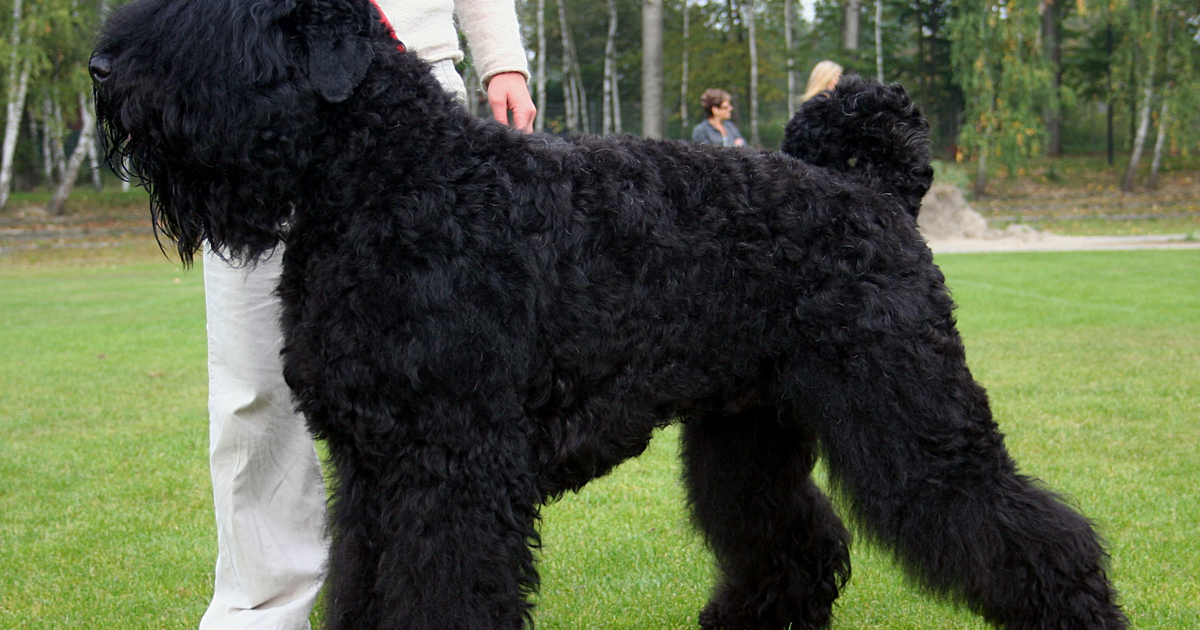
Image: “Wystawa Rybnik 02.10.2011 czarny terier rosyjski 2pl” — Tomasz Kuran alias Meteor2017, CC BY-SA 3.0 (scaled proportionally and centre-cropped to 1200×630).
How to get your pet tested
Some pet DNA tests screen for hereditary-disease carrier status or genetic risk markers, but the results are information, not a diagnosis. If your pet has symptoms or you need a confirmed diagnosis, please consult your veterinarian.
Below is where JLPP / POANV (RAB3GAP1) can be tested, grouped by where you live and marked by whether each service explicitly lists this variant (✅ = listed / ❓ = unverified / ❌ = not offered).
In the United States
In the United Kingdom
In India
Elsewhere
Note: even if the kit can be purchased/shipped internationally, the service itself (sample return, analysis, results) is not guaranteed in your country. Check each service’s stated service area and sample-return method before ordering.
Services offered in other regions (may not be available where you live)
Worried about your pet’s health? — Talk to a veterinarian
A confirmed diagnosis and any treatment plan are decisions for a veterinarian, not a test kit. The links below are professional resources.
AVMA — Find a veterinarian (American Veterinary Medical Association)
This section contains advertising (affiliate links); we may earn a commission if you buy through them. As an Amazon Associate, we earn from qualifying purchases. Genetic tests do not guarantee the prevention, diagnosis, or treatment of any disease — results indicate tendencies and provide information only.
This page is educational information, not veterinary diagnosis or advice. Always consult a veterinarian about your pet’s health.
About the author
Elena Marsh
Editor & writer (not a veterinarian)
A writer with a molecular-biology background and a lifelong dog and cat owner. Not a veterinarian — she translates peer-reviewed genetics research and primary data into plain language, always as information rather than diagnosis.