Bottom line: In the Doberman Pinscher, blue and fawn are not just colors — they are the highest-risk coat colors for a hereditary skin disease in any breed studied. Miller (1990, Veterinary Dermatology 1:113-122) examined 57 blue or fawn Dobermans and found hair loss typical of colour dilution alopecia (CDA) in 42 of them — an incidence of 57.9% in blues and 89.5% in fawns. Both colors are accepted in the AKC breed standard, and the Doberman Pinscher Club of America states that over 90% of blues will at least have thinning hair. The cause is a defect in the MLPH gene at the D locus — the same variant that makes the coat blue also makes the hair shaft break. A DNA test will tell you whether your dog is d/d (dilute), and that is genuinely useful for breeding decisions. What it will not do is tell you whether that particular dog will lose hair: no genetic marker distinguishing dilute dogs that develop CDA from those that do not has been identified. CDA is a clinical diagnosis, not a genetic one. If your dog’s coat is thinning, brittle, or scaly, see your veterinarian — hypothyroidism, demodicosis and dermatophytosis all look similar and must be ruled out first.
- The study that put a number on it
- The gene: one broken part in a delivery system
- Blue and fawn are in the standard. The health data is not in the standard.
- What a D locus test can and cannot tell you
- Where to test in the US and the UK, and what it actually costs
- If your dog already has it: management, honestly
- Frequently asked questions
- References
- How to get your pet tested
The study that put a number on it

Most breed-health conversations run on anecdote. This one does not, because a dermatology study did the arithmetic more than three decades ago and nobody has overturned it.
Miller studied a population of 57 blue or fawn Doberman Pinschers specifically to determine the incidence of colour dilution alopecia in the breed. Forty-two of the 57 had hair loss typical of CDA. Broken out by color:
- Blue Dobermans — 57.9% affected
- Fawn (Isabella) Dobermans — 89.5% affected
The diagnosis was not eyeballed. It was confirmed by skin biopsy in 11 dogs and by light microscopy of plucked hairs in 6 more. The findings were consistent and characteristic: large macromelanosomes inside the hair shafts, free clumps of melanin in the lumens of hair follicles, and numerous perifollicular melanophages. In plain terms — the pigment that should be spread evenly through the hair is instead sitting in lumps, and those lumps are where the hair snaps.
The clinical picture Miller described is the one owners still report today: a poor, dry, brittle coat, then bilaterally symmetrical alopecia over the thorax, flanks and abdomen, starting between 4 and 18 months of age. Puppies look normal. That is the trap — the coat you buy at eight weeks is not the coat you will have at two years.
Fawn is worse than blue. Nearly nine out of ten fawns in that population were affected. If you are weighing colors, that difference is not a rounding error.
The gene: one broken part in a delivery system
The MLPH gene encodes melanophilin, a linker protein. Pigment granules (melanosomes) are built inside melanocytes at the base of the hair follicle and then have to be physically transported to the cell periphery and handed off to the keratinocytes that build the hair. Melanophilin is part of the coupling that moves them.
Philipp et al. (2005, BMC Genetics 6:25) sequenced the canine MLPH gene, identified 48 sequence variants, and showed that polymorphisms in the gene co-segregate with the dilute phenotype. Drögemüller et al. (2007, Journal of Heredity 98:468-473) then pinned down the causal candidate: MLPH:c.-22G>A, a single base change at the last nucleotide of the untranslated first exon, disrupting the splice donor site. That variant is now called d1, and the Doberman is one of the breeds in which it was originally characterized.
When the linker fails, melanosomes are not distributed — they aggregate. Welle et al. (2009, Journal of Heredity 100 Suppl 1:S75-S79) correlated MLPH genotype with the actual melanin phenotype in dilute dogs, confirming that the genotype predicts the clumping pattern seen under the microscope.
Two consequences fall out of one defect:
- Color. Clumped pigment scatters light differently, so black reads as blue-grey and brown reads as fawn/Isabella. Nose, lips and eye rims are dilute too.
- Structure. The clumps are mechanical flaws. Hair shafts fracture at the pigment aggregates, and follicles become plugged with keratin.
Only the second one is a disease. This distinction matters more than anything else in this article, and it is where most owners get lost.
Blue and fawn are in the standard. The health data is not in the standard.
SamIf blue is an accepted color, doesn’t that mean the breed club considers it safe? Elena MarshNo. Recognition is a conformation question. The parent club’s own health page says over 90% of blues get thinning hair.The AKC breed standard for the Doberman Pinscher lists black, red, blue and fawn (Isabella), all with rust markings. A blue Doberman is a purebred Doberman, can be registered, and can be shown. None of that is in dispute.
What is worth noticing is that the parent club publishes the health picture separately, and it is blunt. The DPCA’s page on colour dilution alopecia states that over 90% of all blues will at least have thinning hair, and that roughly 75% of fawns experience extensive hair loss. It also notes that darker dilutes — steel blue, caramel — tend to hold their coats better than the very pale ones, which is a useful observation for anyone evaluating an individual dog rather than a color category.
For context, the same source contrasts breeds: 50-80% of dilute Dobermans are affected, versus roughly 7% of Italian Greyhounds. Same gene, same mechanism, an order of magnitude apart in outcome. Whatever modifies CDA risk, it is breed-specific and it has not been identified.
The DPCA page stops short of prescribing breeding practice. That is a defensible editorial choice for a parent club, but it leaves the decision — and the disclosure — with individual breeders and buyers. If you are buying a blue or fawn puppy in the United States, the honest framing is: you are choosing a color whose parent club reports a very high rate of coat disease, and you should plan for lifelong skin management rather than hope to avoid it.
What a D locus test can and cannot tell you
Three independent dilution variants are now known, and they are not interchangeable. OMIA:000031-9615 records them as:
- d1 — MLPH:c.-22G>A. Found across a wide range of breeds, including the Doberman Pinscher, German Pinscher, Miniature Pinscher, Large Münsterländer, American Staffordshire Terrier, Beagle and Rhodesian Ridgeback.
- d2 — MLPH:c.705G>C, described by Bauer et al. (2018, Animal Genetics). Restricted to Chow Chow, Sloughi and Thai Ridgeback.
- d3 — MLPH:c.667_668insC, a frameshift (p.His223Profs*41) described by Van Buren et al. (2020, Genes 11:639) in Italian Greyhound, Chihuahua, Pekingese, Shih Tzu, Yorkshire Terrier, Tibetan Mastiff, Shetland Sheepdog, Pumi and Mudi.
For a Doberman, d1 is the variant that matters — d2 and d3 have not been reported in the breed. A d1-only test is therefore adequate here, which is not true for every breed. (If you also own a small dilute breed, check whether your provider covers d3; several do not.)
Now the limit. The test reports whether the dog is D/D, D/d or d/d. It does not report whether the dog will develop CDA. LABOKLIN states this explicitly: no genetic factor is currently known that distinguishes diluted animals with CDA from those without. Every dilute Doberman is at risk; the DPCA figures say most will show it; nothing in the genotype tells you which individual is in the minority that will not.
Read the result as a breeding tool, not a prognosis. D/d dogs are black or red to look at and pass dilution to half their offspring. Two D/d parents can produce blue or fawn puppies from a black-and-red pairing. If a kennel says “we don’t have dilutes,” that claim is only verifiable by genotyping the breeding stock.
Where to test in the US and the UK, and what it actually costs
Testing is inexpensive and needs no veterinary visit. Prices below are the providers’ own published list prices.
United States.
- Embark Dog DNA Test — $99 introductory, $159 regular. Covers all three MLPH variants — D1, D2 and D3 — alongside health conditions and a genetic coefficient of inbreeding.
- Wisdom Panel Premium — $159.99, also reporting d1, d2 and d3.
- Orivet D (Dilute) Locus — $60.00 as a single-locus test. This is the route when you want one answer on a stud dog rather than a full panel. (Paw Print Genetics, which ran a dedicated D Locus panel, has merged with Orivet.)
- UC Davis Veterinary Genetics Laboratory — Dilute (D Locus/Blue), the usual academic-lab option.
United Kingdom. Do not assume the American providers are your cheapest route — shipping a swab to the US adds cost and weeks.
- LABOKLIN (UK) — Coat Colour: D-Locus D1 at £48.00 incl VAT, dropping to £24.00 for an additional test on the same sample. The d2/d3 rare variants are a separate order. Turnaround per the German parent lab is 3-5 working days for d1.
- Wisdom Panel Premium (UK) — £144.99.
One thing UK buyers should read before they order, because it is a genuine disagreement in the field. LABOKLIN UK states on that same test page that dilution “is just a colour and it is not known to be associated with any health conditions”, and that “there is no test for CDA and there is no evidence that CDA is caused by dilution.” Set that against Miller’s 57-dog incidence figures and the DPCA’s 90% statement, and the honest reading is this: CDA is only ever seen in dilute dogs, the association is not in dispute, but causation at the level of the individual dog is not established and no marker predicts it. A UK lab is stating the conservative version of that; the American parent club is stating the epidemiological one. Both are describing the same limitation from opposite ends.
The regulatory layer is different on each side of the Atlantic, too. In the UK, third-party puppy sales were banned in England in April 2020 under the Animal Welfare (Licensing of Activities Involving Animals) Regulations 2018 — “Lucy’s Law” — so you should be seeing the puppy with its mother at the breeder’s premises, which is also your chance to see the dam’s coat at four or five years old. That is better evidence than any pedigree claim about dilutes. In the United States there is no federal equivalent; consumer protection runs through state “puppy lemon laws”, which vary widely and generally cover a short window after purchase — a poor fit for a disease that shows up at 4-18 months.
Insurance is where this quietly gets expensive. CDA is not curable, and the ongoing cost is recurrent bacterial folliculitis: repeat consults, cytology, medicated shampoos and antibiotic courses over years. Two rules apply almost everywhere:
- Hereditary and congenital conditions are excluded outright by some policies and covered by others. For a known dilute, read that clause before you buy the policy, not after.
- Pre-existing conditions are excluded universally. Once a veterinarian has recorded thinning hair, that door closes.
In the UK there is an additional structural point: lifetime policies renew the annual limit each year, whereas “maximum benefit” and 12-month policies cap a condition once and for all. For a chronic recurring skin disease, that distinction is the whole game — a per-condition cap can be exhausted in the first two years and then the dog is uninsured for the exact thing it has. Insure a blue or fawn puppy on a lifetime policy at eight weeks, before anything is on the clinical record.
If your dog already has it: management, honestly
SamMy blue is two and going bald along his flanks. What can actually be done? Elena MarshThere is no cure. The realistic goals are controlling secondary infection and not breaking the hair he still has.Start with the diagnosis, because CDA is diagnosed by exclusion. VCA Animal Hospitals describes the workup: history and signalment, characteristic distribution of hair loss confined to dilute-pigmented areas, a trichogram showing macromelanosomes, and where needed a skin biopsy showing follicular dysplasia, melanin aggregates and follicular hyperkeratosis. Fungal culture, skin scrapings for Demodex, and thyroid testing come first — the DPCA page lists exactly these as the differentials to clear.
Then set expectations. There is no cure for CDA. Management has two achievable aims:
- Control secondary infection. Plugged follicles become bacterial folliculitis. Recurrent pyoderma is the part of this disease that actually makes dogs uncomfortable, and it is treatable.
- Stop breaking the remaining coat. Avoid harsh shampoos, abrasive brushes and aggressive grooming. Emollient and antiseborrheic shampoos help with the scaling.
Oral melatonin, essential fatty acids and retinoids are sometimes tried to stimulate partial regrowth. The published support is thin and inconsistent; treat them as a trial with your veterinarian, not a plan. If the pyoderma is recurrent or the diagnosis is uncertain, ask for referral to a board-certified veterinary dermatologist (ACVD diplomate) — this is a condition where a specialist mostly confirms and then optimizes, which is still worth it if you are cycling through antibiotics.
In the UK the equivalent referral is an RCVS Specialist or Advanced Practitioner in Veterinary Dermatology; your practice can refer directly, and most referral centres require it. In the US, ask for an ACVD diplomate.
Sun protection deserves a mention that rarely gets made: dilute skin left exposed by alopecia burns. A Doberman with bald flanks in Arizona, Texas or Florida needs shade management, limited midday exercise and — on advice — a light shirt, not just a better shampoo. In the UK the pressure runs the other way: a short-coated dilute dog losing what little coat it has feels a wet British winter, and outdoor kennelling stops being reasonable.
Frequently asked questions
Q. Are blue and fawn Dobermans purebred?
Yes. Blue and fawn (Isabella) are colors listed in the AKC breed standard and dogs of these colors are fully registrable. The health data discussed here is a separate question from registration eligibility.
Q. What percentage of blue Dobermans get colour dilution alopecia?
Miller (1990) found 57.9% of blues and 89.5% of fawns affected in a population of 57 dogs. The DPCA reports that over 90% of blues will at least show thinning hair.
Q. Can a DNA test predict whether my dilute dog will lose hair?
No. The test reports D/D, D/d or d/d. No genetic factor is currently known that distinguishes dilute dogs that develop CDA from those that do not.
Q. At what age does it start?
Puppies are born with a normal coat. Hair loss typically begins between 4 and 18 months of age and progresses over the following years.
Q. Do I need the d2 and d3 tests for a Doberman?
Not for dilution status in this breed — d1 is the relevant variant in Dobermans. The d2 variant is reported in Chow Chow, Sloughi and Thai Ridgeback, and d3 in several small breeds including the Italian Greyhound and Chihuahua.
Q. Can two black Dobermans produce a blue puppy?
Yes, if both parents are D/d carriers. Dilution is autosomal recessive, so carriers look black or red and pass the variant silently. This is why genotyping breeding stock is more informative than looking at them.
Q. Will the rust markings fall out too?
Typically not. Hair loss is confined to areas of dilute pigment; tan or rust points and any white are usually spared, which is one of the clinical clues that separates CDA from endocrine alopecia.
References
- Miller WH. (1990) Colour Dilution Alopecia in Doberman Pinschers with Blue or Fawn Coat Colours: A Study on the Incidence and Histopathology of this Disorder. Veterinary Dermatology 1(3):113-122.
- Drögemüller C, Philipp U, Haase B, Günzel-Apel A-R, Leeb T. (2007) A Noncoding Melanophilin Gene (MLPH) SNP at the Splice Donor of Exon 1 Represents a Candidate Causal Mutation for Coat Color Dilution in Dogs. Journal of Heredity 98(5):468-473.
- Philipp U, Hamann H, Mecklenburg L, et al. (2005) Polymorphisms within the canine MLPH gene are associated with dilute coat color in dogs. BMC Genetics 6:25.
- Welle M, Philipp U, Rüfenacht S, et al. (2009) MLPH Genotype—Melanin Phenotype Correlation in Dilute Dogs. Journal of Heredity 100(Suppl 1):S75-S79.
- Bauer A, Kehl A, Jagannathan V, Leeb T. (2018) A novel MLPH variant in dogs with coat colour dilution. Animal Genetics 49(1):94-97.
- Van Buren SL, Minor KM, Grahn RA, et al. (2020) A Third MLPH Variant Causing Coat Color Dilution in Dogs. Genes 11(6):639.
- OMIA:000031-9615 — Coat colour, dilution, MLPH-related in Canis lupus familiaris.
- Doberman Pinscher Club of America — Color Dilution Alopecia.
- VCA Animal Hospitals — Color Dilution Alopecia in Dogs.
- Orivet — D (Dilute) Locus test (Paw Print Genetics, which ran a dedicated D Locus panel, has merged with Orivet).
- UC Davis Veterinary Genetics Laboratory — Dilute (D Locus/Blue).
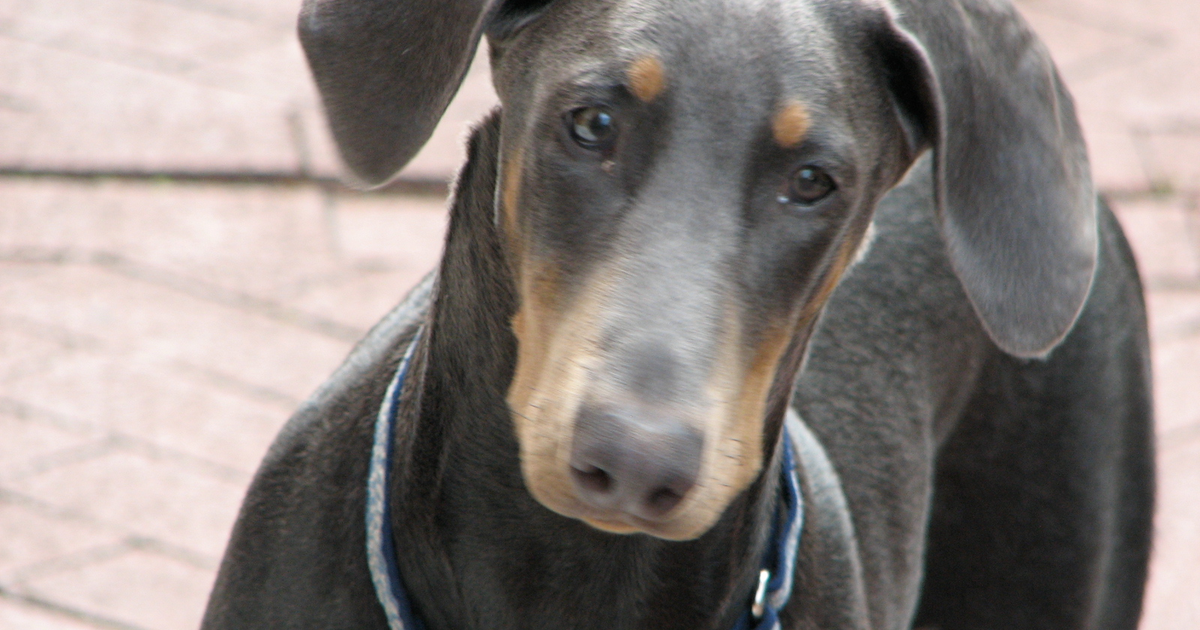
Image: “Doberman Pinscher blue portrait” by Andreas Kollegger, CC BY 2.0 (scaled and cropped to 1200×630).
How to get your pet tested
Some pet DNA tests screen for hereditary-disease carrier status or genetic risk markers, but the results are information, not a diagnosis. If your pet has symptoms or you need a confirmed diagnosis, please consult your veterinarian.
Below is where Color dilution alopecia (CDA/MLPH) can be tested, grouped by where you live and marked by whether each service explicitly lists this variant (✅ = listed / ❓ = unverified / ❌ = not offered).
In the United States
In the United Kingdom
In India
Elsewhere
Note: even if the kit can be purchased/shipped internationally, the service itself (sample return, analysis, results) is not guaranteed in your country. Check each service’s stated service area and sample-return method before ordering.
Services offered in other regions (may not be available where you live)
Worried about your pet’s health? — Talk to a veterinarian
A confirmed diagnosis and any treatment plan are decisions for a veterinarian, not a test kit. The links below are professional resources.
AVMA — Find a veterinarian (American Veterinary Medical Association)
This section contains advertising (affiliate links); we may earn a commission if you buy through them. As an Amazon Associate, we earn from qualifying purchases. Genetic tests do not guarantee the prevention, diagnosis, or treatment of any disease — results indicate tendencies and provide information only.
This page is educational information, not veterinary diagnosis or advice. Always consult a veterinarian about your pet’s health.
About the author
Elena Marsh
Editor & writer (not a veterinarian)
A writer with a molecular-biology background and a lifelong dog and cat owner. Not a veterinarian — she translates peer-reviewed genetics research and primary data into plain language, always as information rather than diagnosis.