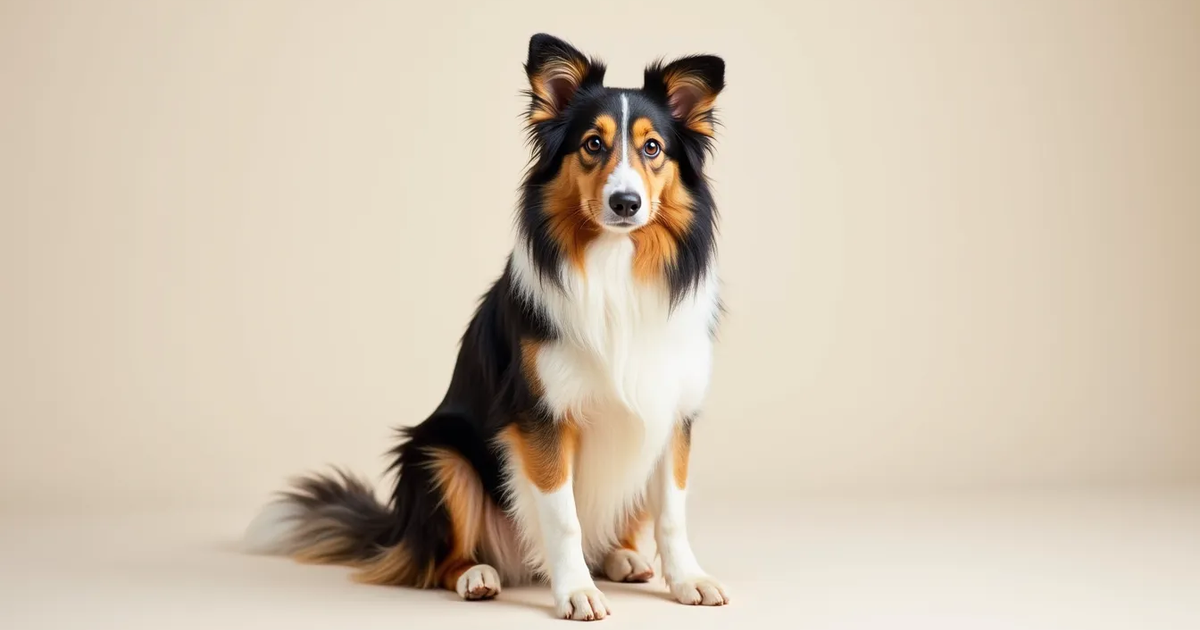
In short: The Rough Collie is the breed most associated with Collie Eye Anomaly (CEA) and carries the highest known mutant-allele frequency for the NHEJ1 deletion, so a DNA test is genuinely useful for breeding decisions. But a “genetically affected” result does not reliably predict clinical disease in this breed (Fredholm 2016) — and the deletion may even be a linked marker rather than the true cause — so an eye exam by a board-certified veterinary ophthalmologist still matters.
What CEA and the NHEJ1 deletion actually are


Collie Eye Anomaly is a congenital, inherited disorder of eye development. The near-constant, defining lesion is choroidal hypoplasia (CH) — an under-developed choroid in the dorsotemporal quadrant of the eye — which is usually mild (Lowe 2003; OMIA:000218-9615). The same variant is the target of essentially every commercial CEA DNA test today.
A smaller subset of dogs reach the severe end of the spectrum, with optic-nerve or staphylomatous coloboma, retinal detachment, or microphthalmia, which can threaten sight (Parker 2007). Because the disorder is recessive, a dog needs two copies of the deletion to be genetically “affected.”
Why the Rough Collie is the “face” of CEA
SamIs it just a Collie problem, or do other breeds get it too? Elena MarshMany herding breeds carry it, but the Rough Collie leads by far — one Thai survey found a mutant-allele frequency of 83.3%, versus 7.8% in Border Collies (Lerdkrai 2022).In the Lerdkrai 2022 survey (Thailand), the Rough Collie showed a mutant-allele frequency of 83.3%, with 66.7% of the sampled dogs homozygous — though the sample was small (n=21). The same study reported far lower frequencies in the Border Collie (7.8%), Australian Shepherd (5.1%), and Shetland Sheepdog (2.8%).
For context, a Norwegian survey put Border Collie mutant-allele frequency at 6.3% (Grosås 2018) — broadly consistent with the Thai figure. Across these datasets the Rough Collie carries by far the highest carrier burden, which is why it has become the breed most strongly associated with CEA.
The catch: genotype is not the same as clinical severity
SamSo if the test says “affected,” the dog is definitely going blind? Elena MarshNo — severity isn’t correlated with genotype at all. A homozygous dog might show only mild CH or, rarely, be blind, and Fredholm 2016 found the deletion didn’t even predict clinical CH in Danish Rough Collies.An important and often-missed point: severity does not correlate with genotype. A dog carrying two copies of the deletion may have only mild choroidal hypoplasia — or, uncommonly, serious sight-threatening lesions. The genetic result tells you the dog is affected; it does not grade how bad the eye will be.
The Rough-Collie-specific wrinkle is stronger still. Fredholm et al. (2016) found the NHEJ1 deletion was not predictive for clinical CH in Danish Rough Collies — genotype and ophthalmologist diagnosis disagreed — even though the same test agreed well in Shetland Sheepdogs. The authors suggested the deletion may be a linked marker rather than the causal mutation. By contrast, Grosås et al. (2018) reported good genotype–phenotype agreement in Border Collies. So the deletion is best described as the standard commercial test target and the most-cited associated variant, with the causality still debated in Rough Collies.
“Go normals” and why early eye exams matter
SamMy friend’s breeder said the Collie’s eyes were “checked and normal” as an adult. Doesn’t that settle it? Elena MarshNot always — in some pups mild CH is visible early, then later pigment masks it, so an affected dog can look “normal” on a later exam. That’s why ophthalmoscopy around 6–8 weeks is advised.In young puppies, mild choroidal hypoplasia is visible before the retinal pigment epithelium fully pigments. As pigment develops, it can later mask that mild CH, so a dog that would have been detectable at a few weeks old can look normal on a later examination — the so-called “go normal” phenomenon. Crucially, the dog remains genetically affected regardless of what a later exam shows.
Because of this, ophthalmoscopic examination is recommended early, at roughly 6–8 weeks of age (OFA). An early clinical exam and the DNA result answer different questions, and together they give a much clearer picture than either alone.
What the DNA test can and cannot tell you
SamSo should my friend even bother with the DNA test, or just trust the eye exam? Elena MarshBoth — the DNA test gives carrier and breeding status even when eyes look normal, but it isn’t a diagnosis; Fredholm 2016 is exactly why a Rough Collie also needs an ophthalmologist’s exam.A CEA DNA test reports genetic risk, carrier status, and breeding status — clear/carrier/affected — which is powerful for planning matings and avoiding two-carrier pairings, and it works even when a dog’s eyes currently look normal. What it does not do is deliver a clinical diagnosis or predict how severe the disease will be.
A clinical diagnosis comes from a board-certified veterinary ophthalmologist through recognised schemes (ACVO, BVA, or ECVO). Given the Rough-Collie discordance reported by Fredholm (2016), the best practice for this breed is explicitly to use both: the DNA test for breeding and risk information, and the ophthalmologist’s exam for actual clinical status. CEA is not curable, so the value here is information — for breeding choices and monitoring — not treatment.
Frequently asked questions (FAQ)
Q. Does a “genetically affected” DNA result mean my Rough Collie will go blind?
No. Severity is not correlated with genotype — an affected dog may show only mild choroidal hypoplasia or, less often, sight-threatening lesions. The test reports genetic status, not how severe the eye disease will be (Parker 2007).
Q. If the DNA test targets the NHEJ1 deletion, why is an eye exam still needed for Rough Collies?
Because Fredholm et al. (2016) found the deletion was not predictive for clinical CH in Danish Rough Collies and may be a linked marker rather than the cause. A veterinary ophthalmologist’s exam checks actual clinical status, so best practice is to use both.
Q. My friend’s adult Collie passed its eye exam — could it still be affected?
Possibly. In some dogs, developing pigment later masks mild CH — the “go normal” effect — so an affected dog can look normal on a later exam. Ophthalmoscopy around 6–8 weeks is advised, and the DNA result stays the same regardless.
Q. How common is the CEA variant in Rough Collies compared with other breeds?
Very common. Lerdkrai (2022) reported a mutant-allele frequency of 83.3% in Rough Collies (small sample), versus 7.8% in Border Collies, 5.1% in Australian Shepherds, and 2.8% in Shetland Sheepdogs.
References
- Lowe JK et al. (2003) Linkage mapping of the primary disease locus for collie eye anomaly. Genomics 82(1):86-95. https://www.sciencedirect.com/science/article/abs/pii/S0888754303000788
- Parker HG et al. (2007) Breed relationships facilitate fine-mapping studies: a 7.8-kb deletion cosegregates with Collie eye anomaly across multiple dog breeds. Genome Research 17(11):1562-1571. https://pmc.ncbi.nlm.nih.gov/articles/PMC2045139/
- Fredholm M et al. (2016) Discrepancy in compliance between the clinical and genetic diagnosis of choroidal hypoplasia in Danish Rough Collies and Shetland Sheepdogs. Animal Genetics 47(2):250-252. https://pubmed.ncbi.nlm.nih.gov/26732749/
- Grosås S et al. (2018) Compliance between clinical and genetic diagnosis of choroidal hypoplasia in 103 Norwegian Border Collie puppies. Veterinary Ophthalmology 21(4):371-375. https://pubmed.ncbi.nlm.nih.gov/29111596/
- Lerdkrai C & Phungphosop N (2022) A novel multiplex PCR assay for the genotypic survey of the NHEJ1 gene associated with Collie eye anomaly in Thailand. Veterinary World 15(1):132-139. https://pmc.ncbi.nlm.nih.gov/articles/PMC8924400/
- OMIA:000218-9615 — Collie eye anomaly in Canis lupus familiaris. https://omia.org/OMIA000218/9615/
- OFA — Collie Eye Anomaly. https://ofa.org/collie-eye-anomaly/
How to get your pet tested
Some pet DNA tests screen for hereditary-disease carrier status or genetic risk markers, but the results are information, not a diagnosis. If your pet has symptoms or you need a confirmed diagnosis, please consult your veterinarian.
Below is where Collie Eye Anomaly (CEA/NHEJ1) can be tested, grouped by where you live and marked by whether each service explicitly lists this variant (✅ = listed / ❓ = unverified / ❌ = not offered).
In the United States
In the United Kingdom
In India
Elsewhere
Note: even if the kit can be purchased/shipped internationally, the service itself (sample return, analysis, results) is not guaranteed in your country. Check each service’s stated service area and sample-return method before ordering.
Services offered in other regions (may not be available where you live)
Worried about your pet’s health? — Talk to a veterinarian
A confirmed diagnosis and any treatment plan are decisions for a veterinarian, not a test kit. The links below are professional resources.
AVMA — Find a veterinarian (American Veterinary Medical Association)
This section contains advertising (affiliate links); we may earn a commission if you buy through them. As an Amazon Associate, we earn from qualifying purchases. Genetic tests do not guarantee the prevention, diagnosis, or treatment of any disease — results indicate tendencies and provide information only.
This page is educational information, not veterinary diagnosis or advice. Always consult a veterinarian about your pet’s health.
About the author
Elena Marsh
Editor & writer (not a veterinarian)
A writer with a molecular-biology background and a lifelong dog and cat owner. Not a veterinarian — she translates peer-reviewed genetics research and primary data into plain language, always as information rather than diagnosis.