SamMy breeder mentioned a “PLL test” for my American Hairless Terrier. Is that really necessary?
Elena MarshIt is one of six screenings the OFA and the breed’s parent club require for a CHIC number, and the only DNA test on that list — the club clearly treats it as a priority.
SamBut the breed is barely fifty years old. Where would an inherited eye disease even come from?
Elena MarshFrom the Rat Terriers it was built on. Farias and colleagues showed in 2010 that a single ADAMTS17 mutation sits behind primary lens luxation across terrier breeds, and it is far older than any of them.
SamAnd if the result comes back badly, is there actually anything I can do about it?
Elena MarshYes. Cornell’s canine health centre reports the lens usually shifts between three and eight years of age, so a result taken in puppyhood gives you years to plan — though Cornell also notes the eye can start changing from around 20 months.

Bottom line: The American Hairless Terrier is one of the 23 breeds the Orthopedic Foundation for Animals lists for the ADAMTS17 primary lens luxation (PLL) DNA test (the list also accepts hybrid and mixed-breed dogs), and PLL is one of six health screenings required for a CHIC number in this breed. A cheek-swab test tells you whether a dog carries none, one or two copies of the c.1473+1G>A variant — it is a risk and breeding tool, not a diagnosis, and it cannot tell you whether or when an eye will actually luxate. Anterior lens luxation is a genuine emergency: a painful, red, cloudy or suddenly blind eye needs an emergency clinic the same day, not a wait-and-see appointment. Talk to your veterinarian about what any result means for your individual dog.
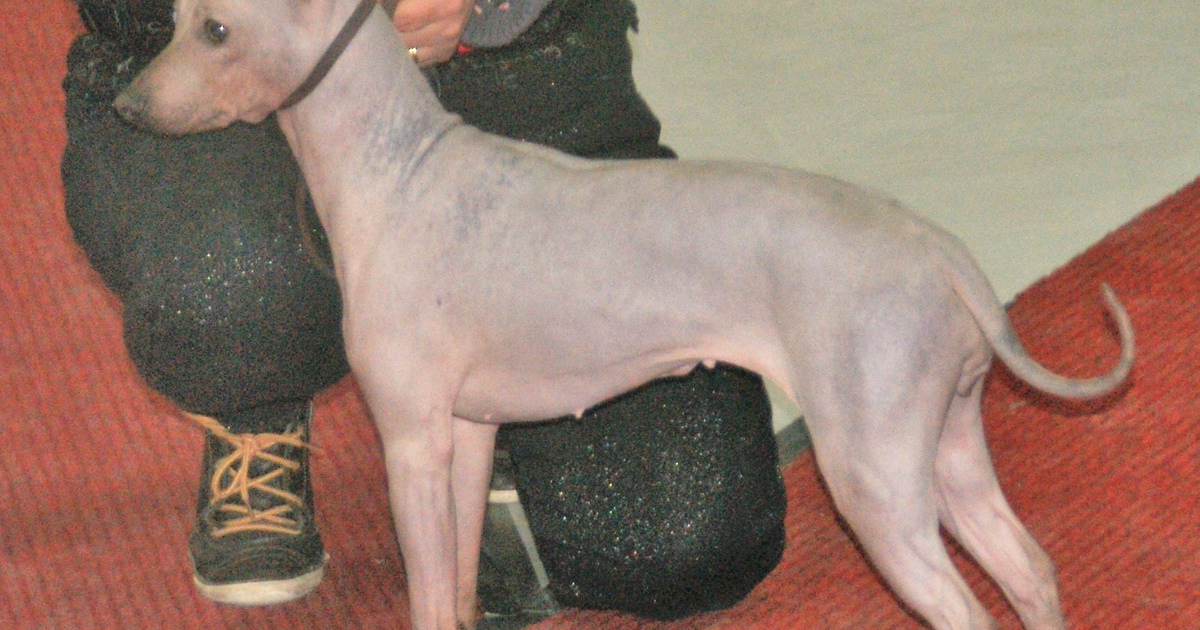
The American Hairless Terrier is one of the youngest breeds the American Kennel Club recognises, and one of the most distinctly American. The United Kennel Club traces the entire population back to a single female born in 1972 — Josephine, a hairless pup in a litter of purebred coated Rat Terriers, taken on by Edwin Scott and turned into the foundation of a new breed. The dogs were registered as Rat Terriers (hairless variety) until 1 January 2004, when the UKC granted separate breed status; the AKC granted full recognition in the Terrier Group in 2016.
That compressed history matters for health, because a breed founded on one dog inherits whatever that dog’s line was carrying. Primary lens luxation is the clearest example. It is an inherited eye disease in which the fibres suspending the lens degenerate and break, letting the lens drift out of position — and when it drifts forward, it can block fluid drainage and drive eye pressure up within hours. This article covers what the ADAMTS17 test does and does not tell an American Hairless Terrier owner, why a breed created in the 1970s carries a mutation that predates every terrier registry, what testing costs in the United States and the United Kingdom, and what to do when one eye suddenly looks wrong.
- What primary lens luxation is, and what ADAMTS17 has to do with it
- A young American breed carrying a very old terrier mutation
- Carriers: why “low risk” is not the same as “no risk”
- Anterior lens luxation is an emergency — know the route before you need it
- Testing an American Hairless Terrier in the United States
- Testing in the United Kingdom: the gap the Royal Kennel Club leaves
- Breeding paperwork, insurance and your rights as a buyer
- Frequently asked questions
- References
- How to get your pet tested
What primary lens luxation is, and what ADAMTS17 has to do with it
The lens of the eye is held in place by the ciliary zonules — a ring of fine fibres anchoring it to the surrounding tissue. In primary lens luxation those fibres degenerate and rupture, and the lens shifts. Cornell University’s Riney Canine Health Center lists the signs owners notice: a “red eye,” squinting or holding the eye closed, “cloudiness or haziness to the eye,” increased tearing or blinking, frequent pawing at the eye, and visual impairment or blindness. Cornell also notes that although the lens most commonly displaces between three and eight years of age, structural changes inside the eye “may already be evident at 20 months of age” — long before an owner sees anything wrong.
The genetic cause was pinned down in 2010. Farias, Johnson, Taylor, Mellersh and colleagues, publishing in Investigative Ophthalmology & Visual Science, used a genome-wide association analysis and fine mapping by homozygosity to place the PLL locus in a 664-kilobase region of canine chromosome 3, containing the candidate gene ADAMTS17. Resequencing revealed a GT→AT splice-donor-site mutation at the 5′ end of intron 10; the predicted skipping of exon 10 and the resulting frameshift were confirmed in RNA taken from PLL-affected eyes and from skin fibroblast cultures. The variant was significantly associated with clinical PLL in three different dog breeds. Online Mendelian Inheritance in Animals records the same change as a G→A transition at c.1473+1 that “destroys the splice donor recognition site in intron 10,” inherited in an autosomal recessive pattern.
ADAMTS17 encodes an enzyme that helps build and maintain the extracellular scaffolding the zonules are made of. Truncating mutations in the human version of the gene cause a Weill-Marchesani-like syndrome that also features displaced lenses — a comparison the 2010 authors drew explicitly.
SamSo the same gene does the same thing in people as it does in dogs?
Elena MarshBroadly, yes. The 2010 paper framed canine PLL as a comparative model for a rare human Weill-Marchesani-like disease caused by truncating ADAMTS17 mutations — same scaffolding protein, same drifting lens.
A young American breed carrying a very old terrier mutation
Before the gene was found, researchers already knew PLL clustered in terriers. Sargan, Pettitt, Gould and Mellersh reviewed ten years of the Veterinary Medical Database and Canine Eye Registration Foundation records in the Journal of Heredity in 2007 and found a PLL diagnosis recorded in 85 breeds, then mapped the disease to a 6.3-megabase region of chromosome 3 in Miniature Bull Terriers and Lancashire Heelers — the stretch of chromosome the causative gene was later found in.
The scale of the problem became clear in 2011, when Gould and colleagues screened PLL-affected dogs from 30 different breeds in Veterinary Ophthalmology and found the c.1473+1G>A variant in 14 breeds beyond the three originally described. Their conclusion was that the mutation “segregates in a large number of different breeds of dog, many of which are terriers or breeds with terrier co-ancestry,” and that it is present at high frequency in most of the breeds where it occurs. Not every case is the same mutation — affected Shar Pei and Brittany Spaniels in that study did not carry the variant at all, indicating a genetically distinct form of the same disease.
This is where the American Hairless Terrier’s unusual origin becomes clinically relevant. The breed was created entirely from Rat Terrier stock, and the UKC’s own breed documentation states that it “will be necessary for the foreseeable future to continue to include some Rat Terrier crosses” to maintain genetic diversity. The Rat Terrier is itself on the OFA’s list of breeds tested for ADAMTS17 PLL. In other words, a breed that did not formally exist until 2004 shares a live gene pool with an older terrier population in which the variant is known to circulate — exactly the pattern Gould and colleagues described, and exactly why the parent club did not wait for a crisis before putting the test on its screening panel.
SamSo outcrossing back to Rat Terriers is helping and hurting at the same time?
Elena MarshThat’s the tension. The crosses keep diversity up in a breed founded on one bitch, but the OFA lists the Rat Terrier for the same ADAMTS17 test — so every cross is a reason to test, not a reason to relax.
Carriers: why “low risk” is not the same as “no risk”
Most owners meet PLL as a simple recessive story: two copies bad, one copy harmless. The literature is less tidy than that. In the same 2011 paper, Gould and colleagues reported that they “identified an increased risk of PLL associated with heterozygosity at ADAMTS17, suggesting that carriers carry a low risk of developing PLL.” The OFA reflects this in how it reports results, describing the middle category not as “carrier” alone but as Carrier / Low Risk, with a stated risk in the region of 5–10 per cent, alongside Normal (clear) and Affected / High Risk. Embark, whose consumer panel includes the variant, classifies the inheritance type as additive rather than recessive for the same reason, and Cornell describes it as “codominant or additive.”
The practical consequence for an American Hairless Terrier household is modest but real. A one-copy result does not mean you should expect trouble; it means the sensible response is an annual eye check rather than a shrug, and it means a carrier should never be bred to another carrier. It also means you should not read “carrier” on a certificate as a clean bill of health when you are choosing a puppy.
Anterior lens luxation is an emergency — know the route before you need it
Everything above is planning. This section is the part to remember. When the lens slips forward into the anterior chamber, it can obstruct the outflow of fluid from the eye and drive intraocular pressure up quickly. Cornell describes the mechanism plainly: an anterior luxation “can rapidly increase pressure inside the eye, known as glaucoma, causing pain and potentially blindness.” Embark’s guidance is equally direct — contact your vet right away if you notice cloudiness, redness, squinting, or pawing at the eye — and notes that surgical correction by a veterinary ophthalmologist is necessary if the lens falls forward, while a lens that drops backwards may only need monitoring.
In the United States, that means an emergency or 24-hour animal hospital the same evening, not a next-day slot at your regular practice. Once the eye is stabilised, definitive treatment sits with a board-certified veterinary ophthalmologist. The American College of Veterinary Ophthalmologists runs a public directory — its “Help My Pet’s Eyes” veterinary ophthalmologist search tool at acvo.org — and a genuine specialist will be an ACVO Diplomate credentialed through the American Board of Veterinary Ophthalmology. Looking it up while both eyes are still fine takes five minutes.
In the United Kingdom the safety net is structured differently. Paragraph 3.1 of the RCVS Code of Professional Conduct states that “all veterinary surgeons in practice must take steps to provide 24-hour emergency first aid and pain relief to animals according to their skills and the specific situation” — practices need not staff the night themselves, but they must direct clients to an appropriate alternative service. In practice that is your registered practice’s out-of-hours provider, whose number is worth having in your phone rather than on a card in a drawer. For referral, Veterinary Ophthalmology is a recognised RCVS specialty, and the RCVS Find a Vet register lets owners look up RCVS Specialists in ophthalmology by location before a general practitioner makes the referral.
SamCould I not just give it a few hours and see whether the eye settles down?
Elena MarshNo. Cornell describes anterior luxation as rapidly raising pressure inside the eye, which is glaucoma — that is a same-day emergency, and Cornell adds that anterior luxation left untreated or not addressed immediately often has a poor prognosis for saving the eye.
Testing an American Hairless Terrier in the United States
The route most American Hairless Terrier owners and breeders take runs through the Orthopedic Foundation for Animals, which lists the breed among the 23 eligible for ADAMTS17 PLL testing (hybrid and mixed-breed dogs are accepted as well). Samples are processed by the University of Missouri’s canine genetics laboratory and results are issued by the OFA. The fee is $65 per test, and the OFA states that this price “includes automatic registration of the results in the OFA database” — which matters, because a result nobody else can see does not help a puppy buyer. The OFA is explicit that collection is non-invasive and “no veterinary appointment is necessary”: the kit arrives with two buccal swabs and instructions, and results are emailed to the address used at ordering.
Consumer panels cover the same variant as part of a broader screen, which is convenient if you want a general picture of an individual pet rather than a breeding certificate. Note the distinction, though: for CHIC purposes the OFA specifies a “DNA based PLL test from an approved lab,” and results have to be registered with the OFA to count, so anyone planning to certify a dog should confirm in advance that their chosen laboratory’s results can be submitted rather than assume it.
Results come back in three categories — clear, carrier/low risk, and affected/high risk — and the test only needs to be done once in a dog’s life. None of these results is a diagnosis. A dog that tests affected may never luxate a lens; a dog that tests clear can still develop eye disease for entirely unrelated reasons. A clear result also rules out only this one variant — Gould and colleagues found PLL-affected dogs in breeds that do not carry it at all, so a clear ADAMTS17 test is not a guarantee against lens luxation itself. What the test buys you is a probability and a breeding decision, and interpretation of a result for your particular dog belongs with your veterinarian.
Testing in the United Kingdom: the gap the Royal Kennel Club leaves
British owners face a specific, breed-level complication that owners of Jack Russells and Lancashire Heelers do not. The Royal Kennel Club sells a Primary Lens Luxation DNA test directly through its own shop at £60.00, cheek swab, results in 1–3 weeks — but the breeds it lists for that test are the Australian Cattle Dog, Bull Terrier, Bull Terrier (Miniature), Chinese Crested, Jack Russell Terrier, Lancashire Heeler, Parson Russell Terrier, Sealyham Terrier, Tibetan Terrier and Welsh Terrier. The American Hairless Terrier is not among them, and it does not appear in the RKC’s Breeds A–Z listing of 227 recognised pedigree breeds at all. There is no KC-recorded health result on a dog’s registration record, and no breed-specific scheme to point a UK buyer towards.
The practical answer is a commercial laboratory. Laboklin UK offers the PLL test at £48.00 including VAT with a 1–2 week turnaround, accepting either buccal swabs or 0.5–1 ml of whole blood in EDTA, and — importantly for this audience — explicitly names the American Hairless Terrier in its breed list, which is useful corroboration in its own right that the breed is considered at risk. Canine Genetic Testing, the DNA testing laboratory inside the Department of Veterinary Medicine at the University of Cambridge and part of the Queen’s Veterinary School Hospital, offers a PLL test at £49.50 including VAT, also 1–2 weeks, and reinvests all of its profits into the Canine Genetics Centre’s research.
One UK point of law is worth being precise about. Lucy’s Law, in force in England since 6 April 2020, bans the sale of puppies and kittens under six months old by pet shops and third-party dealers, so a puppy must be bought from the breeder who bred it, at the premises where it was bred, with the mother present. It is a sales-channel rule aimed at puppy farming — it does not require any health test, does not guarantee a PLL-tested litter, and provides no remedy if a hereditary condition appears later. With an unrecognised breed and no KC paperwork trail, a UK buyer’s only real protection is asking to see the laboratory certificates for both parents and checking that the dog identification on them matches the microchip numbers.
SamIf the Royal Kennel Club doesn’t list the breed, is UK testing even worth the bother?
Elena MarshMore so, not less. Laboklin’s £48 test names the American Hairless Terrier in its own breed list, and with no KC health record to fall back on, that certificate is the only documentation a UK buyer will ever get.
Breeding paperwork, insurance and your rights as a buyer
In the United States, the document that actually signals a responsible American Hairless Terrier breeder is a CHIC number. The OFA’s CHIC requirements for the breed, set with the American Hairless Terrier Club of America as parent club, list six required screenings: a cardiac evaluation, hip dysplasia evaluation (OFA radiographs or PennHIP), a veterinary patellar luxation evaluation, an OFA Legg-Calve-Perthes radiographic evaluation, congenital deafness testing by BAER, and a DNA-based PLL test from an approved laboratory. Three further tests are listed as optional: an ACVO eye examination annually until eight years (96 months) of age, elbow dysplasia evaluation, and a prcd-PRA DNA test. The dog must also be permanently identified by microchip or tattoo, and CHIC numbers generate automatically within one to two weeks once the required results are registered. Crucially, results do not all have to be normal — they have to be public. A breeder who tests but hides the outcomes is not participating in the system.
That optional ACVO examination schedule deserves a second look: annual eye examinations until eight years old line up almost exactly with the window in which PLL typically appears, which makes the add-on far more useful in this breed than the word “optional” suggests.
On insurance, the rule on both sides of the Atlantic is about timing rather than the word “hereditary.” MetLife Pet Insurance states that its plans “can provide coverage for hereditary and congenital conditions as part of our standard accident and illness policy,” subject to a 14-day waiting period, and that a condition showing symptoms before then “will likely be considered pre-existing.” In the UK, Petplan covers hereditary and congenital conditions as standard and will cover conditions “that haven’t shown symptoms before the start of your policy,” and defines a pre-existing condition as an illness or injury a dog suffered from before the policy was taken out, or one an owner had noticed previously or a vet had previously diagnosed. The practical instruction is identical in both markets: insure the puppy before any eye signs appear, and read the hereditary clause rather than assuming it works in your favour.
US buyers also have a statutory backstop that UK buyers do not. According to the Animal Legal & Historical Center, 22 states had enacted pet purchaser protection acts as of 2023, and the congenital or hereditary defect windows differ sharply: California and Florida both allow one year from purchase for a veterinarian to certify the animal unfit, while New York’s window is 180 calendar days. Remedies typically include a refund, an exchange, or keeping the dog with veterinary fees reimbursed. Because PLL surfaces years after purchase in most dogs, even a one-year window will usually have closed before the lens moves; these statutes are a real remedy for early-onset problems, not a warranty against adult-onset eye disease. UK buyers have no direct equivalent and would be relying on the Consumer Rights Act’s “satisfactory quality” standard against a business seller, which means proving the defect existed at the point of sale.
Frequently asked questions
Q. Is the American Hairless Terrier officially recognised as a breed at risk of PLL?
Yes. The Orthopedic Foundation for Animals lists the American Hairless Terrier among the 23 breeds eligible for the ADAMTS17 PLL test, and the OFA’s CHIC requirements for the breed — set with the parent club — include a DNA-based PLL test from an approved laboratory as one of six required screenings. Laboklin UK also names the breed on its own PLL test page.
Q. My dog tested “affected” or “high risk.” Does that mean he will go blind?
No. A genetic result describes risk and inheritance, not a diagnosis, and it cannot say whether or when a lens will luxate. Cornell reports that the lens most commonly displaces between three and eight years of age, with structural changes sometimes visible from 20 months. Take the result to your veterinarian, who may recommend regular examinations with a veterinary ophthalmologist.
Q. What should I do if my dog’s eye suddenly looks red, cloudy or painful?
Treat it as an emergency and seek veterinary attention the same day rather than waiting. Anterior lens luxation can raise pressure inside the eye rapidly, which is glaucoma and can cost the eye its sight. In the US, use an emergency or 24-hour animal hospital; in the UK, use your practice’s out-of-hours provider, which the RCVS Code requires practices to arrange.
Q. Does a “carrier” result matter if I am not breeding?
It matters a little. Gould and colleagues found an increased risk of PLL associated with carrying one copy, and the OFA reports the middle category as “Carrier / Low Risk” with a risk in the 5–10 per cent range. For a pet, that generally means routine eye checks rather than special treatment — but discuss the specific result with your veterinarian, and never breed a carrier to another carrier.
References
- Farias FHG, Johnson GS, Taylor JF, Giuliano E, Katz ML, Sanders DN, et al. (2010). “An ADAMTS17 Splice Donor Site Mutation in Dogs with Primary Lens Luxation.” Investigative Ophthalmology & Visual Science 51(9):4716-4721.
- Gould D, Pettitt L, McLaughlin B, Holmes N, Forman O, Thomas A, et al. (2011). “ADAMTS17 mutation associated with primary lens luxation is widespread among breeds.” Veterinary Ophthalmology 14(6):378-384.
- Sargan DR, Withers D, Pettitt L, Squire M, Gould DJ, Mellersh CS (2007). “Mapping the Mutation Causing Lens Luxation in Several Terrier Breeds.” Journal of Heredity 98(5):534-538.
- OMIA:000588-9615. “Lens luxation in Canis lupus familiaris (dog)” — ADAMTS17 c.1473+1G>A, autosomal recessive.
- Orthopedic Foundation for Animals. “Primary Lens Luxation” — eligible breeds, result categories and at-home sample collection.
- Orthopedic Foundation for Animals. “Browse By Breed: American Hairless Terrier” — CHIC required and optional screenings.
- Orthopedic Foundation for Animals. “Order DNA Tests” — $65 per test, buccal swab kit, automatic database registration.
- Cornell University Riney Canine Health Center. “Primary Lens Luxation” — signs, age of onset and the glaucoma emergency.
- Embark Vet. “Primary Lens Luxation (PLL)” — ADAMTS17, additive inheritance, 3-8 years typical onset.
- American College of Veterinary Ophthalmologists. “Help My Pet’s Eyes” veterinary ophthalmologist search tool.
- Royal College of Veterinary Surgeons. Code of Professional Conduct, supporting guidance on 24-hour emergency first aid and pain relief.
- The Royal Kennel Club. “Primary Lens Luxation (PLL)” DNA test — £60.00, cheek swab, 1-3 weeks, listed breeds.
- Laboklin UK. “Primary Lens Luxation (PLL)” — £48.00 incl. VAT, 1-2 weeks, breed list including the American Hairless Terrier.
- Canine Genetic Testing, University of Cambridge. “Primary Lens Luxation” — £49.50 incl. VAT, 1-2 weeks.
- United Kennel Club. “American Hairless Terrier” — breed history: Josephine (1972), Rat Terrier ancestry, separate breed status 1 January 2004.
- American Kennel Club. “Breeds by Year Recognized” — American Hairless Terrier, 2016.
- Animal Legal & Historical Center, Michigan State University. “Table of Pet Purchaser Protection Acts” — state windows for congenital and hereditary defects.
- MetLife Pet Insurance. “Pet Insurance That Covers Hereditary & Congenital Conditions” — coverage terms and 14-day waiting period.
- Petplan UK. “Dog Insurance” — hereditary and congenital conditions covered as standard.
Photo: Canarian, CC BY-SA 4.0, via Wikimedia Commons.
How to get your pet tested
Some pet DNA tests screen for hereditary-disease carrier status or genetic risk markers, but the results are information, not a diagnosis. If your pet has symptoms or you need a confirmed diagnosis, please consult your veterinarian.
Below is where Primary lens luxation (ADAMTS17) can be tested, grouped by where you live and marked by whether each service explicitly lists this variant (✅ = listed / ❓ = unverified / ❌ = not offered).
In the United States
In the United Kingdom
In India
Elsewhere
Note: even if the kit can be purchased/shipped internationally, the service itself (sample return, analysis, results) is not guaranteed in your country. Check each service’s stated service area and sample-return method before ordering.
Services offered in other regions (may not be available where you live)
Worried about your pet’s health? — Talk to a veterinarian
A confirmed diagnosis and any treatment plan are decisions for a veterinarian, not a test kit. The links below are professional resources.
AVMA — Find a veterinarian (American Veterinary Medical Association)
This section contains advertising (affiliate links); we may earn a commission if you buy through them. As an Amazon Associate, we earn from qualifying purchases. Genetic tests do not guarantee the prevention, diagnosis, or treatment of any disease — results indicate tendencies and provide information only.
This page is educational information, not veterinary diagnosis or advice. Always consult a veterinarian about your pet’s health.
About the author
Elena Marsh
Editor & writer (not a veterinarian)
A writer with a molecular-biology background and a lifelong dog and cat owner. Not a veterinarian — she translates peer-reviewed genetics research and primary data into plain language, always as information rather than diagnosis.