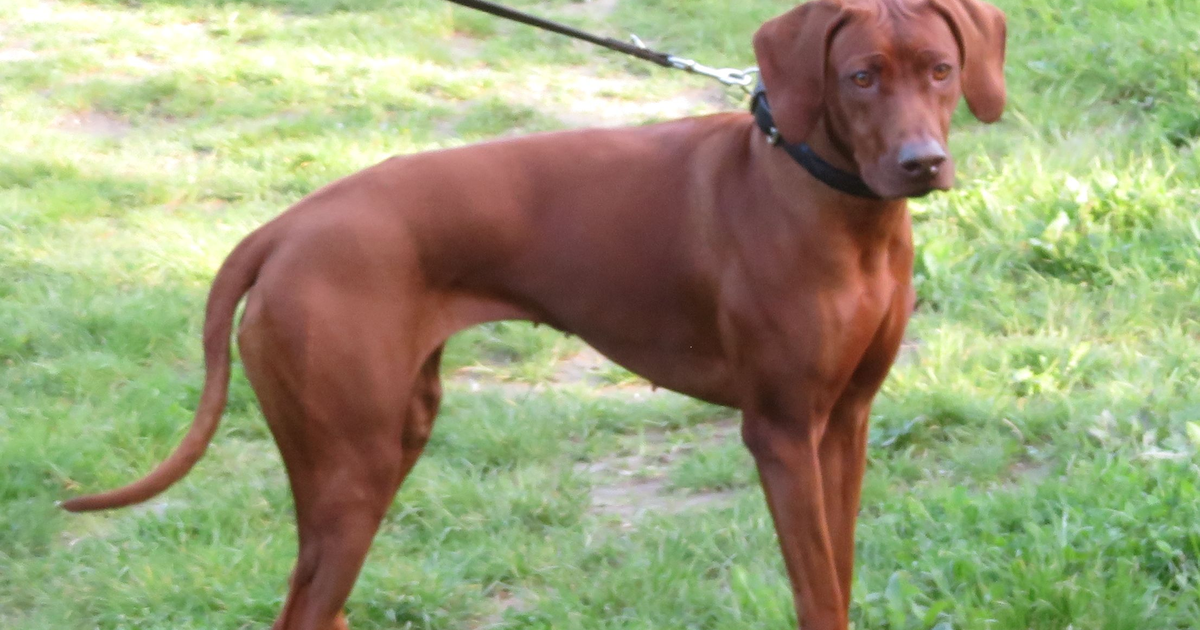


Bottom line: Hemophilia B in the Rhodesian Ridgeback has a named cause: the F9 variant c.731G>A, which turns glycine 244 of clotting factor IX into glutamic acid (G244E). In the 2011 University of Veterinary Medicine Hannover study, six affected males had about 1% of normal factor IX activity. Because F9 sits on the X chromosome, a healthy-looking carrier bitch can pass it to roughly half of her sons even when mated to a clear sire — so the “carrier to clear is fine” rule Ridgeback breeders use for DM, JME and EOAD does not protect against this disease. The variant is tested by LABOKLIN, Orivet and others, yet it sits outside the breed’s CHIC protocol and the US and UK club recommendations, and no representative carrier frequency exists. A DNA result is risk information for breeding, not a diagnosis: a bleeding dog, or one going in for spay, neuter or other surgery, needs clotting tests (aPTT and factor IX activity) ordered by a veterinarian.
The Rhodesian Ridgeback ranked No. 41 of 202 breeds in the American Kennel Club’s 2025 popularity table, and the AKC breed page puts a male at about 85 lb. Size matters here: Wisdom Panel’s veterinary notes say hemophilia B “is usually more severe for active dogs of large size”, which describes a lure-coursing hound well. This article separates US and UK owners where labs, prices and rules differ, and keeps one line throughout: the genotype speaks to inheritance; blood tests speak to bleeding.
- What the Hannover sequencing actually showed
- A club rule built for DM and JME does not fit an X-linked gene
- Carrier bitches look healthy, and their clotting screen can too
- Same breed, a second hemophilia: keeping F9 and F8 apart
- A clean-looking registry that no rule requires anyone to fill
- Who reads c.731G>A, and what each kit costs in dollars and pounds
- Teething, spay day and an 85-lb hound: when bleeding first shows
- Proving a bleeder: citrate plasma, factor IX activity and where it is measured
- Claims, contracts and kennel licences around a Ridgeback that bleeds young
- Frequently asked questions
- References
- How to get your pet tested
What the Hannover sequencing actually showed
The anchor study is Mischke and colleagues in The Veterinary Journal (2011), a nine-author team led by the small animal clinic of the University of Veterinary Medicine Hannover, with LABOKLIN co-authors. They started from dogs already classified by their blood: six males with the hemophilia B phenotype and factor IX activity of about 1% of normal, four suspected carrier females with activity between 48% and 69% (one confirmed through affected offspring), and 12 healthy Ridgebacks.
Sequencing found a single guanine-to-adenine change in exon 7 of the factor IX gene, swapping glycine for glutamic acid at position 244 inside the catalytic domain — the part of the enzyme that does the cutting in the clotting cascade. Genotypes matched the blood results without exception: every affected male was hemizygous, every carrier heterozygous, and no dog with normal factor IX had the change. Protein modelling supported a loss of function. The OMIA catalogue entry for canine haemophilia B records it as c.731G>A, p.(G244E).
The team also screened 30 Ridgebacks of unknown hemophilia status, 20 Dobermanns, 20 German Wirehaired Pointers and 25 Labrador Retrievers; none carried G244E. That is a specificity check, not a frequency estimate. The authors called Ridgeback hemophilia B “currently the most important canine haemophilia in Germany” — a judgement about Germany in 2011. The dogs were German; whether the variant has turned up in US or UK lines has not been published. Mischke’s later German-language review, “Hämophilie A und B beim Hund” (2012), added that dogs bleed more severely than people at the same residual factor activity.
A club rule built for DM and JME does not fit an X-linked gene
SamOur breeder says a carrier is fine as long as she’s bred to a clear male. Is that wrong? Elena MarshSound for the club’s recessive tests, not for F9. LABOKLIN’s result text says half of a carrier bitch’s sons inherit the mutated X, whatever the sire’s result.The Rhodesian Ridgeback Club of the United States (RRCUS) Code of Ethics and its AKC-hosted Health Statement of October 7, 2023 encourage DNA testing “for the autosomal recessive genetic diseases” — DM, JME and EOAD — then state: “While it is perfectly acceptable to breed carriers to dogs that have tested clear, to avoid the production of affected offspring, carriers should never be bred to other carriers.” For those three diseases the logic holds, because an affected puppy needs a copy from each parent.
Hemophilia B breaks it. A male has one X, inherited from his dam, and nothing to cover for a faulty copy. The Mendelian arithmetic:
- Carrier bitch × clear sire: each son has a 1-in-2 chance of being affected and each daughter a 1-in-2 chance of being a carrier. Sons receive the sire’s Y, so his clear result changes nothing for them.
- Affected male × clear bitch: every daughter is a carrier, no son is affected — which is how the allele can skip a visible generation.
- Clear × clear: no G244E puppies, although a new mutation in a dam’s egg remains possible, as Kuder and colleagues (2021) point out.
These are per-puppy probabilities, not a forecast for one litter. LABOKLIN UK’s result wording is blunt: “50% of the male puppies of a carrier bitch will have the mutated x-chromosome and express the disease and 50% of the female puppies will be healthy carriers (conductors)”, and a clear male “should only be bred to clear females”. Kuder’s group advised that heterozygous females be spayed and kept out of breeding. In practice the dam’s result is the one that decides the sons’ risk.
Carrier bitches look healthy, and their clotting screen can too
The Hannover carriers had 48–69% of normal factor IX, a level that does not cause spontaneous bleeding. Their routine coagulation profile may also look normal. Studying an affected Hovawart family, Brenig and colleagues (2019) found carrier females with aPTT values inside the reference range and wrote that “minute reductions in FIX concentrations might not always be reflected in an aPTT increase because of the sensitivity of commercial reagents.”
Factor IX activity is not a clean carrier test either. Marjory Brooks of Cornell, in a 1999 Journal of Heredity review, explained that protein-based carrier detection is fast and cheap but suffers from overlap between carrier and normal values. Molecular tests are more accurate, with the caveat that one phenotype can have several causes. Kuder’s paper concludes that for a carrier female “the best approach is genotyping for the specific pathogenic F9 variant.” The Ridgeback is fortunate here: its variant is known and cheaply testable, so a breeder can settle the dam question with a cheek swab rather than a borderline factor assay.
Same breed, a second hemophilia: keeping F9 and F8 apart
SamThe breed profile I looked at lists hemophilia A as well as B. Are those the same thing? Elena MarshDifferent genes. A 2021 paper in Genes found an F8 insertion causing severe hemophilia A in a Ridgeback family, so a dog can be clear for one and carry the other.Hemophilia A (factor VIII, F8) and hemophilia B (factor IX, F9) are both X-linked and both prolong the aPTT; a bleeding puppy looks the same with either. In dogs, A is generally reported to be the more common form — the Texas A&M review by Barr and McMichael (2012) calls it “the most common coagulation factor disorder” — but this article did not verify a primary source for the ratio of A to B.
For Ridgebacks the overlap is concrete. Kehl and colleagues (2021), a LABOKLIN team, found a SINE insertion in exon 14 of F8 in two related male Ridgebacks with low factor VIII activity, absent from more than 500 unrelated dogs. That is a family finding, not a breed frequency, but it means a G244E-clear dog is not a hemophilia-clear dog. Orivet’s Ridgeback profile lists “Haemophilia B (Rhodesian Ridgeback Type)”, “Haemophilia A (Rhodesian Ridgeback Type)” and “Delayed Postoperative Haemorrhage (Scottish Deerhound Type)” side by side, and LABOKLIN UK’s F8 test (8689, £48.00) also names the breed. Check which factor each report line refers to.
Von Willebrand disease (a primary hemostasis defect) and factor VII deficiency (extrinsic pathway, prolonged PT, usually mild) are autosomal and follow neither the X-linked pattern nor the severity of a Ridgeback with 1% factor IX.
A clean-looking registry that no rule requires anyone to fill
SamOn OFA every Ridgeback tested for hemophilia B is clear. Isn’t that reassuring? Elena MarshIt shows who chose to submit. OFA lists 417 tested, all clear, but the test sits outside the CHIC protocol, so these are voluntary entries, not a breed sample.The Orthopedic Foundation for Animals (OFA) breed statistics show a “HEMOPHILIA B” row for the Ridgeback: 417 tested, 417 normal/clear, no abnormal or carrier entries. Owners decide whether to register a DNA result ($15 per test on OFA’s fee schedule), and a breeder who finds a carrier bitch has less reason to publish. The database does record carriers when they are sent in — the Ridgeback EOAD row shows 26 carriers among 440 tested — but a self-selected 417 is not a prevalence figure, and no lab, club or paper has published a representative G244E frequency for American or British Ridgebacks.
Nor do the official lists steer owners towards the test. In the US, the Ridgeback CHIC protocol requires hips, elbows, an ACVO eye exam and autoimmune thyroiditis screening, with advanced cardiac and BAER hearing as optional; the AKC Hound Group page shows hip and elbow evaluation. In the UK, the Royal Kennel Club breed health standard lists the JME DNA test plus BVA/KC hip and elbow scoring as Good Practice and DM as Best Practice; the breed is Breed Watch Category 1, and the RKC’s accepted DNA list has no haemophilia B entry for any breed, so a G244E result will not appear on its Health Test Results Finder. The Rhodesian Ridgeback Club of Great Britain health page covers JME and hip and elbow dysplasia only. A buyer who wants the F9 answer therefore has to ask for it: the dam’s G244E result from a named laboratory.
Who reads c.731G>A, and what each kit costs in dollars and pounds
Prices were captured in October 2026; sale prices move and US prices exclude sales tax.
United States. Embark has a condition page titled “F9 Exon 7, Rhodesian Ridgeback Variant”, tagged “Provisional” and citing Mischke 2011; Breed + Health was $139 on sale (regular $159). Orivet’s Rhodesian Ridgeback Full Breed Profile, $139.00, includes the Ridgeback-type haemophilia B test and promises results within 28 business days of receipt; Paw Print Genetics pages now redirect to a notice of its merger with Orivet. Wisdom Panel Premium ($127.99 on sale, regular $159.99) lists “Hemophilia B” plus Airedale and Lhasa Apso versions, but its condition page, while citing the Hannover paper among its references, lists a single G>A coordinate that does not match OMIA’s position for G244E, so ask Wisdom which variant it reads. OFA’s “All DNA Tests” matrix, meanwhile, lists Betagene, MyDogDNA, Orivet and Wisdom Health for Ridgeback hemophilia B, but not Embark or LABOKLIN. The lists disagree; confirm with the lab, especially if you want the result registered.
United Kingdom. LABOKLIN UK test 8221 costs £66.00 including VAT. LABOKLIN says the variant was identified “in cooperation with Prof. Dr. Mischke (Tierärztliche Hochschule Hannover)”, and its January 2026 catalogue marks the test “LABOKLIN patented/licenced”. It takes EDTA blood or buccal swabs, works at any age including puppies, and runs each sample twice independently; the UK page quotes one to two weeks, while the international page gives three to five days for the Ridgeback TaqMan assay. Bundle 8647, £144.00 including VAT, covers DM, haemophilia B, EOAD, JME and the B and D colour loci, with a £15.00 patent fee included. Wisdom Panel Premium UK was £144.99.
Any of these reports answers one question — does this dog carry G244E? — and cannot grade severity or see other F9 variants, F8 variants or acquired problems. Kuder’s group described a dam reported “wildtype” for known F9 variants on two commercial panels who still carried a previously unknown one, warning that “non-breed specific results can be misleading breeders, pet owners, and attending veterinary clinicians.”
Teething, spay day and an 85-lb hound: when bleeding first shows
Kuder’s 2021 summary table describes Ridgeback hemophilia B as “spontaneous hemorrhage & severe bleeding after minor surgeries”. OMIA adds bleeding into joints, muscles, chest and abdomen and prolonged bleeding from small wounds; LABOKLIN warns that without precautions a severe case can bleed to death after surgery or injury. Embark notes that affected puppies “may bleed abnormally when teething” and that the disease “is typically diagnosed in puppies or young adults when they are spayed or neutered”. In a German Shepherd family reported by Feldman, Brooks and Dodds (1995), three male puppies needed treatment for vaccination haematomas. Reasons to call the vet promptly about a young male Ridgeback:
- gums that keep oozing while baby teeth are shed;
- a swelling at a vaccination or microchip site;
- sudden lameness or a hot, swollen joint without an obvious injury;
- bruising, nosebleeds or a nail that will not stop bleeding;
- a planned neuter, extraction or other surgery when the dam’s F9 status is unknown.
Repeated joint bleeds leave damage: a 2026 MRI and histology study of two adult Beagles found severe haemophilic arthropathy in the factor IX-deficient dog and only mild changes in the factor VII-deficient one (Pownder et al., 2026). Barr and McMichael name avoiding trauma as the most important measure in diagnosed animals, and Embark’s owner advice is to brief the vet before surgery, keep styptic powder and bandaging at home, and call if gentle pressure has not stopped bleeding within a few minutes.
Treating a bleed is the veterinary team’s job. Mischke’s review describes fresh or fresh frozen plasma plus local haemostatic measures as the mainstay; it controls episodes rather than curing the disease. Hemophilia B research dogs have been central to gene therapy since the 1990s, and a 2024 report followed 12 companion dogs given experimental gene therapy — but 11 had hemophilia A, and this remains research, not a treatment an owner can request.
Proving a bleeder: citrate plasma, factor IX activity and where it is measured
SamIf DNA isn’t a diagnosis, what does the vet run when a puppy bleeds? Elena MarshAn aPTT that is long with a normal PT, then a factor IX assay. A 1979 Malamute looked like hemophilia A until factor IX came back at 1.3% of normal.That Alaskan Malamute, reported by Peterson and Dodds (1979), was a six-month-old male whose mouth wound bled for two weeks. Factor VIII activity was normal; factor IX was 1.3% of normal. Symptoms cannot separate the two hemophilias, and neither can a DNA result for one gene.
In the US, the specialist route is the Comparative Coagulation Laboratory at Cornell’s Animal Health Diagnostic Center, directed by Marjory Brooks, first author of the 1997 Labrador factor IX paper. It runs coagulation screens and factor assays and advises on interpretation. Your regular vet draws blood into a blue-top sodium citrate tube (3.2% or 3.8% is the only accepted anticoagulant), separates and freezes the plasma (up to two weeks) and ships it overnight on frozen cold packs. Cornell’s canine aPTT reference interval is 11.0–17.5 seconds, though each lab sets its own. Fees sit inside Cornell’s online portal and could not be retrieved; Canada’s University of Guelph lists its factor IX assay as a five-to-ten-day send-out.
In the UK, the first-opinion vet runs the screen and, if the aPTT is long with a normal PT, arranges factor assays through a referral or reference laboratory. We found no published UK price for a canine factor IX assay, so ask your practice for a quote first.
Transfusion history matters too. In a 1997 Cornell report on a Labrador whose F9 gene was entirely deleted, the dog formed antibodies against transfused factor IX — the first canine factor IX inhibitor described. Large deletions carry the highest risk; G244E is a single-letter change, and no inhibitor data for Ridgebacks have been published.
Claims, contracts and kennel licences around a Ridgeback that bleeds young
Because this disease tends to surface at teething or at a first neuter, the order of events — policy start, waiting period, first noted gum bleed — can decide a lifetime of claims. Embrace (US) covers hereditary and congenital conditions “when not pre-existing at the time of enrollment”, and counts anything noted before the waiting period ends, “even if your pet never went to see the vet for it”. It also lists DNA testing among exclusions, so the swab is paid out of pocket. Petplan’s Covered for Life (UK) states, “We will cover conditions that haven’t shown symptoms before the start of your policy”, with annual vet-fee limits of £4,000, £7,000 or £12,000. Animal Friends excludes anything first noticed before the start date or inside the waiting period, offering vet-fee cover from £1,000 to £18,000.
On the sale side, Florida’s Statutes § 828.29 lets a buyer return a dog for a refund, among other remedies, if a veterinarian certifies within a year that a congenital or hereditary disorder makes it unfit for purchase; other states differ. England’s SI 2018/486 bars a licensed breeder (three or more litters a year, or advertising a dog-selling business) from keeping a dog for breeding if its “genotype, phenotype or state of health” means breeding could harm its offspring. Haemophilia is not named, and whether a known carrier bitch falls under that wording is interpretation; Scotland and Wales were not checked.
Frequently asked questions
Q. How many Rhodesian Ridgebacks carry G244E?
Nobody knows. Hannover screened 30 Ridgebacks of unknown status and found none; OFA lists 417 submitted dogs, all clear. Both groups are small or self-selected, and no US or UK frequency has been published.
Q. My male puppy is clear for G244E. Can he still have a bleeding disorder?
Yes. The test reads one F9 variant. A Ridgeback F8 variant causes hemophilia A, other F9 changes or new mutations are possible, and acquired problems exist. Unusual bleeding needs clotting tests.
Q. The sire is clear and the dam is a carrier. Are the puppies safe?
Not all of them. The sire’s X never reaches his sons, so each male puppy still has about a one-in-two chance of being affected.
Q. Should my Ridgeback have a clotting panel before neutering?
Raise it with your vet, especially for a male whose dam’s F9 status is unknown. Wisdom Panel’s vet notes recommend PT and PTT before surgery or invasive procedures.
Q. Is hemophilia B milder than hemophilia A in dogs?
Not as a rule. Some lab pages, including Wisdom Panel’s, describe hemophilia B as milder than hemophilia A, but the peer-reviewed evidence cited here does not support that as a generalisation: severity follows residual factor activity, and the Hannover Ridgebacks had about 1% factor IX, the severe range.
Q. Can a female Ridgeback have hemophilia B?
Rarely. She would need two copies of the variant, one from each parent. Carrier females with one copy normally do not bleed.
Q. Who makes the diagnosis?
A veterinarian, using aPTT, PT and a factor IX activity assay. A DNA result is risk information for breeding and planning, not a diagnosis.
References
- Mischke R, Kühnlein P, Kehl A, Langbein-Detsch I, Steudle F, Schmid A, Dandekar T, Czwalinna A, Müller E (2011). G244E in the canine factor IX gene leads to severe haemophilia B in Rhodesian Ridgebacks. Vet J 187(1):113-118.
- Mischke R (2012). Hämophilie A und B beim Hund [Haemophilia A and B in dogs]. Tierarztl Prax Ausg K Kleintiere Heimtiere 40(1):44-53.
- Kuder H, Sandzhieva-Vuzzo L, Kehl A, Rappaport JM, Müller E, Giger U (2021). A Single Base Insertion in F9 Causing Hemophilia B in a Family of Newfoundland-Parti Standard Poodle Hybrid Dogs. Genes (Basel) 12(10):1491.
- Kehl A, Haaland AH, Langbein-Detsch I, Mueller E (2021). A SINE insertion in F8 gene leads to severe form of hemophilia A in a family of Rhodesian Ridgebacks. Genes (Basel) 12(2):134.
- Brenig B, Steingräber L, Shan S, Xu F, Hirschfeld M, Andag R, Spengeler M, Dietschi E, Mischke R, Leeb T (2019). Christmas disease in a Hovawart family resembling human hemophilia B Leyden is caused by a single nucleotide deletion in a highly conserved transcription factor binding site of the F9 gene promoter. Haematologica 104(11):2307-2313.
- Brooks M (1999). A review of canine inherited bleeding disorders: biochemical and molecular strategies for disease characterization and carrier detection. J Hered 90(1):112-118.
- Barr JW, McMichael M (2012). Inherited disorders of hemostasis in dogs and cats. Top Companion Anim Med 27(2):53-58.
- Peterson ME, Dodds WJ (1979). Factor IX deficiency in an Alaskan Malamute. J Am Vet Med Assoc 174(12):1326-1327.
- Brooks MB, Gu W, Ray K (1997). Complete deletion of factor IX gene and inhibition of factor IX activity in a labrador retriever with hemophilia B. J Am Vet Med Assoc 211(11):1418-1421.
- Feldman DG, Brooks MB, Dodds WJ (1995). Hemophilia B (factor IX deficiency) in a family of German shepherd dogs. J Am Vet Med Assoc 206(12):1901-1905.
- Pownder SL, Caserto BG, Brooks MB, Hayashi K (2026). Canine haemophilic arthropathy: magnetic resonance imaging and histologic assessment of joints in two adult Beagles with confirmed factor deficiencies. Vet Comp Orthop Traumatol 39(2):147-154.
- Doshi BS, Samelson-Jones BJ, Nichols TC, Merricks EP, Siner JL, French RA, Lee BJ, Arruda VR, Callan MB (2024). AAV gene therapy in companion dogs with severe hemophilia: Real-world long-term data on immunogenicity, efficacy, and quality of life. Mol Ther Methods Clin Dev 32(1):101205.
- Online Mendelian Inheritance in Animals (OMIA). OMIA:000438-9615: Haemophilia B in Canis lupus familiaris (dog). University of Sydney. Accessed 2026-10-13.
How to get your pet tested
Some pet DNA tests screen for hereditary-disease carrier status or genetic risk markers, but the results are information, not a diagnosis. If your pet has symptoms or you need a confirmed diagnosis, please consult your veterinarian.
Below is where Hemophilia B (F9) can be tested, grouped by where you live and marked by whether each service explicitly lists this variant (✅ = listed / ❓ = unverified / ❌ = not offered).
In the United States
In the United Kingdom
In India
Elsewhere
Note: even if the kit can be purchased/shipped internationally, the service itself (sample return, analysis, results) is not guaranteed in your country. Check each service’s stated service area and sample-return method before ordering.
Services offered in other regions (may not be available where you live)
Worried about your pet’s health? — Talk to a veterinarian
A confirmed diagnosis and any treatment plan are decisions for a veterinarian, not a test kit. The links below are professional resources.
AVMA — Find a veterinarian (American Veterinary Medical Association)
This section contains advertising (affiliate links); we may earn a commission if you buy through them. As an Amazon Associate, we earn from qualifying purchases. Genetic tests do not guarantee the prevention, diagnosis, or treatment of any disease — results indicate tendencies and provide information only.
This page is educational information, not veterinary diagnosis or advice. Always consult a veterinarian about your pet’s health.
About the author
Elena Marsh
Editor & writer (not a veterinarian)
A writer with a molecular-biology background and a lifelong dog and cat owner. Not a veterinarian — she translates peer-reviewed genetics research and primary data into plain language, always as information rather than diagnosis.