SamOur breeder recommended a PLL DNA test. Is it worth it?
Elena MarshYes — OFA lists Miniature Bull Terrier among 24 breeds officially tested for Primary Lens Luxation.
SamCould this really make my dog go blind?
Elena MarshUntreated luxation can trigger acute glaucoma, which is why vets treat it as a same-day eye emergency.
SamDoes the AKC actually require this test?
Elena MarshNo — AKC lists PLL as a recommended test for the breed, not a mandatory one for registration.
SamSo how do I know the risk before symptoms start?
Elena MarshA DNA test flags it years ahead — a 2012 study found homozygous dogs are almost fully affected by age six.


Conclusion: In the Miniature Bull Terrier, Primary Lens Luxation (PLL) is caused by a splice-site mutation in the ADAMTS17 gene, first pinpointed in this breed’s discovery cohort by Farias et al. (2010) and studied in Miniature Bull Terrier-specific detail by Gharahkhani et al. (2012, 2015). OFA lists the breed among 24 breeds tested for PLL, and a separate 30-breed screening study estimated the disease affects roughly 7.3–15.2% of the population. A DNA test flags genetic risk years in advance; only a veterinary ophthalmologic exam confirms an actual luxation.
The Miniature Bull Terrier is a British terrier breed (FCI Standard No. 359) developed as a scaled-down version of the Bull Terrier, with a sub-4.5kg “miniature” class already documented as early as 1863. The breed’s population crashed in the early 20th century before the UK Kennel Club approved the newly-formed Miniature Bull Terrier Club’s petition for guaranteed show classes in May 1939, formally establishing it as a breed separate from the standard Bull Terrier; the American Kennel Club followed by recognizing the breed in 1991. Unlike some rare terrier breeds, the Miniature Bull Terrier remains a well-established, actively registered breed: UK Kennel Club figures show 185 registrations in 2025 and a ten-year range fluctuating between roughly 165 and 364 registrations a year — a population size and registration volume that puts hereditary disease monitoring on a much more solid statistical footing than in genuinely rare breeds.
Primary Lens Luxation is one of the conditions most consistently documented in this breed’s genetics, with a research record spanning more than 40 years — from a 1983 clinical case report to modern genome-wide modifier studies. This article walks through what that research actually shows, how the ADAMTS17 DNA test works in practice in the US and UK, and what a result does and does not tell an owner.
- The ADAMTS17 gene and how PLL affects the eye
- How the discovery unfolded: four decades of research
- Why the Miniature Bull Terrier is an internationally documented test breed
- Symptoms and telling PLL apart from PRA and LAD
- How to get tested: US and UK routes and pricing
- Breeding considerations and regulation
- Pet insurance implications
- What Miniature Bull Terrier owners can do today
- Frequently Asked Questions
- References
- How to get your pet tested
The ADAMTS17 gene and how PLL affects the eye
ADAMTS17 encodes a protein involved in building the extracellular matrix of the zonular fibers — the fine, elastic strands (sometimes called the ciliary zonule or suspensory ligament) that hold the eye’s lens in its correct position behind the iris. The mutation associated with PLL is a point mutation at a splice donor site within an intron (c.1473+1 G>A), which disrupts normal recognition of that splice site and is believed to interfere with normal production of the ADAMTS17 protein. Without properly formed zonular fibers, the fibers progressively weaken and eventually rupture, allowing the lens to shift out of position — anteriorly (forward, into the front chamber of the eye) or posteriorly (backward, into the vitreous).
Inheritance is autosomal recessive at its base, but research has shown the risk behaves as an additive, dose- and age-dependent trait rather than a simple on/off switch. Dogs with two copies of the mutation (homozygous) become almost fully penetrant past roughly six years of age, while dogs with a single copy (heterozygous carriers) still carry a measurably elevated risk — OFA describes carrier risk in the range of roughly 5–10% above baseline. Clinically, the first subtle signs tend to appear around 20 months of age, with full luxation most commonly occurring between three and eight years old. It’s also worth noting what the test cannot rule out: Gould et al. (2011) documented PLL-affected dogs in some breeds (such as the Shar Pei) that did not carry this ADAMTS17 variant at all, meaning a different, unrelated genetic cause was at work, and trauma or other non-genetic causes can dislocate a lens independently of any DNA result. A “clear” ADAMTS17 result rules out this specific mutation — it does not rule out PLL altogether.
How the discovery unfolded: four decades of research
The clinical picture came decades before the genetics. Curtis, Barnett, and Startup published the first clinical description of PLL specifically in the Miniature Bull Terrier in 1983 in Veterinary Record — 27 years before the causative mutation was identified — establishing that this was a recognized, breed-associated eye condition long before molecular tools existed to explain why.
The causative gene was identified in 2010, when Farias, Johnson, Taylor, and colleagues first used a genome-wide association study in the Jack Russell Terrier (28 affected dogs, 20 controls) to narrow the causative region, published in Investigative Ophthalmology & Visual Science. They then carried out fine-mapping and genotyping of the resulting ADAMTS17 splice-donor variant across a larger set of 829 dogs spanning Jack Russell Terrier, Lancashire Heeler, and Miniature Bull Terrier — 196 affected and 633 control — confirming the mutation segregated with disease across all three breeds. The Miniature Bull Terrier was one of this original three-breed discovery cohort, not a breed added after the fact.
A year later, Gould and colleagues (2011) screened 30 breeds for the same mutation and confirmed it in 14 additional breeds beyond the original three, bringing the documented total past 17 breeds. That study also produced Miniature Bull Terrier-specific statistics: an estimated mutation frequency of 0.27–0.39, translating to an estimated disease prevalence of roughly 7.3–15.2% in the breed population.
Gharahkhani and colleagues then focused specifically on the Miniature Bull Terrier (alongside the related Australian Tenterfield Terrier) in a 2012 paper in the Open Genomics Journal, showing the additive, age-dependent risk model described above and using microsatellite haplotype analysis to conclude the mutation is old and was introduced into the Miniature Bull Terrier population through a single founder event (versus at least three independent introductions in the Tenterfield Terrier). A follow-up 2015 study by the same lead author, published again in Investigative Ophthalmology & Visual Science, searched for modifying genetic loci in Miniature Bull Terriers and found associations between the ADAMTS17 genotype and other traits in the breed, including pedal hyperkeratosis (thickened footpads) and persistent pupillary membranes — a reminder that two dogs with the identical PLL genotype do not necessarily show identical severity.
Why the Miniature Bull Terrier is an internationally documented test breed
The Miniature Bull Terrier’s status as a PLL test breed is recognized across multiple national systems, not just one country’s registry. In the US, OFA officially lists the Miniature Bull Terrier among 24 breeds for which it offers Primary Lens Luxation DNA testing. The American Kennel Club’s Terrier Group breed-specific health testing page lists PLL DNA testing as a recommended test for the breed — alongside a cardiac exam, BAER hearing testing, a DNA test for a breed-specific form of laryngeal paralysis, a DNA test for Lethal Acrodermatitis (LAD), and a kidney urine protein:creatinine ratio test — though it is not currently one of the core categories (cardiac, BAER hearing, kidney UPC ratio, and an eye clearance) required for a CHIC (Canine Health Information Center) number; the parent club nonetheless expects member breeders to test for it. The core CHIC eye requirement itself is satisfied through the OFA Companion Animal Eye Registry (CAER): an annual clinical exam performed by a board-certified ACVO (American College of Veterinary Ophthalmologists) diplomate, which most general-practice vets can refer an owner to directly (ACVO maintains a public directory of diplomates). Note that ACVO’s well-known free “National Service Animal Eye Exam Event” each May is restricted to certified service, working, and therapy animals with documentation — it does not cover ordinary pets, so a Miniature Bull Terrier kept purely as a companion would need a standard paid CAER exam rather than that event. A DNA result and a CAER exam answer different questions — the DNA test flags genetic risk years before any sign appears, while the ACVO exam is what actually confirms whether a luxation, or an early warning sign such as lens wobble (phacodonesis), is present right now.
In the UK, DNA testing for PLL has an institutional history: The Kennel Club’s testing scheme for Bull Terrier (Miniature) was launched in 2009 through a collaboration between the Miniature Bull Terrier Club, The Kennel Club, and the Animal Health Trust (which ceased operating in July 2020). Puppies can be tested from five weeks of age, and because the result does not change over a dog’s lifetime, only one test is ever needed per dog. The UK’s parallel clinical pathway is the BVA/KC/ISDS Eye Scheme, run jointly by the British Veterinary Association, The Kennel Club, and the International Sheep Dog Society: owners can book directly with one of the scheme’s panellists (veterinary ophthalmologists, often RCVS Recognised Specialists) or go through their own vet, for the same kind of clinical exam that ACVO diplomates perform in the US — a routine exam costs £72.00 including VAT, and official guidance recommends testing within 12 months before breeding, with a final exam at around 8 years old for breeding stock. If sudden eye pain, redness, or a visibly shifted lens develops outside normal clinic hours, an out-of-hours emergency vet service (such as Vets Now in the UK) should be treated as the right first call rather than waiting for a routine appointment, given how quickly secondary glaucoma can set in.
SamWhy did three different countries all end up testing this breed?
Elena MarshBecause it’s a shared founder mutation — Farias et al. found it in this breed’s original 2010 discovery cohort, not added on later.
Symptoms and telling PLL apart from PRA and LAD
Early PLL is often symptomless, which is exactly why genetic screening — rather than waiting for visible signs — is the practical approach breed clubs recommend. Once luxation begins, owners may notice a red or painful-looking eye, excessive tearing, squinting, a visibly displaced or wobbling lens (sometimes described as a shimmering or trembling iris, called iridodonesis), cloudiness, or sudden apparent blindness; because a luxated lens can block normal fluid drainage inside the eye, secondary glaucoma can develop rapidly and is genuinely painful, making sudden-onset eye symptoms in this breed a same-day veterinary emergency rather than a wait-and-see situation.
PLL should not be confused with Progressive Retinal Atrophy (PRA), a separate group of inherited retinal diseases that cause gradual, progressive vision loss over months to years through degeneration of the retina’s photoreceptor cells — a fundamentally different mechanism and, in most breeds studied to date, a different gene than ADAMTS17. PLL should also not be confused with Lethal Acrodermatitis (LAD), a separate, unrelated, and far more severe inherited disease specific to Bull Terriers and Miniature Bull Terriers, caused by a mutation in the MKLN1 gene and inherited as autosomal recessive; LAD causes poor growth, immune dysfunction, and skin lesions on the paws and face from puppyhood, and affected puppies are frequently euthanized. LAD and PLL are commonly sold together as a combined DNA test bundle because both are breed-specific concerns, but they are entirely different diseases caused by entirely different genes, and a result for one says nothing about the other. A full veterinary ophthalmologic exam remains necessary to distinguish PLL from PRA or from unrelated causes of eye pain, rather than relying on visual symptoms or a single DNA test category alone.
How to get tested: US and UK routes and pricing
In the United States, PLL testing for the Miniature Bull Terrier goes through the OFA testing pathway: an at-home buccal (cheek) swab is collected, mailed to the University of Missouri College of Veterinary Medicine’s Small Animal Molecular Genetics Lab for processing, and the result — normal/clear, carrier, or affected/at-risk — is registered in the OFA database. The current fee for this DNA test is $65, with results typically returned within about two weeks of the lab receiving the sample.
In the United Kingdom, owners have several routes, and prices are worth comparing directly rather than assuming one lab is cheapest. The Kennel Club’s own DNA testing service for Bull Terrier (Miniature) (run in partnership with the Miniature Bull Terrier Club since 2009) accepts samples from five weeks of age and prices its PLL test at £60, with the result recorded against the dog’s Kennel Club registration. LABOKLIN UK offers a combined “Bull Terrier DNA bundle” covering LAD, PLL, and Laryngeal Paralysis (LP) together for £126.00 including VAT, accepting either an EDTA blood sample or a buccal swab, with a turnaround of roughly one to three weeks depending on the individual test. Cambridge University’s CAGT (Canine Genetic Testing, cagt.co.uk) offers a standalone Primary Lens Luxation test at £49.50 including VAT for owners who only want the PLL result rather than a bundled package, and also lists a “Bull Terrier (Miniature) Bundle” covering LAD and PLL together at £99.00, discounted to £75.24 under current pricing. As with any cross-border testing decision, postage costs and currency conversion on card payments should be confirmed with the lab directly if sending a sample internationally.
SamDo I need to keep retesting my dog every year?
Elena MarshNo — PLL genotype doesn’t change, so both OFA and the Kennel Club treat it as a once-in-a-lifetime test.
Breeding considerations and regulation
The Miniature Bull Terrier Club (UK) publishes clear, specific breeding guidance based on test results: Clear × Clear pairings can only produce clear puppies, so those puppies do not need to be individually tested (they are “clear by parentage”); Clear × Carrier pairings are acceptable but every puppy must be tested, since each could be clear or a carrier; the club states plainly that “under no circumstances should anyone breed using two carriers” (Carrier × Carrier); and while a Clear × Affected pairing is theoretically possible and would produce only carrier puppies (each requiring a test and certificate), the club does not endorse breeding from affected dogs at all. In the US, the Miniature Bull Terrier Club of America expects member breeders to test for PLL as part of responsible breeding practice, even though it sits outside the four core CHIC categories.
On the regulatory side, licensed dog breeding in England falls under the Animal Welfare (Licensing of Activities Involving Animals) (England) Regulations 2018, which requires a licence for anyone breeding three or more litters in a 12-month period, or advertising a dog-breeding business regardless of litter count — a general framework that applies to Miniature Bull Terrier breeders like any other breed, with PLL test results functioning as supporting evidence of responsible practice rather than a separate legal requirement in themselves. In the US, breeding regulation is primarily a state- and local-level matter rather than a single federal standard, so specific licensing thresholds vary by state.
Pet insurance implications
In the US, Trupanion states that it covers hereditary and congenital conditions without special payout limits, provided the condition is not pre-existing — defined as a condition for which signs or evidence existed within the 18 months prior to a policy’s effective date — and applies standard waiting periods of 5 days for injuries and 30 days for illness before coverage begins. Healthy Paws similarly excludes pre-existing conditions and, as one illustrative example of how a single insurer can apply an extended, condition-specific waiting period to a hereditary issue, imposes a 12-month waiting period specifically for hip dysplasia treatment; because exact waiting-period structures for a given hereditary eye condition like PLL vary by insurer and are not standardized, owners should confirm the specific policy language for PLL coverage directly with any US insurer before assuming a particular wait applies.
In the UK, Petplan states that its policies cover hereditary, congenital, and chronic conditions as standard, provided the condition did not show symptoms before the policy began, and applies a 14-day waiting period for illness cover. UK insurers more broadly are split between “lifetime” policies, which renew a condition’s benefit pool every year and are generally the better structural fit for a recurring or lifelong condition, and “time-limited” or “maximum benefit” policies, which stop paying out for a given condition once a fixed amount or fixed time window has been reached — a distinction that matters more for a condition like PLL, which can require ongoing monitoring or a second eye’s surgery years after the first, than the DNA result itself. In both markets, insuring a Miniature Bull Terrier puppy as early as possible — ideally before or shortly after a PLL DNA test, and disclosing any known result accurately — puts an owner in a stronger position than waiting until clinical signs appear, since a diagnosed or symptomatic eye is treated as pre-existing by virtually every insurer.
SamShould I insure my puppy before or after the PLL test?
Elena MarshBefore, if possible — Trupanion and Petplan both exclude conditions already showing signs, so early enrollment avoids that gap.
What Miniature Bull Terrier owners can do today
- Ask breeders for both parents’ PLL DNA test results (Clear, Carrier, or Affected) before committing to a puppy, and confirm whether the LAD result — a separate disease — was tested too.
- Have a puppy tested from five weeks of age through the Kennel Club scheme (UK) or an OFA-registered lab (US); because the result never changes, one test per dog is enough for life.
- Treat sudden eye redness, pain, squinting, or a visibly shifted lens — especially from around 20 months of age onward — as a same-day veterinary emergency rather than something to monitor at home.
- Confirm directly with any pet insurer how it structures cover for hereditary eye conditions (lifetime vs. time-limited in the UK; pre-existing-condition and waiting-period wording in the US) before assuming ongoing PLL-related costs will be met.
- Favor breeders who follow Miniature Bull Terrier Club (UK) breeding guidance or are affiliated with the Miniature Bull Terrier Club of America and OFA/CHIC certification in the US.
- Treat this article as general background information only — always defer an actual diagnosis, interpretation of a specific test result, and any treatment decision to a licensed veterinarian or veterinary ophthalmologist.
Frequently Asked Questions
Q. What causes Primary Lens Luxation in the Miniature Bull Terrier?
PLL is caused by a splice-donor mutation in the ADAMTS17 gene, which disrupts the zonular fibers that hold the eye’s lens in place. Farias et al. (2010) identified the mutation using a discovery cohort that included the Miniature Bull Terrier alongside the Jack Russell Terrier and Lancashire Heeler.
Q. How common is PLL in Miniature Bull Terriers?
A 2011 screening study by Gould and colleagues estimated a mutation frequency of 0.27–0.39 in the breed, translating to an estimated disease prevalence of roughly 7.3–15.2%. A 2012 study further found the mutation traces back to a single founder event in the breed’s history.
Q. Is PLL testing required for AKC or UK Kennel Club registration?
No. AKC lists the PLL DNA test as a recommended, not required, health test for the breed. In the UK, The Kennel Club runs the testing scheme (in partnership with the Miniature Bull Terrier Club since 2009), but the test itself is not a precondition of registration — it functions as a breeding and buying decision tool.
Q. Is PLL the same condition as Lethal Acrodermatitis (LAD)?
No. They are unrelated diseases that happen to both be documented in this breed and are often sold as a combined test bundle. PLL is caused by an ADAMTS17 mutation and affects the eye; LAD is caused by an MKLN1 mutation and causes severe skin, growth, and immune problems from puppyhood. A result for one condition says nothing about the other.
References
- Curtis R, Barnett KC, Startup FG (1983). “Primary lens luxation in the miniature bull terrier.” Veterinary Record 112(14):328-330.
- Farias FH, Johnson GS, Taylor JF, et al. (2010). “An ADAMTS17 splice donor site mutation in dogs with primary lens luxation.” Investigative Ophthalmology & Visual Science 51(9):4716-4721.
- Gould D, Pettitt L, McLaughlin B, et al. (2011). “ADAMTS17 mutation associated with primary lens luxation is widespread among breeds.” Veterinary Ophthalmology 14(6):378-384.
- Gharahkhani P, O’Leary C, Duffy D, Bernays M, Kyaw-Tanner M (2012). “Primary Lens Luxation in Australian Tenterfield and Miniature Bull Terriers is Due to An Old ADAMTS17 Mutation and is an Additive Trait.” Open Genomics Journal 5:7-13.
- Gharahkhani P, O’Leary CA, Duffy DL, Kyaw-Tanner M (2015). “Potential Modifying Loci Associated With Primary Lens Luxation, Pedal Hyperkeratosis, and Ocular Phenotypes in Miniature Bull Terriers.” Investigative Ophthalmology & Visual Science 56(13):8288-8296.
- Orthopedic Foundation for Animals (OFA). “Primary Lens Luxation” — breed list and DNA testing information.
- American Kennel Club. “Terrier Group Health Testing Requirements” — Miniature Bull Terrier recommended tests.
- American Kennel Club. “Breeds by Year Recognized” — Miniature Bull Terrier, 1991.
- The Kennel Club (UK). “Comparative Tables of Registrations 2016-2025, Terrier Group” — Miniature Bull Terrier registration statistics.
- The Miniature Bull Terrier Club (UK). “Primary Lens Luxation (PLL)” — breeding guidance for Clear/Carrier/Affected combinations.
- LABOKLIN UK. “Bull Terrier DNA bundle (LAD + PLL + LP)” — test pricing and sample requirements.
- Trupanion. “Does Pet Insurance Cover Pre-Existing Conditions?” — hereditary/congenital condition coverage and waiting periods.
- Petplan (UK). “Pet Insurance for Pre-Existing Conditions” — hereditary and congenital condition cover.
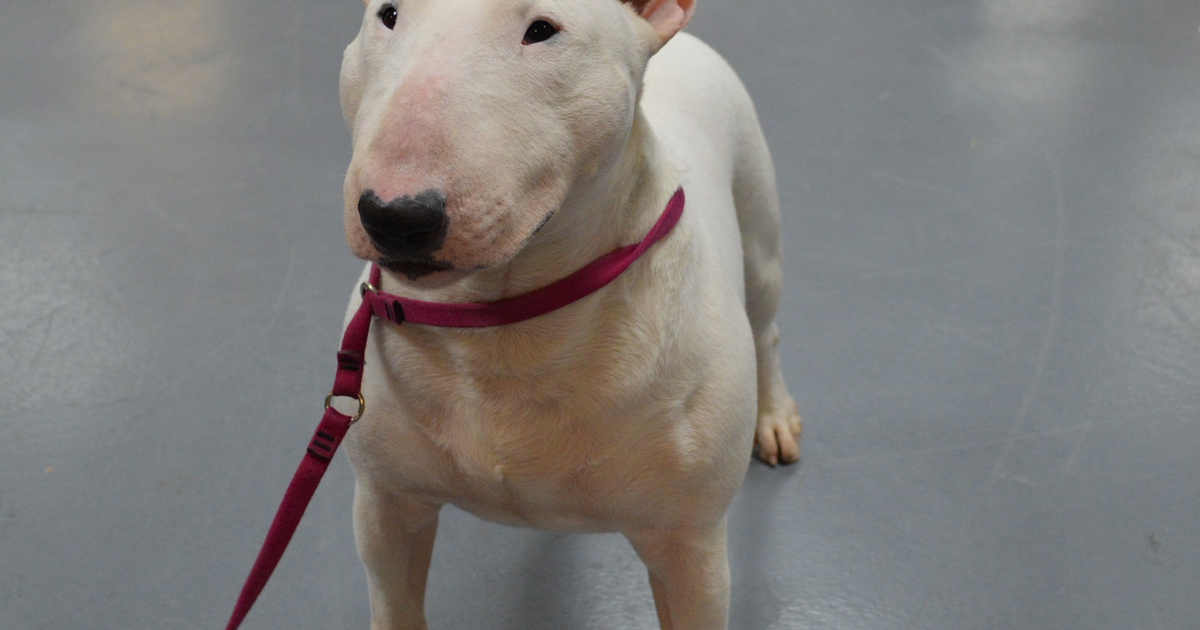
Image: Pets Adviser, “Miniature Bull Terrier – GCH Cambria’s Kid N Play 1 (16417656149).jpg”, CC BY 2.0, via Wikimedia Commons.
How to get your pet tested
Some pet DNA tests screen for hereditary-disease carrier status or genetic risk markers, but the results are information, not a diagnosis. If your pet has symptoms or you need a confirmed diagnosis, please consult your veterinarian.
Below is where Primary lens luxation (ADAMTS17) can be tested, grouped by where you live and marked by whether each service explicitly lists this variant (✅ = listed / ❓ = unverified / ❌ = not offered).
In the United States
In the United Kingdom
In India
Elsewhere
Note: even if the kit can be purchased/shipped internationally, the service itself (sample return, analysis, results) is not guaranteed in your country. Check each service’s stated service area and sample-return method before ordering.
Services offered in other regions (may not be available where you live)
Worried about your pet’s health? — Talk to a veterinarian
A confirmed diagnosis and any treatment plan are decisions for a veterinarian, not a test kit. The links below are professional resources.
AVMA — Find a veterinarian (American Veterinary Medical Association)
This section contains advertising (affiliate links); we may earn a commission if you buy through them. As an Amazon Associate, we earn from qualifying purchases. Genetic tests do not guarantee the prevention, diagnosis, or treatment of any disease — results indicate tendencies and provide information only.
This page is educational information, not veterinary diagnosis or advice. Always consult a veterinarian about your pet’s health.
About the author
Elena Marsh
Editor & writer (not a veterinarian)
A writer with a molecular-biology background and a lifelong dog and cat owner. Not a veterinarian — she translates peer-reviewed genetics research and primary data into plain language, always as information rather than diagnosis.