

Bottom line: Acral mutilation syndrome (AMS) in French Spaniels is an autosomal recessive sensory neuropathy: from a few months of age the toes stop registering pain, and many affected puppies lick and bite their feet until claws, toes or pads are lost. A 2016 study by CNRS/University of Rennes 1 and the Université de Montréal traced it to a single-letter change roughly 90 kb upstream of the GDNF gene, inside a regulatory non-coding RNA called GDNF-AS, shared with German Shorthaired Pointers, English Pointers and English Springer Spaniels. No cure has been reported. A DNA result describes this one variant; it does not diagnose a puppy, and a clear result does not rule out other causes of paw self-injury. Confirmation belongs to a veterinarian, ideally with a neurological exam and electrodiagnostic testing. In Canada, the breed club’s December 2024 rules require member breeders to test breeding dogs and share the results.
- A puppy that chews its toes and still walks normally
- From a Saint-Hyacinthe dermatology service to chromosome 4
- The affected dog that never hurt itself
- Not a broken gene but a weakened switch upstream of GDNF
- Other paw-destroying neuropathies a GDNF result cannot see
- What the Quebec breed club now asks of every breeding French Spaniel
- OFA, CKC, AKC and the Kennel Club give AMS very different weight
- Which lab, which currency, and whose report the club will recognise
- Getting a numb-footed puppy assessed, and what policies say about it
- Frequently asked questions
- References
- How to get your pet tested
A puppy that chews its toes and still walks normally
Most owners first meet this disease as a grooming problem that will not go away. The Université de Montréal case series of 13 French Spaniels, published in Veterinary Dermatology in 2005, found that signs were first noticed between 3.5 and 12 months of age. The puppies licked, bit and severely mutilated their feet. Ulcers followed, with secondary bacterial infection, and in severe cases the dogs auto-amputated claws, digits and footpads. Sometimes one foot was involved, sometimes several.
What made the clinicians suspicious was the gait. According to the abstract by Paradis and colleagues, the dogs walked on severely mutilated feet without evidence of pain, lameness or ataxia. A dog with an infected toe would normally hold the foot up. These dogs did not. In the full report, the team pricked and pinched the affected limbs and got no pain response, with the exception of two dogs that appeared to keep a deep pain response to toe pinching.
Some owners in the Quebec series linked the onset to boarding or other possible triggers, such as stress, nervousness, hard surfaces like concrete, or digging at a kennel door with feet that could not feel the effort. These are owner impressions, not proven causes.
Commercial test pages describe the same entry point. Embark’s AMS page warns that the signs “can appear similar to dogs with a food or environmental allergy,” and LABOKLIN notes that some affected dogs show only pain insensitivity without obvious self-mutilation, which makes the diagnosis harder. A puppy that licks its paws is far more often itchy than neuropathic, yet a puppy that licks open wounds and keeps trotting comfortably on them should go to the vet soon rather than after another round of allergy food trials.
SamHow would a vet even tell an itchy puppy from one that can’t feel its feet? Elena MarshThe 2005 Montreal team pricked and pinched the toes and got no pain response in most dogs. A neurologist goes further, mapping sensation and testing nerve function electrically.From a Saint-Hyacinthe dermatology service to chromosome 4
The French Spaniel, or Épagneul français, is a pointing spaniel that the Canadian Kennel Club says first came to Canada in 1974 and was recognized in 1985. Quebec has long been its North American stronghold. The 2005 paper gathered its data from owners and breeders of affected dogs in the province, and 10 of the 13 dogs were examined by the Dermatology Service of the university’s veterinary teaching hospital in Saint-Hyacinthe. The authors also traced a likely route of entry: in the early 1990s two males, which they called sire A and sire B, were imported from France, and their data suggested these two dogs may have introduced the syndrome into Canada.
At the time no carrier test existed. The authors’ advice was the classic one for a recessive disorder: remove affected animals and their parents from breeding.
The genetic answer came eleven years later from a collaboration between the CNRS team at the University of Rennes 1, led by Catherine André, and Montreal researchers including Manon Paradis, the first author of the 2005 series. Published in PLoS Genetics, the study by Plassais and 20 co-authors first assembled 173 French Spaniel blood samples with pedigree information, which confirmed a single-gene recessive pattern. The genome-wide association scan used 49 French Spaniels (21 affected, 28 unaffected) from two subpopulations, one in France and one in Canada, each with three small families. Five German Shorthaired Pointers, four English Pointers and four English Springer Spaniels, each group with one affected dog, brought the total to 62.
The scan pointed to a 3 Mb region on chromosome 4. Affected dogs of all four breeds shared the same homozygous stretch of DNA, which the authors read as a founder effect: one ancient mutation spread through related gundog breeds. Recombination break points seen in French Spaniels and English Springer Spaniels then narrowed the region to 1.8 Mb. Targeted sequencing of eight dogs turned up 478 variants, public databases cut that list to 156, and screening other breeds left a single candidate. In the validation set of 250 sporting dogs with known clinical status (24 affected, 226 unaffected), genotype and disease matched perfectly. The variant was never found in 900 unaffected dogs from 130 other breeds. The paper credits the first reports of the disorder to German short-haired Pointers in 1964, followed by English Pointers, English Springer Spaniels and, most recently, French Spaniels.
The affected dog that never hurt itself
The most useful lesson for owners in the 2016 paper sits in a short clinical passage. The French Spaniels were examined by neurologists in Lyon and in Saint-Hyacinthe. Pain perception was absent in the feet and became progressively normal above the knees; proprioception and motor function were normal, and there were no autonomic signs. One affected dog had never shown any self-mutilation. Because of that dog, the authors treated insensitivity to pain, rather than the wounds, as the first clinical sign of the disease.
The validation data held a similar case: heterozygous dogs showed no clinical signs, and only one homozygous dog had insensitivity to pain without acral mutilation. In other words, two copies of the variant do not always produce the dramatic picture in the case reports. Some dogs simply cannot feel their toes.
The authors drew a breeding conclusion from this. In their discussion they wrote that owners often did not notice the loss of pain sensation, and that this helped the disorder spread across the four breeds. A dog with numb feet that never chews them looks healthy, may be bred, and hands one copy of the variant to every puppy it produces.
SamIf a dog never chews its feet, does it matter that it can’t feel them? Elena MarshFor breeding it matters a lot. The 2016 Rennes authors concluded that owners often missed the pain loss, which helped the variant spread through four gundog breeds.Not a broken gene but a weakened switch upstream of GDNF
The variant does not sit in the protein-coding part of GDNF. Sanger sequencing found nothing wrong in the gene’s three exons or its promoter. The change lies about 90 kb upstream, in the last exon of a newly annotated canine long intergenic non-coding RNA that the team named GDNF-AS. All twelve versions of that RNA share the exon, and it is read in the opposite direction from GDNF. OMIA, the University of Sydney’s catalogue of inherited animal traits, records it as OMIA:001514-9615, a regulatory substitution written NC_006586.3:g.70875561C>T on the CanFam3.1 reference.
Glial cell line-derived neurotrophic factor (GDNF) supports the development and survival of sensory neurons. Mouse work from 1996 showed how essential it is: mice lacking GDNF entirely were born without enough dorsal root ganglion, sympathetic and nodose ganglion neurons, and lacked kidneys and an enteric nervous system. A 1997 study in Neuron reported that one group of dorsal root ganglion neurons switches from dependence on nerve growth factor to dependence on GDNF in early postnatal life. The Rennes authors cited this work on GDNF’s role in sensory neurons and suggested that neuron loss could happen during the first months of life, which would fit the early age of onset.
In dorsal root ganglia from two affected French Spaniels, a brother and sister, compared with two controls, GDNF messenger RNA was about 60% lower and GDNF-AS about 80% lower, while neighbouring genes were unchanged. Gel-shift tests showed that nuclear proteins bound the normal sequence strongly and the mutant sequence weakly, although a luciferase reporter test showed no difference. The working interpretation is a dose effect: GDNF is still made, but less of it, which would explain why affected dogs have no kidney or gut abnormalities, unlike the knockout mice. That rests on four dogs and a few assays.
For human medicine the finding is a lead rather than an answer. As of 2016, the paper notes, no mutation in GDNF or its regulatory regions had been described in human patients with hereditary sensory and autonomic neuropathy. A 2022 review of genetic pain-loss disorders in Nature Reviews Disease Primers lists disrupted gene regulation, including long non-coding RNAs, among the mechanisms, and describes treatment in people as mainly symptomatic.
Other paw-destroying neuropathies a GDNF result cannot see
“Acral mutilation” describes what happens to the feet, not one cause. Several genetically distinct conditions produce similar wounds, and a GDNF test is blind to all of them.
- Border Collie sensory neuropathy. A 2016 study in G3 linked it to an inversion disrupting FAM134B, now called RETREG1. Sensory and, to a lesser degree, motor nerves degenerate, and onset is at 2 to 7 months. Two mixed-breed dogs with ataxia and knuckling carried the same inversion in a 2018 report.
- RETREG1 missense variant. A related family of mixed-breed dogs (2021, University of Glasgow and others) and a purebred German Spitz (2024, the Rennes group) carried RETREG1 c.656C>T. The 2021 authors contrasted their dogs, which had autonomic and hind-limb gait problems, with the pointer and spaniel form, which shows pain loss without proprioceptive deficits.
- SCN9A congenital insensitivity to pain. Two mixed-breed littermates in 2023 had no superficial or deep pain anywhere on the body, with painless fractures and burns, not just numb toes.
- Cases with no known variant. A 2026 multicentre study from the University of Parma described 11 dogs, mostly Miniature Pinschers and mixed breeds, with distal sensory loss before one year of age. GDNF was not tested, and the outcomes ranged from stable disease to euthanasia within 12 months.
Acral lick dermatitis, a skin and behaviour problem in which dogs lick one spot raw, is a separate thing again, and so are allergies. One practical consequence shows up on LABOKLIN’s UK page for test 8038: the product lists both “GDNF (Spaniels & Pointers)” and “RETREG1 (Spitz)” under one number and runs only the variant relevant to the breed submitted. Writing “French Spaniel” correctly on the form is what decides which DNA is read.
The reverse question, whether the GDNF variant causes disease in breeds where it was not discovered, is also open. In the 2023 Wisdom Panel study of about 1.05 million dogs, the variant appeared in breeds such as the Old English Sheepdog and the Cirneco dell’Etna, but none of the three homozygous dogs whose veterinary records were reviewed had a confirmed AMS phenotype. French Spaniels were not in that study’s breed table, so it offers no figure for the breed.
SamSo a clear GDNF result doesn’t mean my dog can’t get a paw neuropathy? Elena MarshCorrect. Studies since 2016 found RETREG1 changes in Border Collies, a German Spitz and mixed breeds, and an SCN9A variant in two littermates. A GDNF test sees none of them.What the Quebec breed club now asks of every breeding French Spaniel
The Club de l’Épagneul Français du Canada (CEFC) revised its general rules on 2 December 2024. In Annexe 3, its protocols for hereditary disease, breeders who want to use a French Spaniel for reproduction must submit it to a list of screening tests and openly share all results. Acral mutilation syndrome (“syndrome de mutilation acrale”) is on that list. The club document explains the purpose in plain terms: the test is not meant to remove every carrier from breeding but to make absolutely sure two carriers are never mated together. It names two sources for the test, the Faculté de médecine vétérinaire of the Université de Montréal in Saint-Hyacinthe and the French company Antagene. Whether the Montreal faculty still offers the test today could not be confirmed.
The wording differs from the club’s hip rule. For hips, breeding is forbidden without a certificate from OFA, the Montreal faculty or PennHIP after radiographs at 24 months or older. For AMS the obligation is to test and disclose. That fits the genetics. With an autosomal recessive variant, a carrier bred to a clear dog produces no affected puppies, while a mating of two carriers gives each puppy roughly a one-in-four chance of inheriting two copies.
Article 9 of the club’s code of ethics adds a buyer protection: breeders guarantee to take back an animal that is affected by a hereditary disease. Active membership costs CA$80 on the 2026 form.
Provincial law covers a different gap. Since February 2024, Quebec’s regulation on the welfare and safety of companion animals has required a veterinary consultation before a dog’s first commercial breeding. The government’s guidance says the exam attests that the animal is healthy and free of behaviour problems, and that it is not a certificate of breeding quality. A carrier of the AMS variant is, by definition, healthy. The provincial exam and the club’s DNA rule therefore do separate jobs, and only the second can find a carrier.
England has a broader rule. Licensed dog breeders there must follow Schedule 6 of The Animal Welfare (Licensing of Activities Involving Animals) (England) Regulations 2018 (SI 2018/486), whose paragraph 6(5) says no dog may be kept for breeding if it can reasonably be expected, on the basis of its genotype, phenotype or state of health, that breeding from it could harm its own or its offspring’s health or welfare. The regulation does not name an AMS test or any specific DNA test, so whether a UK breeder tests for AMS is left to the breeder’s judgment. In the United States, we found no federal or state law requiring AMS testing; the test becomes a requirement only for breeders who want an OFA/CHIC number.
OFA, CKC, AKC and the Kennel Club give AMS very different weight
In the United States, the Orthopedic Foundation for Animals lists five Canine Health Information Center requirements for the French Spaniel: OFA hip and elbow evaluations, an ACVO eye exam, a degenerative myelopathy DNA test, and an AMS DNA test from an approved laboratory with results registered with OFA. Dogs living outside the US or Canada may submit their country’s equivalent results. On the OFA breed page, published statistics exist only for hips (315 dogs evaluated, 9.8% dysplastic) and elbows (101 dogs); OFA shows summaries only where at least 100 dogs have been tested, and it publishes no AMS figures for the breed.
OFA’s laboratory matrix, captured on 14 October 2026, lists only Betagene and Embark as AMS labs for the French Spaniel, while noting that the list is not exhaustive. Neither of the two sources named by the Canadian club appears in that row. Whether OFA will register a result from Antagene, LABOKLIN, Orivet or Wisdom Panel for CHIC purposes could not be verified, so it is worth asking OFA or the lab before ordering if a CHIC number is the goal.
The national registries are quieter. The Canadian Kennel Club places the “Spaniel (French)” in Group I, Sporting Dogs, but its Breed Health Strategies and DNA Program pages both read “Coming Soon!” at the time of writing. The American Kennel Club keeps the breed in its Foundation Stock Service, with no parent-club health statement and no listed tests. The United Kennel Club has recognized the Epagneul Francais since 1 January 1996. In the UK, the Royal Kennel Club lists “Epagneul Français (Imp)” in the Gundog group with no Good Practice tests and no breed-specific restrictions.
Which lab, which currency, and whose report the club will recognise
Several laboratories name the French Spaniel for this variant. Prices below were collected in October 2026 and change often; sales tax is not included in US prices unless stated.
- Embark (US): its AMS page names the result “GDNF-AS, Spaniel and Pointer Variant,” cites Plassais 2016 and lists seven breeds, including the French Spaniel. The Breed + Health and Purebred kits were on sale for US$139 (regular US$159); Embark for Breeders was US$139. No Canadian-dollar storefront was found.
- Wisdom Panel: the French Spaniel breed page lists acral mutilation syndrome as the breed’s genetic health condition. Premium was US$127.99 (regular US$159.99) and £144.99 in the UK.
- Orivet: a single test, “Acral Mutilation Syndrome (SPANIEL & POINTER TYPE),” for US$60.00, reading the chr4:70875561 C>T variant.
- LABOKLIN UK: test 8038 at £48.00 including VAT, from an EDTA blood sample of 0.5 to 1 ml or cheek swabs, with a turnaround of one to two weeks. The site’s currency switch displays CA$106.56 or US$76.80.
- Antagene (France): AMS is one of four diseases in its French Spaniel Genetic Check-Up at a recommended public price of €168 including tax, from a cheek swab; a single disease test is €77. Ordering and shipping terms from Canada or the US were not stated.
- Genomia (Czech Republic): lists the French Spaniel for its AMS test at US$56.00 before VAT, with a usual turnaround of 12 business days.
One US lab is a trap for this breed. Animal Genetics sells an AMS test for US$45.00 (or £40.00 through its UK lab), but its breed list does not name the French Spaniel. Its breed list does offer an “Unspecified Breed” option, but whether the CEFC or OFA would accept that report is not stated.
For a Quebec breeder, the practical sequence is to decide first whose paperwork matters: the CEFC rule names Montreal and Antagene, OFA’s matrix names Betagene and Embark, and the other labs are not named by either. A pet owner testing one puppy has more freedom, but should check that the report names the GDNF variant.
SamIs a cheaper single-disease test good enough if I only care about AMS? Elena MarshFor one dog, perhaps. Every lab reads the same chr4 change, but the 2024 Quebec club rules and OFA each name specific labs, so breeders should confirm acceptance before paying.Getting a numb-footed puppy assessed, and what policies say about it
The family vet comes first, to examine the feet, treat infection and rule out allergy. If pain sensation seems missing, referral to a neurologist is the next step. Confirmation rests on a neurological examination, electrodiagnostic testing such as electromyography and nerve conduction studies, and exclusion of other diseases, with the DNA result as supporting evidence.
In Quebec the obvious destination is the Centre hospitalier universitaire vétérinaire (CHUV) in Saint-Hyacinthe, the same teaching hospital whose dermatologists saw most of the 2005 cases. Its referral page is reserved for veterinarians; requests filled in by owners are not processed, so owners must go through their regular vet. The neurology service lists electrodiagnostic equipment, including electromyography, and an MRI unit upgraded in 2024. In the US the arrangement can differ. Cornell University Hospital for Animals in Ithaca, New York, states that its neurology service does not require a referral and that payment is due at the time of service. ACVIM’s owner-facing directory, VetSpecialists.com, lists board-certified neurologists elsewhere.
Owners should go in with realistic expectations. No curative treatment has been reported for this form of AMS, and no study has tested a therapy in it. In the Quebec series, an Elizabethan collar, bandages or both were needed to stop further mutilation, and lesions typically took two to four months to heal if the dog was prevented from reopening them. The authors described management as difficult, time-consuming, expensive and frustrating. Seven of the 13 dogs were euthanized at the owner’s request, four were still alive two to seven years after diagnosis, and two were lost to follow-up. Those figures describe one case series, not a prognosis for any individual dog; decisions belong to the owner and the veterinarian.
Insurance wording matters because the signs usually appear after a puppy goes home. Pets Plus Us, a Canadian insurer, lists hereditary conditions among covered items and says it has no breed exclusions for conditions that are not pre-existing, but it defines a pre-existing condition as one that showed itself before coverage, even if undiagnosed, and applies waiting periods of 48 hours for accidents and 14 days for illness. Trupanion, the CKC’s insurance partner, described coverage of hereditary and congenital conditions in a 2014 press release, with an 18-month look-back for pre-existing conditions. Embrace in the US covers hereditary conditions that are not pre-existing but never covers DNA testing. None of this guarantees that an AMS claim would be paid; the current policy text is what counts, and enrolling before any paw licking has been recorded is the only point under the owner’s control.
Frequently asked questions
Q. How many French Spaniels carry the AMS variant?
No peer-reviewed study has published a carrier frequency for the breed: the large 2023 Wisdom Panel study did not include French Spaniels in its breed table, and OFA shows no AMS statistics for the breed. The only figure we found is on the French Spaniel page of the French laboratory Antagene, which gives the frequency as “34% carriers”. The page does not say how many dogs that figure is based on or where they came from, so treat it as a rough signal, not a population estimate.
Q. My puppy tested clear. Can it still develop paw self-mutilation?
Yes, from other causes. The test reads one regulatory variant near GDNF. RETREG1 and SCN9A neuropathies, allergies, injuries and compulsive licking are not covered. A dog with numb or chewed feet needs a veterinary examination whatever the DNA says.
Q. Can a carrier French Spaniel be bred?
Under the CEFC’s 2024 rules, yes, as long as results are shared and two carriers are never paired. A carrier mated to a clear dog produces no affected puppies, while a carrier-to-carrier mating gives each puppy about a one-in-four chance of being affected.
Q. Does every affected dog destroy its feet?
No. In the 2016 study one affected French Spaniel never self-mutilated, and another dog with two copies showed only insensitivity to pain. That is why the researchers called pain loss, not wounds, the first sign.
Q. Is the GDNF gene itself broken in these dogs?
No. The coding part of GDNF is normal. The change sits in GDNF-AS, a non-coding RNA about 90 kb upstream, and is linked to lower GDNF levels in sensory ganglia.
Q. Who confirms the diagnosis?
A veterinarian, usually a neurologist, using a neurological exam, electrodiagnostic tests and exclusion of other diseases. At the CHUV in Saint-Hyacinthe that means going through your regular vet; Cornell’s neurology service accepts owners without a referral.
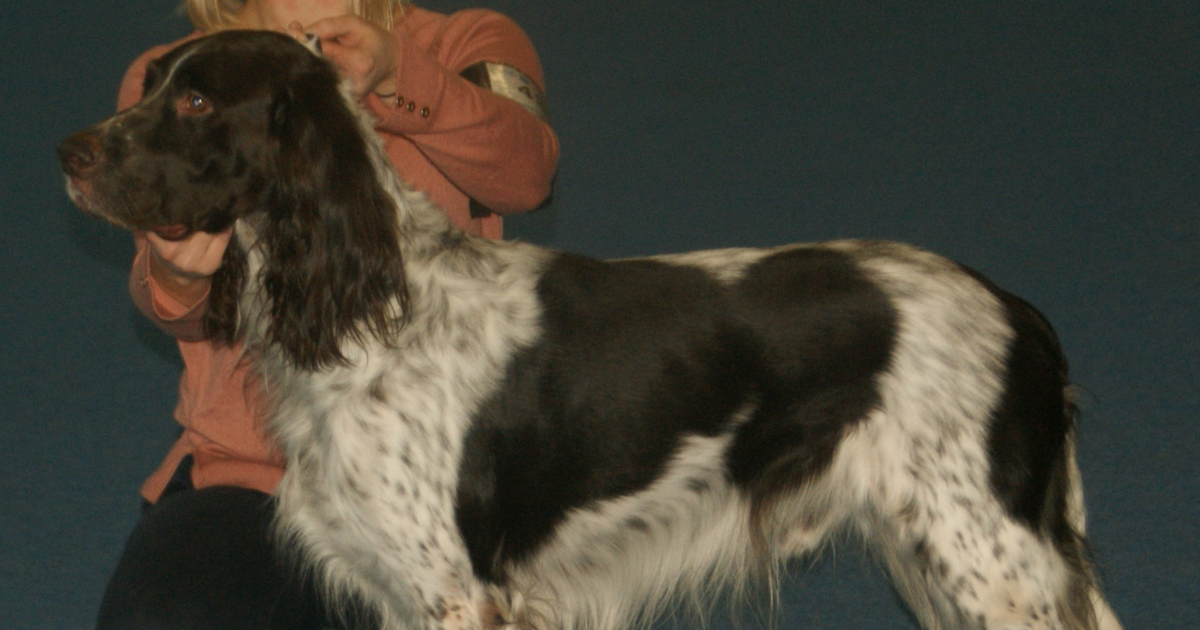
Featured image: Canarian, “Francais1” (cropped), CC BY-SA 4.0, via Wikimedia Commons.
References
- Plassais J, Lagoutte L, Correard S, Paradis M, Guaguère E, Hédan B, Pommier A, Botherel N, Cadiergues M-C, Pilorge P, Silversides D, Bizot M, Samuels M, Arnan C, Johnson R, Hitte C, Salbert G, Méreau A, Quignon P, Derrien T, André C (2016). A Point Mutation in a lincRNA Upstream of GDNF Is Associated to a Canine Insensitivity to Pain: A Spontaneous Model for Human Sensory Neuropathies. PLoS Genet 12(12):e1006482.
- Paradis M, de Jaham C, Page N, Sauve F, Helie P (2005). Acral mutilation and analgesia in 13 French spaniels. Vet Dermatol 16(2):87-93.
- Donner J, Freyer J, Davison S, Anderson H, Blades M, Honkanen L, Inman L, Brookhart-Knox CA, Louviere A, Forman OP, Chodroff Foran R (2023). Genetic prevalence and clinical relevance of canine Mendelian disease variants in over one million dogs. PLoS Genet 19(2):e1010651.
- Forman OP, Hitti RJ, Pettitt L, Jenkins CA, O’Brien DP, Shelton GD, De Risio L, Quintana RG, Beltran E, Mellersh C (2016). An Inversion Disrupting FAM134B Is Associated with Sensory Neuropathy in the Border Collie Dog Breed. G3 (Bethesda) 6(9):2687-2692.
- Gutierrez-Quintana R, Mellersh C, Wessmann A, Ortega M, Penderis J, Sharpe S, Freeman E, Stevenson L, Burmeister L (2021). Hereditary sensory and autonomic neuropathy in a family of mixed breed dogs associated with a novel RETREG1 variant. J Vet Intern Med 35(5):2306-2314.
- Letko A, Quignon P, Quilleré M, Husson JC, de Citres CD, Donner J, Dréano S, Plassais J, André C (2024). A RETREG1 variant is associated with hereditary sensory and autonomic neuropathy with acral self-mutilation in purebred German Spitz. Anim Genet 55(6):810-819.
- Gutierrez-Quintana R, Christen M, Faller KME, Guevar J, Jagannathan V, Leeb T (2023). SCN9A variant in a family of mixed breed dogs with congenital insensitivity to pain. J Vet Intern Med 37(1):230-235.
- Buffagni V, Gasparinetti N, Furiani N, Attili PL, Belforti F, Gagliardo T, Gandini G, Gianni S, Biffani S, Bianchi E (2026). Suspected hereditary sensory and autonomic neuropathies: clinical signs and electrodiagnostic findings in eleven dogs. J Vet Intern Med 40(4):aalag192.
- Moore MW, Klein RD, Fariñas I, Sauer H, Armanini M, Phillips H, Reichardt LF, Ryan AM, Carver-Moore K, Rosenthal A (1996). Renal and neuronal abnormalities in mice lacking GDNF. Nature 382(6586):76-79.
- Molliver DC, Wright DE, Leitner ML, Parsadanian AS, Doster K, Wen D, Yan Q, Snider WD (1997). IB4-binding DRG neurons switch from NGF to GDNF dependence in early postnatal life. Neuron 19(4):849-861.
- Lischka A, Lassuthova P, Çakar A, Record CJ, Van Lent J, Baets J, Dohrn MF, Senderek J, Lampert A, Bennett DL, Wood JN, Timmerman V, Hornemann T, Auer-Grumbach M, Parman Y, Hübner CA, Elbracht M, Eggermann K, Woods CG, Cox JJ, Reilly MM, Kurth I (2022). Genetic pain loss disorders. Nat Rev Dis Primers 8(1):41.
- Online Mendelian Inheritance in Animals (OMIA). OMIA:001514-9615: Acral mutilation syndrome in Canis lupus familiaris (dog). University of Sydney. Accessed 2026-10-15.
- Club de l’Épagneul Français du Canada (CEFC). Règlements généraux, revised 2 December 2024 (Annexe 3 and Code d’éthique). Accessed 2026-10-15.
- Orthopedic Foundation for Animals (OFA). CHIC program requirements and breed statistics: French Spaniel. Accessed 2026-10-15.
- LABOKLIN UK. Genetic test 8038: Acral mutilation syndrome (AMS). Accessed 2026-10-15.
How to get your pet tested
Some pet DNA tests screen for hereditary-disease carrier status or genetic risk markers, but the results are information, not a diagnosis. If your pet has symptoms or you need a confirmed diagnosis, please consult your veterinarian.
Below is where Acral mutilation syndrome (GDNF) can be tested, grouped by where you live and marked by whether each service explicitly lists this variant (✅ = listed / ❓ = unverified / ❌ = not offered).
In the United States
In the United Kingdom
In India
Elsewhere
Note: even if the kit can be purchased/shipped internationally, the service itself (sample return, analysis, results) is not guaranteed in your country. Check each service’s stated service area and sample-return method before ordering.
Services offered in other regions (may not be available where you live)
Worried about your pet’s health? — Talk to a veterinarian
A confirmed diagnosis and any treatment plan are decisions for a veterinarian, not a test kit. The links below are professional resources.
AVMA — Find a veterinarian (American Veterinary Medical Association)
This section contains advertising (affiliate links); we may earn a commission if you buy through them. As an Amazon Associate, we earn from qualifying purchases. Genetic tests do not guarantee the prevention, diagnosis, or treatment of any disease — results indicate tendencies and provide information only.
This page is educational information, not veterinary diagnosis or advice. Always consult a veterinarian about your pet’s health.
About the author
Elena Marsh
Editor & writer (not a veterinarian)
A writer with a molecular-biology background and a lifelong dog and cat owner. Not a veterinarian — she translates peer-reviewed genetics research and primary data into plain language, always as information rather than diagnosis.