

Bottom line: Myotonia congenita in the Australian Cattle Dog rests on one dog. A 2007 University of Guelph study of a purebred cattle dog seen at the Ontario Veterinary College found it homozygous for a single-base insertion in the CLCN1 gene (written c.2665insA in later work), the first canine myotonia outside the Miniature Schnauzer to be explained at the gene level. It is autosomal recessive: only dogs with two copies are expected to show signs, and one-copy carriers are not. A 2016 panel study later found the same variant in 2 of 29 Border Collies, as carriers, with no affected Border Collie reported. No carrier rate for Australian Cattle Dogs has been published. A DNA result is risk and breeding information, not a diagnosis; a stiff puppy needs your veterinarian and, if needed, a veterinary neurologist with EMG. Order a test that names this variant, because tests built for other breeds’ variants say nothing about it.
- Guelph, 2007: the cattle dog that put a second breed on the CLCN1 map
- Why a faulty chloride channel produces a stiff, hopping puppy
- One disease, many spellings: the canine CLCN1 variants found so far
- Two Border Collies out of 29: reading a carrier finding without stretching it
- What a single case lets you say, and where it stops
- Matching the test to the variant: what labs actually offer
- Not every stiff working dog has myotonia: the look-alikes
- From the clinic down the road to an EMG room: the referral route
- Cover, costs and breeding rules in Australian and US dollars
- Frequently asked questions
- References
- How to get your pet tested
Guelph, 2007: the cattle dog that put a second breed on the CLCN1 map
Until 2007, inherited myotonia in dogs had a molecular explanation in one breed only: Vanderbilt University and University of Pennsylvania researchers had shown in 1999 that a single amino-acid change in the muscle chloride channel caused recessive myotonia congenita in Miniature Schnauzers.
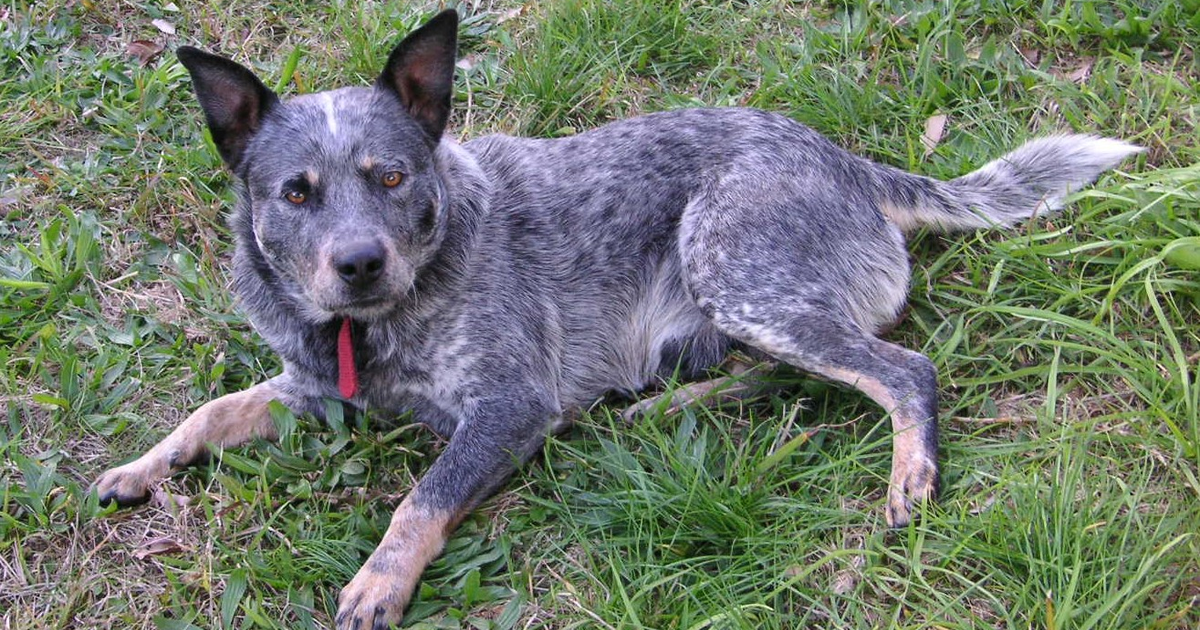
Then a purebred Australian Cattle Dog from Ontario, Canada, came to the Ontario Veterinary College with generalized muscle stiffness and visibly bulky muscles. Finnigan, Hanna, Poma and Bendall, writing from the University of Guelph’s Department of Biomedical Sciences, made the diagnosis of “myotonia hereditaria” from the clinical signs and electromyography, then collected a muscle biopsy for genetic work. They suspected the same gene as in the Schnauzer form.
It was the same gene, but not the same spot. Sequencing showed the dog was “homozygous for a single base insertion in the CLCN1 coding sequence”, a change predicted to produce a shortened channel protein. The authors concluded that their report “describes the 1st case of myotonia in an Australian Cattle Dog and represents the 1st non-Schnauzer canine myotonia to be genetically characterized”. They also built a PCR-based screen to detect heterozygous carriers “in the at-large Australian Cattle Dog population”.
That last sentence is easy to misread. Developing a carrier screen is not the same as running one across the breed, and the abstract reports no survey results. The 2017 classification review by Lowrie and Garosi spells this out: for both the cattle dog and a Jack Russell Terrier, “only mutations in single individuals were identified and the clinical relevance of these mutations within the breed population is uncertain”. For the Jack Russell, parents and a sibling were tested; “Similar investigations were not performed for the Australian Cattle dog”.
SamSo nobody checked the Ontario dog’s parents or littermates? Elena MarshNot according to the 2017 Lowrie and Garosi review: family testing was done for the Jack Russell case but not the cattle dog. That is one reason breed figures don’t exist.Why a faulty chloride channel produces a stiff, hopping puppy
CLCN1 carries the instructions for ClC-1, the voltage-gated chloride channel of skeletal muscle. A 2014 study by Gandolfi and colleagues notes that this channel “is responsible for up to 80% of the resting sarcolemmal conductance”. In plain terms, ClC-1 is what lets a muscle fibre settle back to rest after it fires. When the channel is missing or crippled, a single nerve signal can set off a train of repeated electrical discharges, and the muscle stays contracted after the dog has stopped asking it to.
So the disease shows up as slow relaxation, not weakness. Lowrie and Garosi describe the typical picture: “After a period of rest, dogs develop marked stiffness in all 4 legs, exhibiting a ‘bunny-hopping’ gait in the pelvic limbs for the first few steps that subsides with exercise but remains abnormal”. In severe cases, dogs fall sideways “with all 4 limbs rigidly extended”, and the episodes pass quickly. Muscles often look enlarged.
The improvement with repeated movement is called the warm-up phenomenon, and a 2024 Brazilian case report calls it “a valuable clinical tool” for separating true myotonia from conditions where stiffness gets worse with exercise. On an electromyogram, the needle picks up myotonic discharges that rise and fall in amplitude and frequency. The 2024 report describes them as having a “wax and wane” sound; in dogs they are classically likened to a dive bomber.
Two reassurances recur. The episodes are generally not painful: a Jack Russell Terrier reported from South Africa in 2009 had “non-painful muscle spasms”, and drug therapy was not used because the condition was non-painful and was not affecting its apparent quality of life. And the 2024 authors write that “Hereditary myotonia does not seem to reduce the life expectancy of affected individuals”. The same paper adds a practical warning: owners often mistake the stiff episodes for pain, so explaining the condition to the family matters.
The Ontario dog adds little to this picture beyond stiffness and muscle bulk; its abstract gives no age or sex. What the cattle dog offers is the gene, not a breed-specific symptom list.
One disease, many spellings: the canine CLCN1 variants found so far
The most useful fact for anyone reading a DNA report: canine myotonia congenita is not one mutation. Different dogs carry different changes in the same gene:
- Miniature Schnauzer (1999): a missense change, now written c.803C>T (p.T268M), identified by Rhodes and colleagues at Vanderbilt University and the University of Pennsylvania.
- Australian Cattle Dog (2007): the single-base insertion from the Ontario case, listed as c.2665insA (p.Arg889fs) in the 2016 panel study.
- Labrador Retriever (2018): c.2275A>T (p.R759X) in one eight-week-old puppy studied by teams at LMU Munich and the University of Helsinki.
- American Bulldog (2020): a four-base insertion causing a frameshift, reported from Brazil.
- Mixed-breed dogs (2023 and 2024): two Brazilian dogs, each with its own complex variant, one in exon 6 and one in exon 15.
- French Bulldog (2024): an 8-base duplication found in two related young dogs from the same breeder, seen at a Sydney referral centre.
A 2020 paper counted hereditary myotonia in 12 dog breeds, with CLCN1 mutations described in five of them; the French Bulldog and mixed-breed cases came later. Even a known variant can appear somewhere unexpected. The 2009 Jack Russell Terrier tested positive on the University of Pennsylvania’s Schnauzer-variant test, yet its mother, father and sister were all clear, so the author interpreted it as a spontaneous new mutation.
The 2024 mixed-breed report states the pattern bluntly: “CLCN1 gene mutations exhibit complex heterogeneity with different mutations found across various dog lineages”. For an Australian Cattle Dog owner, the consequence is that a “clear” result on a Schnauzer-type test, or a Labrador-type test, does not speak to the cattle dog variant at all.
Two Border Collies out of 29: reading a carrier finding without stretching it
Nine years after the Guelph report, the variant surfaced again, this time in a database rather than a clinic. Donner and colleagues, working with samples submitted to Genoscoper Laboratories in Helsinki, screened nearly 7,000 dogs from around 230 breeds for 93 disease-associated variants with the MyDogDNA panel. Their Table 1 records CLCN1 c.2665insA, originally described in the Australian Cattle Dog, in 2 of 29 Border Collies tested, both as carriers.
The authors chose their words carefully: “The discovery of a variant (CLCN1 c.2665insA) known to cause myotonia congenita in the Australian Cattle Dog in another breed popular in Australia, the Border Collie, calls for an investigation of whether its presence is limited to a single line of dogs or is more widespread in the breed”. Their general conclusion added that “careful follow up studies of any unexpected discoveries are essential to establish genotype-phenotype correlations”.
What follows from that finding, and what does not:
- It shows the variant is not unique to one Ontario dog. It exists in at least one other herding breed’s gene pool.
- The 6.9% figure belongs to 29 Border Collies who happened to be tested through a commercial panel. It is not a Border Collie carrier rate, and it is certainly not an Australian Cattle Dog figure.
- No affected Border Collie was reported. Carriers with one copy are not expected to show signs.
- The count alone does not tell us whether the two dogs were related or how the variant reached the breed.
The mixed-breed population tells a similar story about the limits of large numbers. A 2017 study using Wisdom Panel data tested 33,761 mostly North American mixed-breed dogs for myotonia and found zero copies. But the authors noted, “The present study tested only for the Miniature Schnauzer mutation”. Tens of thousands of negative results said nothing about the cattle dog variant.
SamSo if my cattle dog’s breeder says “our lines are clear”, what does that prove? Elena MarshOnly what was tested. The 2017 mixed-breed study screened 33,761 dogs for the Schnauzer variant alone, so ask which variant the “clear” refers to and see the lab report.What a single case lets you say, and where it stops
Single-case evidence is common in veterinary genetics, useful, and easy to inflate. Here is a ledger of claims sorted by how well the cattle dog record supports them.
Supported: the c.2665insA variant can cause myotonia congenita in an Australian Cattle Dog when present in two copies; it was found in a purebred dog in Canada; a carrier screen was designed for it; the same variant has been detected as a carrier finding in Border Collies; commercial laboratories now test for it.
Not supported: any statement about how common the variant is among cattle dogs in Australia, North America or elsewhere; any claim that the breed is “prone” to myotonia; any clinical timeline specific to cattle dogs; and any claim that Border Collies develop the disease. A PubMed search made for this article did not turn up a second affected Australian Cattle Dog after 2007.
It helps to compare the Schnauzer record, which shows what population data can look like. In a 2002 University of Pennsylvania study of 372 Miniature Schnauzers tested between March 2000 and October 2001 in the US, Canada, Australia and Europe, 76 (20.4%) were carriers and 4 (1.1%) were affected, and every carrier and affected dog traced back to one popular sire. Even that study drew on dogs submitted for testing, including relatives, rather than a random sample. For the Australian Cattle Dog, nothing comparable has been published.
So the honest position for a breeder is modest. Testing breeding stock for this variant is cheap protection against an affected litter, given that it has already appeared in a second breed. But a carrier is not an unhealthy dog, and the variant should not be treated as a known breed-wide problem until data show it is.
Matching the test to the variant: what labs actually offer
Laboratories label this test differently, which is exactly why the variant name matters more than the brand. All prices are as shown on 7 October 2026.
Orivet (Australia). The Australian laboratory, which has joined forces with Paw Print Genetics, sells a single-variant test called Myotonia Hereditaria (Cattle Dog Type). It showed US$60.00 to our connection, with tax not stated; check the Australian-dollar price at checkout. Orivet lists separate Miniature Schnauzer, Labrador Retriever and American Bulldog types at the same displayed price, which underlines the point that these are different tests. Its page writes the variant in a different coordinate system, as “c.2703-2704 insertion A”, rather than c.2665insA. If you need to match a result to the published literature, ask the lab to confirm it is the variant from the 2007 Australian Cattle Dog report.
Wisdom Panel (US). Wisdom Panel publishes a condition page titled “Myotonia Congenita (Discovered in Australian Cattle Dog)”, listing CLCN1, an insertion on chromosome 16, and the signs “Delayed muscle reaction, Stiff movements, Hypertrophic skeletal muscles, Bunny-hop-like movement”. In the US, Wisdom Panel Premium (“270+ health tests”) was US$111.99 on sale against a regular US$159.99, and Essential (“25+ health tests”) was US$83.99 against US$119.99, tax not stated. We could not confirm which tier includes this variant, so check before buying. Its reference credits the 1999 Schnauzer paper, not the 2007 cattle dog report.
LABOKLIN (Germany, international). LABOKLIN tests the Australian Cattle Dog, Border Collie and Labrador Retriever types by sequencing, with results 1 to 2 weeks after the sample arrives. No price is displayed.
Animalabs (Europe). Its “Sheepdogs and Cattledogs Type” test lists the Australian Cattle Dog and Border Collie at 54.90 euros including VAT. Shipping times from Australia or North America were not verified.
Tests that do not cover this variant. PennGen at the University of Pennsylvania, whose researchers co-authored the 1999 Schnauzer discovery, offers its myotonia test for the Miniature Schnauzer variant (US$75.00 processing, tax not stated). Embark’s published myotonia page is likewise the “CLCN1 Exon 7, Miniature Schnauzer Variant”, listing Miniature and Standard Schnauzers. Both are fine tests for what they target; neither page lists the cattle dog variant.
One more detail for Australian readers: the French laboratory Antagene lists the Australian Stumpy Tail Cattle Dog among the breeds for its c.2665insA test, alongside the Australian Cattle Dog and Border Collie. Dogs Australia recognises the Stumpy Tail as a separate breed, so breeders of either should know which variant their lab is reporting.
SamShould I just buy the cheapest test that mentions myotonia? Elena MarshOnly if it names the cattle dog insertion. Orivet sells a Cattle Dog Type and LABOKLIN lists the breed; PennGen’s test targets the Schnauzer variant found in 1999.Not every stiff working dog has myotonia: the look-alikes
A stiff gait in a young, athletic dog has many possible causes, and the timing of the stiffness points in different directions.
Paradoxical pseudomyotonia. A 2020 study of four English Springer and three English Cocker Spaniels described stiffness that always came on with exercise and, in all but one of the 7 dogs, resolved at rest within 45 seconds, the opposite of the warm-up pattern. Electromyography in those dogs was normal.
Stiffness with hypercortisolism. A 2023 study described 37 dogs with Cushing’s syndrome and severe muscle stiffness. Treating the hormone disorder did not resolve the stiffness in most of them (31 of 36 stayed the same or worsened). The point for owners is that stiffness first appearing in an adult dog has acquired causes too.
Other inherited muscle conditions already covered on this site. Malignant hyperthermia (RYR1) is triggered by certain anaesthetic drugs; exercise-induced collapse (DNM1) follows strenuous activity; Duchenne-type muscular dystrophy (DMD) involves progressive muscle damage. Each has a different gene and mechanism from myotonia congenita, and none should be confused with it on a DNA report.
In the 2009 Jack Russell, blood counts, creatine kinase and electrolytes were normal, and Lowrie and Garosi note that creatine kinase usually stays low in the Schnauzer form. The 2018 Labrador puppy was diagnosed from clinical signs, abundant myotonic discharges on EMG, and muscle histology that ruled out a structural myopathy. Normal bloodwork, characteristic EMG and a matching genotype together separate myotonia from the look-alikes.
From the clinic down the road to an EMG room: the referral route
A genotype report cannot diagnose a dog. The route starts with your regular veterinarian, who takes a history, examines the dog and runs basic bloodwork. Short phone videos of the dog rising after rest help, because episodes may not happen in the consulting room.
If myotonia is suspected, the next step is a veterinary neurologist with electrodiagnostic equipment, because EMG is the test that shows myotonic discharges.
- Australia: the Animal Referral & Emergency Network (AREN) states that its neurology specialists “routinely perform EMG, nerve conduction studies, and repetitive nerve stimulation” for neuromuscular disease in dogs and cats, across sites that include the Animal Referral Hospital and the Adelaide Veterinary Services & Referral Centre. Referral is made by your vet.
- Canada: the Ontario Veterinary College, where the 2007 cattle dog was examined, runs the OVC Companion Animal Hospital, which it describes as “a referral hospital for cats and dogs”.
- United States: VetSpecialists.com, the owner-facing directory of the American College of Veterinary Internal Medicine, lets you search for board-certified neurologists and notes that “Your primary veterinarian may refer you to a veterinary specialist”.
If a DNA test has already been done, take the lab report itself, not a screenshot of an app summary, so the neurologist can see which variant was tested. If the dog tests homozygous for the cattle dog variant and the clinical findings fit, the genotype supports the diagnosis; if it tests clear, the vet still has to look for other causes, including other CLCN1 variants.
Treatment is limited. Lowrie and Garosi write that there is no safe, effective drug acting directly on the chloride channel. Sodium-channel-blocking drugs have been tried in case reports, but “In dogs, only higher doses of these medications resulted in clinical improvement, but the adverse events at these higher doses make them unsuitable as long-term treatment”. Whether any drug is appropriate is a decision for the treating veterinarian. Several reported dogs were managed without medication: the 2024 mixed-breed dog was not treated and had not worsened two years later.
SamIf our dog is affected, will it have a normal life? Elena MarshThe 2024 Brazilian case report says hereditary myotonia does not seem to shorten life, and its untreated dog was stable two years on. Your neurologist judges how your dog copes.Cover, costs and breeding rules in Australian and US dollars
Insurance in Australia. Wording matters more than headlines. Pet Insurance Australia lists “Hereditary and congenital conditions” under what is covered in all its dog plans, with “Certain pre-existing conditions” excluded, and the same page says hereditary conditions are covered “unless pre-existing”. Its plans offer annual benefit limits of A$15,000, A$25,000 or A$35,000, reimbursement of 70%, 80% or 90%, and an excess from A$0 to A$600. Bow Wow Meow states that it does not pay for conditions that first existed before the policy started or during a waiting period, and Petsy defines pre-existing as signs or symptoms shown before sign-up or during an exclusion period. Because myotonia signs typically appear in young puppies, the practical step is to arrange cover before any stiffness is noted in the vet record, and to read the product disclosure statement for hereditary-condition wording.
Insurance in the US. Embrace lists “Hereditary and congenital conditions … when not pre-existing at the time of enrollment” as covered. Nationwide states that “pre-existing conditions are not covered”. The same timing logic applies.
Test costs. A single-variant test runs from about US$60 (Orivet, as displayed) to 54.90 euros (Animalabs); multi-condition panels from Wisdom Panel sat between US$83.99 and US$111.99 on sale. EMG under a specialist is a separate, larger cost that depends on the referral centre; we did not find published fee schedules.
Breed clubs and registries. None of the three major kennel clubs we checked lists a myotonia test for the breed. Dogs Australia’s breed page names prcd-PRA and primary lens luxation as hereditary diseases with DNA tests, plus BAER hearing tests and hip and elbow scoring. The American Kennel Club, where the breed ranks 52 of 210 in popularity, recommends hip, elbow, eye and BAER evaluations and DNA tests for PLL and PRA-prcd. The Royal Kennel Club’s pre-breeding list is similar. Myotonia testing is a breeder’s own choice.
Law in New South Wales. From 1 December 2025, every dog breeder in NSW needs a Breeder Identification Number, and dog adverts must carry a microchip number, the BIN or a rehoming organisation number. A premises may keep no more than 20 non-desexed females over six months unless exempt, and a bitch is limited to five litters in her lifetime (or three by caesarean), with penalties up to A$110,000 for individuals who breach the cap. None of this requires DNA testing, but a BIN makes a breeder traceable if you later need the parents’ test results.
Frequently asked questions
Q. Is myotonia congenita common in Australian Cattle Dogs?
Nobody knows. Only one affected Australian Cattle Dog has been described in the scientific literature, in Ontario in 2007, and no carrier rate for the breed has been published. Rare in the literature is not the same as absent from the breed.
Q. My cattle dog tested as a carrier. Will it get stiff?
A dog with one copy of a recessive variant is not expected to develop myotonia congenita. The result matters for breeding: pair a carrier with a dog tested clear for the same variant. If a carrier shows stiffness, your veterinarian should look for another cause.
Q. Does a “clear” myotonia result rule the disease out?
No. It rules out the specific variant the lab tested. Several different CLCN1 variants are known in dogs, and the mixed-breed cases show new ones still turn up. Diagnosis of a stiff dog belongs to your veterinarian and, where needed, a veterinary neurologist using EMG.
Q. My Border Collie carries the “cattle dog” variant. Is that a mistake?
Not necessarily. A 2016 panel study found this exact variant in 2 of 29 Border Collies tested, both carriers. No affected Border Collie has been reported, and the study did not establish how widespread the variant is in the breed.
Q. Is myotonia painful for the dog?
Published reports describe the stiff episodes as painless, and they tend to ease as the dog keeps moving. Owners sometimes read the episodes as pain, which is one reason a proper diagnosis and explanation from your vet help.
Q. Can it be treated?
There is no cure. Some drugs that act on sodium channels have been used in individual case reports, with side effects at the doses that helped dogs. Several affected dogs in the literature were managed without medication. Any treatment decision rests with your veterinarian.
References
- Finnigan DF, Hanna WJ, Poma R, Bendall AJ (2007). A novel mutation of the CLCN1 gene associated with myotonia hereditaria in an Australian cattle dog. Journal of Veterinary Internal Medicine 21(3):458-463.
- Donner J, Kaukonen M, Anderson H, Möller F, Kyöstilä K, Sankari S, et al. (2016). Genetic Panel Screening of Nearly 100 Mutations Reveals New Insights into the Breed Distribution of Risk Variants for Canine Hereditary Disorders. PLoS ONE 11(8):e0161005.
- Lowrie M, Garosi L (2017). Classification of Involuntary Movements in Dogs: Myoclonus and Myotonia. Journal of Veterinary Internal Medicine 31(4):979-987.
- Rhodes TH, Vite CH, Giger U, Patterson DF, Fahlke C, George AL Jr (1999). A missense mutation in canine ClC-1 causes recessive myotonia congenita in the dog. FEBS Letters 456(1):54-58.
- Bhalerao DP, Rajpurohit Y, Vite CH, Giger U (2002). Detection of a genetic mutation for myotonia congenita among Miniature Schnauzers and identification of a common carrier ancestor. American Journal of Veterinary Research 63(10):1443-1447. (Erratum: Am J Vet Res 2003;64(1):25)
- Zierath S, Hughes AM, Fretwell N, Dibley M, Ekenstedt KJ (2017). Frequency of five disease-causing genetic mutations in a large mixed-breed dog population (2011-2012). PLoS ONE 12(11):e0188543.
- Lobetti RG (2009). Myotonia congenita in a Jack Russell terrier. Journal of the South African Veterinary Association 80(2):106-107.
- Quitt PR, Hytönen MK, Matiasek K, Rosati M, Fischer A, Lohi H (2018). Myotonia congenita in a Labrador Retriever with truncated CLCN1. Neuromuscular Disorders 28(7):597-605.
- Rodrigues DJ, Damasceno AD, Araújo CET, Torelli SR, Fonseca LGH, Delfiol DJZ, Oliveira-Filho JP, Araújo-Júnior JP, Borges AS (2020). Hereditary myotonia in American Bulldog associated with a novel frameshift mutation in the CLCN1 gene. Neuromuscular Disorders 30(12):991-998.
- Chimenes ND, Caramalac SM, Caramalac SM, Fernandes TD, Basso RM, Cerri FM, Oliveira-Filho JP, Borges AS, Palumbo MIP (2023). A complex CLCN1 variant associated with hereditary myotonia in a mixed-breed dog. Journal of Veterinary Diagnostic Investigation 35(4):413-416. (Corrigendum: 35(6):811-812, doi:10.1177/10406387231198291)
- Eguchi GU, Palumbo MIP, Cerri FM, Basso RM, de Oliveira-Filho JP, Caramalac SM, Borges AS (2024). Case report: A CLCN1 complex variant mutation in exon 15 in a mixed-breed dog with hereditary myotonia. Frontiers in Veterinary Science 11:1485454.
- Shelton GD, Mickelson JR, Friedenberg SG, Cullen JN, Graham K, Carpentier MC, Guo LT, Minor KM (2024). Variants in CLCN1 and PDE4C Associated with Muscle Hypertrophy, Dysphagia, and Gait Abnormalities in Young French Bulldogs. Animals 14(5):722.
- Gandolfi B, Daniel RJ, O’Brien DP, Guo LT, Youngs MD, Leach SB, Jones BR, Shelton GD, Lyons LA (2014). A novel mutation in CLCN1 associated with feline myotonia congenita. PLoS ONE 9(10):e109926.
- Stee K, Van Poucke M, Peelman L, Lowrie M (2020). Paradoxical pseudomyotonia in English Springer and Cocker Spaniels. Journal of Veterinary Internal Medicine 34(1):253-257.
- Golinelli S, Fracassi F, Bianchi E, Pöppl ÁG, Miceli DD, et al. (2023). Clinical features of muscle stiffness in 37 dogs with concurrent naturally occurring hypercortisolism. Journal of Veterinary Internal Medicine 37(2):578-585.
- PennGen (University of Pennsylvania School of Veterinary Medicine). Myotonia Congenita — Genetic test page (testid=26). Accessed 2026-10-07.
- LABOKLIN Europe. Myotonia congenita (Service ID 8022). Accessed 2026-10-07.
- Wisdom Panel. Health condition pages: Myotonia Congenita (Discovered in the Labrador Retriever) / (Discovered in Australian Cattle Dog) / Myotonia Congenita (cat). Accessed 2026-10-07.
- Antagene (France). Myotonia Congenita — disease page. Accessed 2026-10-07.
- Animalabs. Myotonia Congenita (MC) Sheepdogs and Cattledogs Type. Accessed 2026-10-07.
- Orivet Genetic Pet Care. Myotonia Hereditaria (Cattle Dog Type). Accessed 2026-10-07.
- Embark Veterinary. Myotonia Congenita — health condition page. Accessed 2026-10-07.
- American Kennel Club. Australian Cattle Dog breed page. Accessed 2026-10-07.
- The Royal Kennel Club. Australian Cattle Dog breed page. Accessed 2026-10-07.
- Pet Insurance Australia. Dog insurance. Accessed 2026-10-07.
- Embrace Pet Insurance. Coverage. Accessed 2026-10-07.
- American College of Veterinary Internal Medicine. VetSpecialists.com. Accessed 2026-10-07.
- Ontario Veterinary College, University of Guelph. Get Care. Accessed 2026-10-07.
- NSW Government. NSW Government puts puppies and buyers first with law changes starting 1 December. Ministerial media release, 15 November 2025.
How to get your pet tested
Some pet DNA tests screen for hereditary-disease carrier status or genetic risk markers, but the results are information, not a diagnosis. If your pet has symptoms or you need a confirmed diagnosis, please consult your veterinarian.
Below is where Myotonia congenita (CLCN1) can be tested, grouped by where you live and marked by whether each service explicitly lists this variant (✅ = listed / ❓ = unverified / ❌ = not offered).
In the United States
In the United Kingdom
In India
Elsewhere
Note: even if the kit can be purchased/shipped internationally, the service itself (sample return, analysis, results) is not guaranteed in your country. Check each service’s stated service area and sample-return method before ordering.
Services offered in other regions (may not be available where you live)
Worried about your pet’s health? — Talk to a veterinarian
A confirmed diagnosis and any treatment plan are decisions for a veterinarian, not a test kit. The links below are professional resources.
AVMA — Find a veterinarian (American Veterinary Medical Association)
This section contains advertising (affiliate links); we may earn a commission if you buy through them. As an Amazon Associate, we earn from qualifying purchases. Genetic tests do not guarantee the prevention, diagnosis, or treatment of any disease — results indicate tendencies and provide information only.
This page is educational information, not veterinary diagnosis or advice. Always consult a veterinarian about your pet’s health.
About the author
Elena Marsh
Editor & writer (not a veterinarian)
A writer with a molecular-biology background and a lifelong dog and cat owner. Not a veterinarian — she translates peer-reviewed genetics research and primary data into plain language, always as information rather than diagnosis.